
A Roof Report You Can Hand A Lender
Berkeley’s small commercial buildings, its institutional roofs and the flat roofs over rentals near the tracks often belong to people who never go up there. An inspection is how you find out what you actually own. We walk every part of the field, put a drone over it where the airspace allows, and write it up with photographs that an owner three towns away can follow without us on the phone.
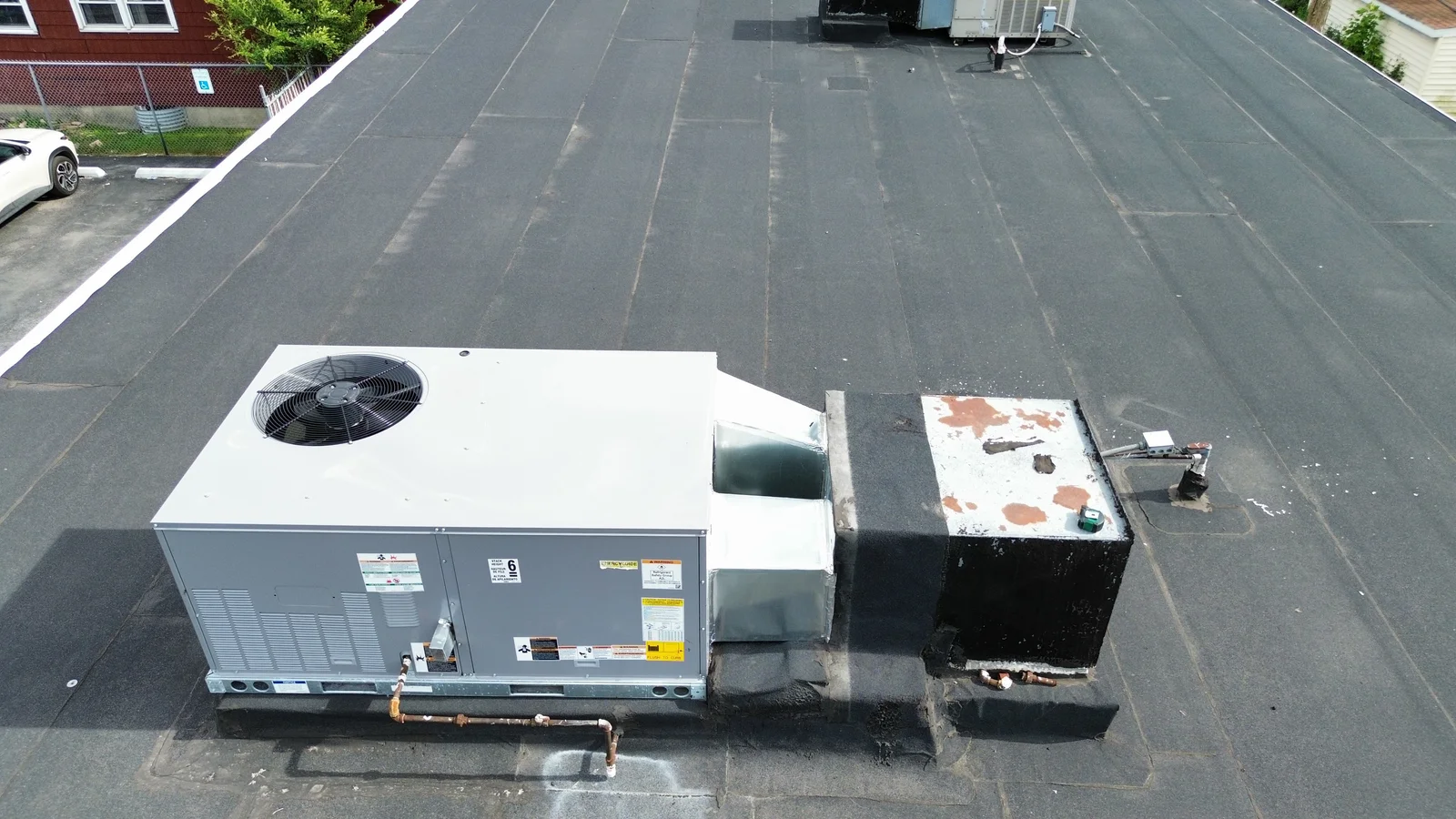
Modified bitumen field and a new unit from above
The Walk, Piece By Piece
See It All First
An overhead view of the whole roof first, by drone where we can fly, so nothing gets judged from the hatch alone.
Work The Joints
Every lap seam, curb and penetration looked at up close and photographed where it sits.
Feel For Soft Spots
Anywhere the roof gives underfoot gets marked, because soft usually means wet below.
Make The Call
Repair, coat or replace, with the photos and the reasons on the same pages.
Seams, Curbs And The Spots That Give Underfoot
A flat roof fails at its joints long before the field wears out. We start at one edge and work across, checking every lap seam for edges that have lifted or opened, every curb under a rooftop unit for open corners and soft wood, and every pipe, vent stack and conduit that passes through the membrane. Each penetration is a hole somebody had to seal, and some were sealed a lot better than others.
Drains and edges get the same attention. A drain sitting higher than the field around it leaves water standing after every rain, and edge metal that has pulled loose lets wind get under the membrane. We note where water collects, how long it looks like it has been sitting there, and whether the coping and edge details are still tight against the parapet.
Rooftop Units And Their Traffic
Equipment on a small commercial roof brings its own wear. Every service visit sends a technician across the membrane with tools and ladders, and the path they take tends to wear first. Dropped screws on the field, panels left loose and condensate lines draining onto the roof all turn up on an inspection. We photograph each curb from all four sides, check that the flashing still runs up the curb wall and under its counterflashing, and press on the corners for soft wood, because a rotted curb has to be rebuilt before any new membrane goes around it.
The Coating, If There Is One
On a roof that has been coated before, we look at whether the coating is still bonded or starting to chalk, crack or peel. The photo below is a coated field with its lap seams in plain view, the kind of surface we read seam by seam. A coating that is holding can usually be cleaned and recoated. One that is lifting has to come off before anything new goes on, and that changes the scope.

Coated field, lap seams and clay tile coping
What A Boot Can Feel
Walking the field matters as much as looking at it. Insulation that has taken on water feels different underfoot, softer and sometimes spongy, even where the surface looks fine from a drone or a ladder. Those areas get marked on the photos so that if the roof needs work, the crew starts digging in the right place instead of guessing.
A Report Somebody Three Towns Away Can Use
A good share of Berkeley property is owned by people who do not live in it, particularly the frame two-flats and small rental houses on the blocks near the tracks. An owner who lives elsewhere needs to see the roof without driving out, so the report is built around photographs: the overhead view of the whole field first, then each problem shown where it sits, with a short plain note on what it is.
The same report works for a lender or a buyer’s inspector. It is written in ordinary sentences, so nobody reading it has to call us to decode trade shorthand. Doyle Caffrey left us a Google review after we handled a real-estate roof certification, and that is the kind of paper an inspection produces: a clear record of the roof’s condition on the day it was walked.
When the building has tenants, we coordinate roof access with them directly, so an owner across the county does not have to arrange a key or show up to open a hatch.
We would rather walk a roof that is dry and clear. Snow hides seams and soft spots, and a roof walked under several inches of it produces a report full of guesses. If a closing date forces a winter inspection, the report names every area that could not be seen, so nobody reads a covered section as a clean one.
Repair, Coat Or Replace, And Why
Every inspection ends with a recommendation, and the recommendation follows the evidence. If the field is dry and the trouble sits in a few seams, a curb or some flashing, repair is the answer and the list stays short. If the membrane is sound but tired across its surface, a coating can buy real years with a lot less disruption than a tear-off.
If large areas are wet underneath, a coating would lock that water in. That roof needs new membrane, at least over the wet sections. We write down which of the three we would choose and why, and give you a straight price on each option that holds up. Plenty of reports say a roof has years left, and when that is true, the report says so plainly.
Angelo Ristich, who learned roofing from his father Frank and runs the company now, is on the roof for these walks. The company carries an A+ with the BBB and a HomeAdvisor Elite Service award, and stays licensed and insured in Illinois. Roofs we have repaired, coated and replaced are in the gallery, the wider service is on our commercial roof inspections page, and the contact page takes the address and whatever you know about the roof’s history.
What Comes Back
A drone view of the whole field, every problem photographed in place, and a written call on repair, coat or replace.
Plain sentences throughout, so nobody needs a roofer beside them to read it.
(312) 590-4853Owners Who Live Elsewhere
We set up roof access with tenants so you do not have to drive out. If the report points to work, a first number can come from satellite measurements before anyone climbs back up.
What Owners Ask Before An Inspection
Do you have to get on the roof, or is the drone enough?
Both are part of it. The drone view shows the whole field and how water moves across it, but seams, curbs and soft spots have to be checked on foot. We need access through a hatch, a ladder point or a tenant space, and we can arrange that with tenants directly.
Who is the written report meant for?
Whoever has to make a decision about the roof: the owner, a property manager, a lender or a buyer’s inspector. It is built from photographs and plain sentences, so someone who has never been up there can see what we saw and understand why we recommended what we did.
What makes a spot on the roof feel soft?
Usually water in the insulation under the membrane, and sometimes rotted decking. A soft area often looks no different from the surface around it, which is why we walk the field instead of only viewing it. Soft spots get marked on the photos so any repair starts in the right place.
Is an inspection worth it if the roof is not leaking?
Often more so. Seams, curbs and flashing usually start failing well before water reaches a ceiling, and they cost much less to fix at that stage. A dated set of photos from a roof in good shape also gives you something to compare against the next time someone goes up.
How long is a roof report good for if the building is being sold?
It describes the roof on the day it was walked, so a buyer or lender will usually want one done close to the closing. A report from last year still shows how the roof was trending, but a storm or a hard winter since then can change the picture, and a fresh walk settles it.
Do you inspect roofs on institutional buildings too?
Yes. The village’s institutional roofs get the same walk as a small commercial building: seams, curbs, penetrations, drains and edges, soft spots, and the coating if there is one. We work around the building’s schedule and stay off the roof during any hours you ask us to avoid.
Get The Whole Roof On Paper
Send the address, what the building is used for, and anything you know about the roof: roughly when it went on, past leaks, and whether it has ever been coated. If the report is for a sale, a purchase or a refinance, say so, and tell us who it needs to reach.
Other Berkeley pages cover the work an inspection can lead to: flat roof repair for seams and flashing on smaller roofs, commercial roofing for curb rebuilds and new membrane, storm damage repair after wind and hail, and shingle roof replacement for the pitched roof on the house next door. The Berkeley page covers the village as a whole, and we walk roofs in Broadview, Westchester and Maywood on the same trips.