
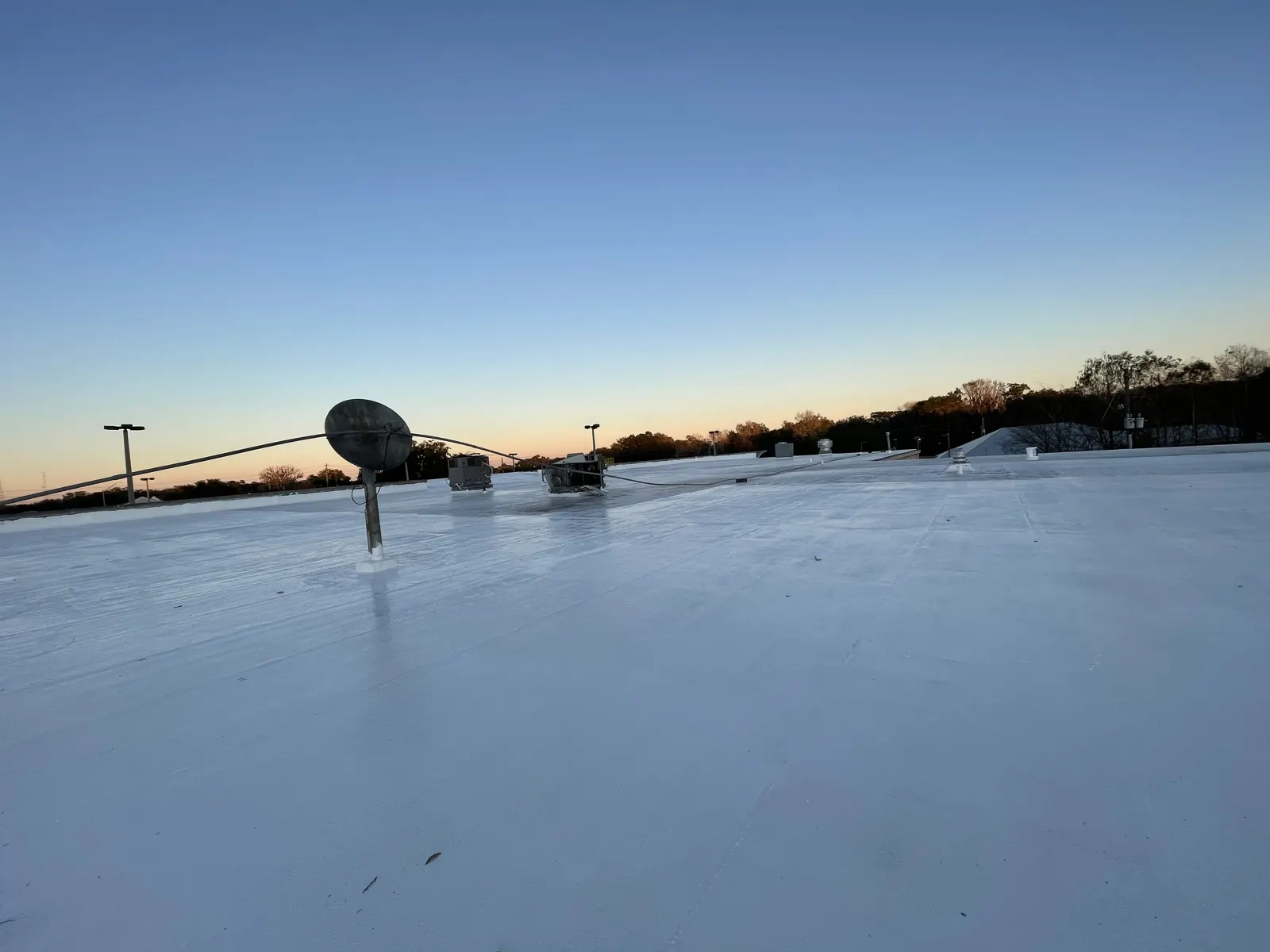
Field walked before the light went
A Roof With No Pitch Is A Different Trade
Steep-slope roofing lets gravity do the work. Low-slope does not, and everything about the repair changes because of it. If your building near the station, your rear addition or your flat-topped garage is letting water in, you want somebody whose day job includes membrane.
Where The Water Goes When There Is Barely Any Slope
On a shingle roof, water lands and leaves. That is why a shingle roof can be assembled from thousands of overlapping pieces and still keep a house dry: nothing has to be watertight, because gravity does the sealing.
A low-slope roof gets a quarter inch of fall per foot if it is lucky, and plenty of older buildings around town have less. Water does not leave, it wanders toward whatever is lowest, which after fifty years of settling is rarely where the original drain sits. So the roof has to be a genuinely sealed membrane, one continuous waterproof plane with every joint welded or bonded shut.
That flips every rule. On a membrane, every fastener, seam, drain bowl and pipe collar is a deliberate hole somebody made and then had to seal back up. The repair is not about replacing a damaged piece. It is about finding which seal quit.
Ponding Is Both The Symptom And The Cause
Water still standing forty-eight hours after the rain stopped is telling you two things at once, and people usually only hear the first one. As a symptom, it says the roof lost its geometry: decking sagged between joists, insulation compressed under years of foot traffic to the rooftop units, or a drain flush in 1985 now sits proud of the field because everything around it settled.
As a cause, it goes to work. Standing water magnifies ultraviolet exposure on the membrane under it, so that patch ages faster than the dry field ten feet away. It adds weight to the spot that already sagged, which deepens the sag, which collects more water. So when we find a pond we do not just patch under it. We look at whether the fix is tapered insulation, a drain reset, or a sump so the last inch actually leaves.
Membrane Types And The Specific Way Each One Quits
Arlington Heights has all of them. The mixed-use buildings near the station are mostly single-ply. The older brick storefronts still carry the built-up and modified bitumen roofs they have always had. The flat work behind houses is whatever was cheapest that year.
- TPO and other single-ply sheets are hot-air welded at the laps. A good weld is stronger than the sheet. A cold weld, made when the machine ran too fast or the sheet was dirty, holds for years and then peels along the lap.
- EPDM is the black rubber. The sheet is durable and failures are almost never in the field. They are at the seam tape, a different material with a different lifespan, and at the details where the rubber has to turn a corner and stay turned.
- Modified bitumen and built-up roofs fail by drying out. The asphalt loses its oils, the surface goes chalky, laps get brittle and open. On these we look for alligatoring first.
- Punctures cut across every system, and they are the hardest failures to find because the hole is often the size of a pencil.
Parapets And Curbs: Where Low-Slope Roofs Actually Die
The field membrane is rarely the problem. The problem is every place the flat plane has to stop being flat and go vertical.
Parapet walls are the classic one downtown. The membrane runs up the inside face and terminates, and that termination has to be sealed and mechanically held. Above it sits masonry with mortar joints and a coping on top. Mortar joints soften. Coping stones crack or the joints between them open. Water enters at the top of a wall nobody looks at, runs down inside the cavity, and appears as a ceiling stain along the exterior wall. Everybody blames the roof field, and the field is fine.
Curbs are the other one. Every rooftop unit, hatch and skylight sits on a raised box with four inside corners where the membrane gets cut, folded and detailed by hand. We check curbs early, because a mechanical contractor swapping a condenser will happily set the new unit on flashing he never touched.
What A Chicago Winter Does To Every Seam Up There
This is where the problem gets genuinely local. A low-slope roof holds water, and northwest Cook spends months crossing back and forth over freezing, sometimes twice in a day when a February afternoon gets sun. Every crossing is a cycle, and it happens exactly where you cannot afford it: in the pond, in the seam running through the pond, in the drain that iced shut and turned the whole field into a pond.
Water expands when it freezes. Under a lifted lap or inside a hairline crack in aging modified bitumen, that expansion is a wedge driving the opening wider every cycle. A seam weeping a teaspoon in November is open in March. That is the pattern we see every spring: roofs fine in the fall and leaking by the thaw.
It also changes when we can do what. Adhesives need temperature to bond, so a January leak often means a solid temporary patch now and the permanent detail on the first workable stretch. Wind and hail season runs through storm damage repair here in town.
Doing Roofs Is Not The Same As Doing This One
Plenty of good shingle crews are genuinely good at shingles. Low-slope is a separate skill set with separate tools: a hot-air welder and the judgment to run it at the right speed, torch experience on modified bitumen, and enough hours on membrane to know a cold weld by feel. A crew without those caulks the spot above your stain, which is usually not the leak.
Flat systems have been part of what this shop does since Angelo took it over from his father Frank, alongside the shingle work across the ranch and split belts here. If the field is past patching, that job is on the flat roof replacement page. Low-slope work is in the gallery, or send photos through the contact page.
The Short Version
Ponding, split seams, blistered field, parapet terminations, coping joints and curb flashing. Water-tested, not guessed at.
Downtown storefronts, rear additions, flat-topped garages. Winter calls get an honest patch now, the permanent detail when it bonds.
(312) 590-4853Booked On Our Northwest Run
Non-urgent work rides the grouped northwest Cook schedule out of our Alsip shop. No travel charge. Active leaks do not wait for the run.
How We Work A Low-Slope Call
Read The Building
Storefront, mid-rise, addition or garage. Building type tells us which system is up there before we climb.
Walk The Field
Soft spots underfoot, standing water, lifted laps, chalky surface, drains, every curb corner. Photographed as we go.
Prove The Entry Point
Sections isolated and water-tested until the stain wets. Where water travels sideways, guessing costs you twice.
Repair In Kind
Welded, torched or bonded to match what is there. Then a straight read on the life the field has left.
Around town: shingle work on the ranch belt goes to shingle roof repair, a full tear-off to shingle roof replacement. Water coming over the eave instead of through the roof is gutter work. White membrane specifically? TPO roof repair. Storefronts also run through commercial roof leaks, and neighbors on the same run include Rolling Meadows and Palatine.
Questions From Owners Of Low-Slope Buildings
Water has been sitting up there for three days. Is that the leak?
Probably not the leak itself, but it is a real problem and often near one. Ponding means the roof lost its slope through settling, compressed insulation or a drain that ended up high. Standing water then ages the membrane under it faster than the dry field around it.
Is a flat roof really that different from my shingle roof?
Completely different trade. Shingles shed water downhill and never have to be watertight. A low-slope roof has to be a continuous sealed membrane because water sits on it and travels sideways. A crew that is excellent at shingles is not automatically any good on membrane.
My ceiling stain is right along the outside wall. Is the roof shot?
Often the field is fine. A stain hugging an exterior wall usually points at the parapet rather than the roof surface: soft mortar joints, cracked coping, or a termination that pulled loose at the top of the wall. We check the wall before condemning the roof.
Why does my roof leak in spring when it was fine all fall?
Freeze-thaw. A low-slope roof holds water, and every crossing of the freezing point drives a wedge of ice into whatever seam or hairline crack is already there. A joint weeping in November can be open by March, and iced drains make it worse.
Can you repair a system somebody else installed?
Almost always. We work on TPO, EPDM, modified bitumen, built-up gravel roofs and coated systems, and we match the repair to whatever is already up there. What we will not do is weld a mismatched material onto your roof because it fits in the truck.
How do you decide between patching and replacing?
Mostly by whether the insulation under the membrane is dry. Isolated failures over dry insulation on a field that still has flexibility is a repair. Once water is into the insulation, no patch and no coating fixes it. We find out by cutting a test square and we show you what came out.
Tell Us What Is Coming Through The Ceiling
Describe where the stain is, when it started, and what the roof is over. You will get a real number and an honest read on whether this is a patch, a detail rebuild or a roof that is done.