Industrial Roofing For Buildings That Cannot Stop
Plants and factories put things on a roof that no other building does: process exhaust that eats metal, heat that never lets the panels cool, vibration from equipment running three shifts. We work those buildings around Alsip and the Chicago industrial belt, on your shutdown windows and under your safety rules.
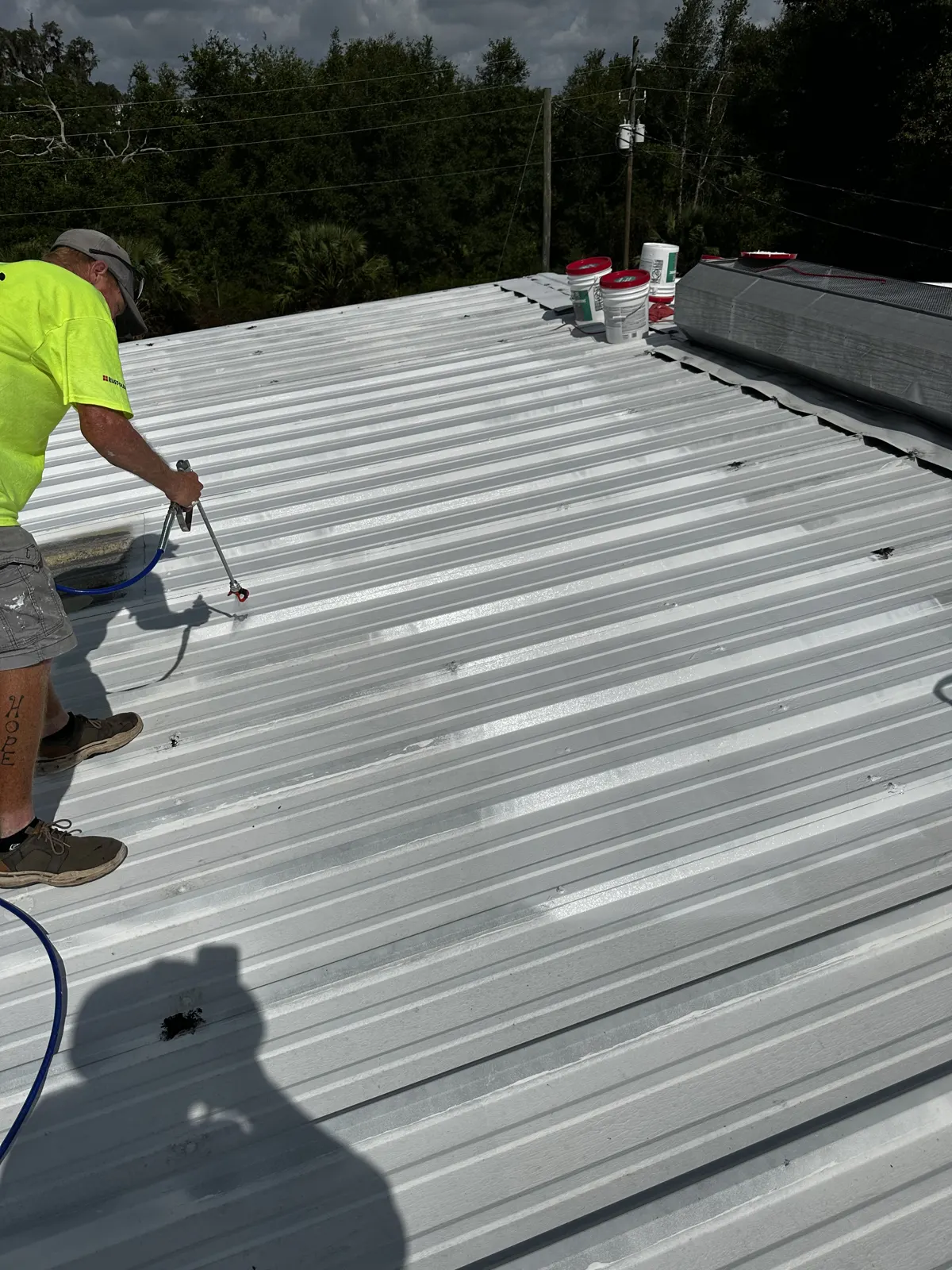
Spray coating a metal field · Crew at work
What A Plant Roof Is Up Against
Ask a facility engineer why the roof on the north end is fifteen years older than the roof on the south end and the answer is almost always something the building does for a living. Process exhaust puts chemistry into the air that lands on the panels. A furnace or an oven line keeps a section of deck warm all winter, which means snow melts there and refreezes at the eave. A press or a compressor puts vibration through the structure that works fasteners loose over years. Solvent vapor, salt, acid mist, sugar, whatever your process produces, some of it lands on your roof.
Metal roofs show it first at the fasteners. The washers go, then the holes weep, then the panel starts corroding around each opening. Membrane roofs show it as chalking, softening or actual chemical attack near the exhaust stacks. Neither one is a mystery once somebody gets up there and looks, but both are invisible from the ground until the day water lands on a control panel.
That is the part we want facility managers to hear: on an industrial roof the leak that matters is rarely the one over the break room. It is the one over the switchgear, the MCC, the finished goods, the line that costs real money for every hour it is down. So the first thing we do is find out what is under each section of roof, and we prioritize accordingly.
Metal Roof Systems And Coatings
Most Chicagoland industrial buildings are metal, and metal has one enormous advantage: it can usually be restored instead of replaced. A structurally sound metal roof with corroded fasteners and open seams does not need to come off. It needs the fasteners upsized and resealed, the seams stripped and reinforced, the penetrations reflashed, rust treated, and then a coating system over the whole field that stops the corrosion cycle and drops the heat load in the building underneath.
- Fastener replacement with larger diameter screws and new washers where the originals have backed out or the holes have opened up.
- Seam and lap reinforcement with fabric and mastic, which is where most metal roofs actually leak.
- Rust treatment and priming before any coating goes on, because coating over active corrosion just hides it for a season.
- Curb, stack and pipe reflashing, especially around anything the process exhausts through.
- A reflective coating over the field, which extends the roof life and measurably lowers summer temperature in the space below. In a plant with no air conditioning on the floor, that second part is not a footnote.
Where the metal is genuinely gone, gone in the pan and not just at the fasteners, we say so and price replacement. But a lot of metal roofs get torn off in Cook County that had ten more years in them under a proper restoration, and that is money that did not have to leave the building.
Safety Is Not Paperwork To Us
The crew wears high-vis for a reason, and it is not decoration. Industrial roofs have skylights that will not hold a person, unguarded edges, live equipment, hot stacks, and other trades working the same space. A plant that runs a real safety program does not want a roofing crew that treats tie off as optional, and frankly neither do we. We have families in the trucks.
Practically, that means we show up expecting your rules to apply to us: site orientation before we start, sign in and badging, hot work permits where any is required, lockout and tagout coordination when we are working near equipment, designated access routes and roof hatches instead of whatever ladder is closest, and clear communication with your EHS person about what we are doing and where. Insurance certificates and Illinois licensing go over before mobilization, not after somebody asks twice.
Angelo supervises the work personally, which on an industrial site means there is one person on our side who knows your rules and is on the roof enforcing them. That is different from a crew dropped off by a salesman who has never seen the building.
Working Planned Shutdown Windows
Plants schedule their downtime months ahead, and that window is the cheapest time on the calendar to do roof work over an operating area. We plan around it. If your shutdown is two weeks in July, the sections that require the line to be down get sequenced into that window, and the sections that can be done over a running operation get done the rest of the year.
Where a shutdown is not possible, we work over live operations carefully: no more roof open than we can close before weather, protection for what sits below, coordination with your maintenance staff on anything that has to be de-energized or moved. Weekend and off-shift work is available. What we do not do is show up with a plan that assumes you can stop production because it suits our schedule.
Documenting For Capital Planning
Industrial roof spending gets approved from a capital plan, and a capital plan needs numbers with evidence behind them. Every job we quote comes with photos tied to a roof plan showing which sections are failing, which are marginal and which are sound, plus a straight opinion on how many years each section has left. That lets a plant engineer walk into a budget meeting with something defensible rather than a single lump sum.
It also makes storm claims easier. Hail and straight line wind events across the Chicago area damage metal roofs in ways that are easy to miss and easy to underpay if nobody documented the roof beforehand. If your building has taken a hit, we photograph the damage properly and will work the insurance claim with you so the scope reflects what actually happened.
Satellite measurements give a realistic range on big industrial fields fast, and an on-roof survey firms the number. See completed metal and coating work in the gallery, then set up a walk through the contact page. We work plants and industrial buildings in Harvey, Bensenville and Frankfort and across the Cook, DuPage and Will county corridors.

Working under the tank
The Short Version
Metal restoration before replacement where the pan is sound. Fasteners upsized, seams reinforced, rust treated, reflective coating over the field.
Your safety program applies to our crew. Shutdown window sequencing, photo record tied to a roof plan for capital budgeting.
(312) 590-4853How A Plant Roof Job Runs
Map What Is Below
Switchgear, finished goods, production lines. Roof sections get prioritized by what a leak there would actually cost you.
Survey The Metal
Fasteners, seams, stack flashings, corrosion at exhaust. Photos tied to a roof plan with years-remaining on each section.
Clear The Safety Side
Orientation, badging, permits, lockout coordination, certificates in hand before mobilization. Your rules, not our habits.
Hit The Window
Shutdown sections sequenced into your downtime, live sections worked off shift. Roof closed before weather every day.
Related work: panel and fastener issues fall under metal roof repair. Low slope sections are covered by commercial flat roofs and flat roofing replacement. Annual surveys run through commercial roof inspections. We serve plants in Harvey, Bensenville and Frankfort.
Plant And Factory Roof Questions
Can our metal roof be restored instead of replaced?
If the panels are sound in the pan and the corrosion is at fasteners and seams, usually yes. Fasteners get upsized, seams get reinforced, rust gets treated and the field gets coated. Plenty of metal roofs come off in Cook County that had another decade in them.
Will a coating actually lower the temperature inside?
On a metal building with no air conditioning on the floor, a reflective coating makes a real difference in summer. It is not a mechanical system and we will not oversell it, but crews working under a coated roof notice, and the reduced thermal cycling extends panel life as well.
Our process exhaust is corrosive. Does that change the system?
It changes the material selection and the maintenance interval. Coatings and flashings around a corrosive stack have to be chosen for that exposure, and those areas get inspected more often than the rest of the field. Tell us what the process puts in the air and we will spec accordingly.
Can you work during our scheduled shutdown?
That is the ideal time and we plan around it. Sections needing the line down get sequenced into your window. Everything that can be done over a running operation gets scheduled the rest of the year, off shift or weekends where needed.
Will your crew follow our site safety program?
Yes, including orientation, badging, permits and lockout coordination. Certificates and Illinois licensing go over before mobilization. Angelo is on the roof supervising, so there is one person on our side accountable for our crew following your rules.
We need numbers for next year’s capital plan. Can you help?
That is what the survey produces. Photos tied to a roof plan, sections marked as failing, marginal or sound, years remaining on each, and a price on each. A plant engineer can take that into a budget meeting and defend it line by line.
Get The Roof Onto Your Capital Plan
Call Guardian Roofing with the building and the process. We will survey the field, mark what is failing and what is sound, and hand you numbers you can budget against instead of a single scary total.