
The First 48 Hours After The Storm Decide Everything
Water is already inside by the time most people call. What happens in the next two days sets the ceiling on what your insurance will cover and how much of the house you keep. We tarp, we patch, we photograph, and we do it in the order that protects both the building and the claim.

Crew on a storm tear-off · Same week response
Hour Zero To Hour Forty-Eight
A storm rolls through Cook County at nine at night. By ten the wind has quit, the rain has not, and somewhere over your kitchen a stain is spreading. Most homeowners spend that night with a bucket and spend the next morning calling contractors who will not answer until Monday. That gap is where the real money gets lost, because water that runs for two days does not stay in the roof. It gets into insulation, then drywall, then the framing.
We answer at night. One of our reviews came from a Chicago three-flat owner who called on a Friday evening in blizzard conditions. The crew was there the next morning, shoveled the ice off the roof, and patched it before the thaw could send another gallon down the stairwell. Storm work is not scheduled work. It shows up when it shows up and somebody has to go.
The Triage Order We Actually Follow
Every storm call gets worked in the same sequence, because doing it out of order costs the homeowner money:
- Stop the water first. Emergency tarp over the open area, mechanically fastened, weighted at the edges so the next gust does not take it into the neighbor’s yard. Not a blue tarp thrown over a ridge with bricks on it.
- Photograph before anything gets touched. Wide shots of the elevation, close shots of every lifted tab, broken seal strip, torn flashing and dented soft metal. Time-stamped, from the roof and from the ground.
- Find the entry point, not the stain. Water travels down rafters and shows up ten feet from where it got in. We trace it back to the actual breach before quoting anything.
- Patch what can be patched, flag what cannot. A temporary repair that holds through the claim process is worth more than a rushed permanent one done in the wrong weather.
- Write up scope with photos attached, in language an adjuster reads without arguing.
That fourth point matters more than people expect. Nobody should be reroofing a house in a February wind. A properly built temporary patch buys weeks, and weeks is exactly what a claim takes.
Document Before You Clean Up
This is the one thing we tell every caller before we hang up. Do not clean up the yard. Do not throw out the shingle pieces in the driveway or the piece of fascia in the hedge. Those things are evidence, and an adjuster who arrives to a spotless property has nothing to look at except a roof that has already been tarped.
Take your own photos from ground level with your phone, including the debris, the wet ceiling, and anything else the storm moved. Note the date and roughly the time the storm hit. Keep the receipts for anything you buy to stop the damage, tarps, buckets, a hotel night if the house is not livable. Then call us and stop doing anything else. We handle the rest of the record.
What Chicagoland Storms Actually Do To Roofs
Cook County does not get many tornadoes, and that fools people. What we get is straight-line wind, which is a different animal. Derechos and bow echoes push sustained wind across a whole neighborhood in one direction at once, and the damage pattern shows it: every house on the block loses tabs off the same slope. A tornado twists a few houses apart. A derecho quietly wrecks four hundred roofs and nobody notices for a month.
Straight-line wind gets under a shingle edge, breaks the seal strip, and lifts. The tab often falls right back down and looks fine from the driveway. But the seal is gone, and every wind event after that peels it further until one day it is on the lawn. This is why we walk the whole roof after a storm instead of only the slope where you can see the problem.
The other thing this climate does is timing. A storm in October leaves damage that does not leak until the first big freeze-thaw in January, by which point some carriers will argue the loss date. Getting the inspection on the record within days of the event is worth real money three months later.
Emergency Patch Versus Permanent Repair
These are two different jobs and we price them as two different jobs. The patch is triage: get the building watertight tonight, whatever the weather. The permanent repair happens once the weather cooperates and the scope is settled. Sometimes that means a section of shingles and new flashing. Sometimes the storm did enough that a full shingle roof replacement is the honest answer, and we will tell you that plainly rather than patch a roof into a slow leak.
If the damage is hail, the evidence and the adjuster conversation work differently, and that lives on our hail damage repair page. If it is lifted tabs and creased shingles from wind, start with wind damage repair. Either way, the documentation we build in the first 48 hours is what the claim runs on.
Guardian On Site, Not A Storm Chaser In A Rental Truck
After every big Chicagoland storm the out-of-state trucks show up with door hangers and a promise. Many of them are gone by spring, and the warranty goes with them. Guardian has been at the same Alsip address since 2013 and Angelo Ristich supervises storm work personally, the way his father Frank ran it. You will have his phone number while the tarp is still on your roof.
Storm repairs we have finished are in the gallery, and we work storm calls across Chicago, Blue Island and Harvey every season. If the roof is open right now, stop reading and call. If it can wait until morning, the contact page gets you on the list first thing.
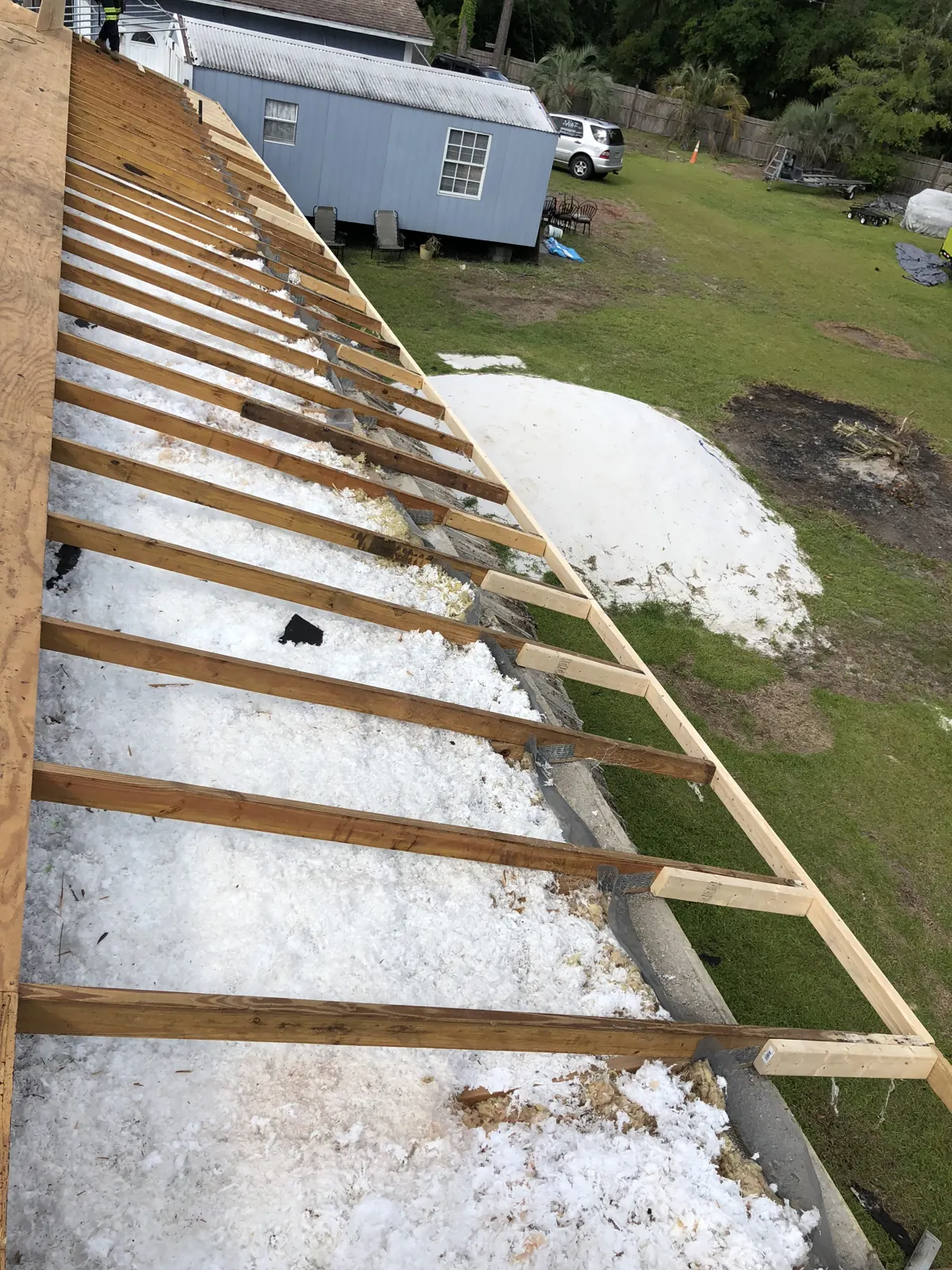
Rafter and fascia rebuilt after wind
If The Roof Is Open Now
Call first, clean up later. Leave the debris where it landed, photograph the ceiling stain, and let us tarp before the next band comes through.
Emergency patch response around the clock. Full photo documentation built for your claim, at no charge to look.
(312) 590-4853How A Storm Call Runs
You Call, We Go
Describe what you see and hear. If water is moving inside the house, we treat it as tonight’s problem, not next week’s.
Tarp And Stabilize
Fastened emergency cover over the breach, edges weighted, interior protected. The building stops getting worse.
Document Everything
Roof-level and ground-level photos, entry point traced, soft metals checked, written scope you can hand an adjuster.
Repair For Real
Once weather and scope allow, the permanent fix goes in with Angelo on site and the warranty in your name.
Related work: dents and bruising in the shingle mat point to hail damage repair. Lifted tabs and creased shingles point to wind damage repair. When the carrier gets involved, our roof insurance claims page explains what we handle and what stays your call. Storm crews run out of Alsip to Chicago, Blue Island and Harvey the same week.
Storm Damage Questions
It is midnight and water is coming through the ceiling. What do I do right now?
Move furniture, put a bucket under it, and if the ceiling is bulging, poke a small hole at the low point with a screwdriver to let the water drain in one spot instead of collapsing a whole panel. Then call us. Do not go on the roof yourself in the dark or in wind. That is how people get hurt.
Should I clean up the yard before the adjuster comes?
No. Shingle pieces in the grass, a bent downspout, a piece of fascia in the bushes: all of that is evidence that the storm hit your property on the date you say it did. Photograph it, leave it, and clean up after the adjuster has walked the property.
How fast can you get a tarp on my roof?
For active water intrusion in our core area we aim for same day or first thing the next morning, weather permitting. Big regional storms slow everybody down because five hundred houses call the same afternoon, so calling early puts you higher in the order.
Is the emergency tarp part of the repair price or separate?
Separate, and itemized. Emergency mitigation is usually a covered line on an Illinois homeowner policy, so it belongs on its own invoice with its own photos. Keeping it separate from the permanent repair keeps the paperwork clean for everybody.
My neighbors all had roofs done after that storm and mine looks fine. Should I worry?
Probably worth a look. Straight-line wind hits a whole block on the same slope, and the damage on your house may be broken seal strips that lie back down flat. If four houses on your street had legitimate claims from one event, get yours inspected before the reporting window on your policy closes.
Do you do the interior repairs too, or only the roof?
We do the roof, the flashing, the gutters and the structural work under them, including decking, rafters and fascia. Drywall, paint and flooring go to trades we can point you at. We will make sure the roof scope and the interior scope line up so nothing falls between the two on your claim.
Call Before The Next Band Comes Through
Angelo answers storm calls himself. Tell him what the roof is doing and what the ceiling is doing, and he will tell you whether it waits until morning or whether a truck rolls tonight.