
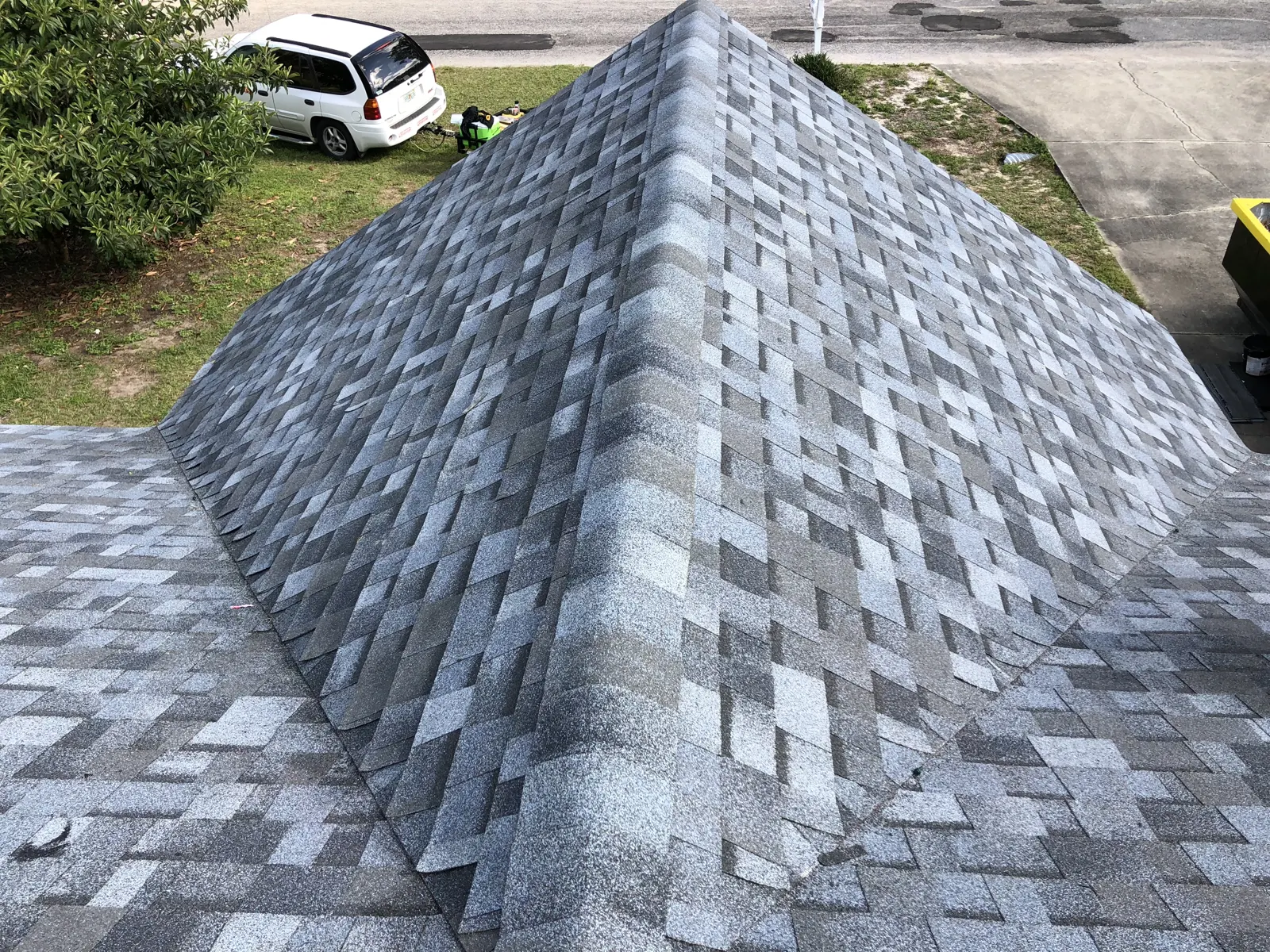
Two valleys, one short eave, one overflow
Most Gutter Problems Out Here Are Volume Problems
Not clogs. Not a bad seam. The gutter is doing exactly what it was built to do and the roof above it is simply handing it more water than it can hold. Resealing something that was undersized from the start buys you one dry season and a repeat call.
A Forty Foot Roof Plane Against A Five Inch Trough
Standard five inch gutter cannot carry what a forty foot roof plane sends it. That is the single most useful sentence anybody can tell a Barrington homeowner about their gutters, and it explains the overflow that half the calls up here are about.
The roofs up here are on another scale entirely from our south suburban work, and land is the reason. Because lot sizes stay generous around the village and through the horse country past it, a house here grows outward where a tighter lot would have pushed it up. Long roof planes are the result. A plane that runs forty feet up the rafter line is collecting rain across every one of those feet and delivering all of it to a single strip of aluminum a few inches wide hanging off the bottom edge.
Five inch gutter was sized for ordinary houses with ordinary planes above it. Put it under a large slope and it does not fail gradually. It runs full, and once it is full the extra water goes over the front lip in a sheet, which is the waterfall people call us about. The gutter is not broken. It is just outmatched.
So when we look at an overflowing run here, the first thing we work out is whether the honest repair is a repair at all. Rehanging and resealing a trough that was never big enough is work we can do and it will not solve your problem. Going to a six inch profile on the runs that are actually overloaded, and leaving the rest alone, usually does. Six inch carries meaningfully more water and takes a larger downspout, and the two together are what a big plane needs.
Valleys Point Everything At One Short Stretch Of Eave
The other capacity problem here is not about total roof area at all. It is about where the roof sends the water.
A single house can carry more linear feet of valley metal than a whole block of Alsip bungalows, because the multiple intersecting gables, the dormers and the turrets on the custom builds all create valleys where two planes meet. A valley is a channel. Everything that lands on both planes above it funnels into that channel, accelerates down it, and arrives at the eave as a concentrated stream rather than an even sheet.
If that valley dies into a long unbroken eave, the gutter has room to absorb the hit. If it dies into a short section of eave over an entry, a bay or a garage door, which is extremely common on these rooflines, then a jet of water is arriving at a few feet of gutter that also has to handle its own plane. Nothing in the world reseals that into working.
What we do about it varies. Sometimes it is a valley diverter that spreads the stream before it lands. Sometimes it is a downspout placed directly under the valley rather than at the far corner where a crew put it because the corner was convenient. Sometimes it is upsizing just that short run. What we do not do is tell you the gutter needs cleaning and leave.
Long Runs, Tired Hangers And The Fascia Behind Them
Houses that spread instead of stacking have long gutter runs, and long runs sag. Every hanger carries the weight of the trough plus whatever is in it, and water is heavy. A run that fills during every hard rain is cycling that load thousands of times over its life.
The old spike and ferrule system is the worst offender. A spike driven through the front lip into the fascia works loose a little each time the gutter loads and unloads, and once it backs out the trough tips forward at that point, which pools water there, which adds weight, which pulls the next spike. Owners find one spike lying in the mulch and hammer it back in, which does nothing, because the hole it came out of is now oversized.
The part that matters more is what is behind the fascia. A sagging or back-pitched gutter spills water down the board it is attached to, and that board stays wet. Give it a few seasons and you have soft fascia, sometimes rotted rafter tails behind it, and hangers screwed into wood that no longer holds a fastener. That is why we pull a section and look before quoting a rehang. Refastening new hangers into rotted fascia is the definition of a repair that comes back.
- Pulled spikes and failed ferrules along long runs, and the enlarged holes they leave behind.
- Back-pitched sections where the run has settled between hangers and holds standing water.
- Separated or leaking seams at the joints of long runs and at inside and outside corners.
- Soft or rotted fascia behind the trough, and rafter tails that need carpentry before anything gets rehung.
- Gutter aprons missing or bent, so water runs behind the trough instead of into it.
Downspouts And Where The Water Should Actually Go
Capacity is only half of it. A downspout is the drain, and a gutter with too few drains, or drains in the wrong places, behaves like a gutter that is too small.
On a large house the common mistake is too few downspouts spaced too far apart, usually at the building corners because that is the tidy-looking place to put them. Water in the middle of a long run has to travel a long way to reach one, and it only travels if the pitch is right the whole way. Add a valley dumping into the middle of that run and the trough is over its limit in the middle while both ends run half empty.
Then there is the discharge. On a large lot there is usually somewhere sensible to put the water, which is an advantage most of our south suburban work does not have. Extensions that carry the discharge well clear of the foundation, out past a walk or a bed, are worth doing while the ladders are already up. Dumping a downspout at the base of the wall on the uphill side of the house is how a dry basement stops being dry, and it costs almost nothing to fix at the same time as the gutter work.
Ice Dams: What Gutter Work Fixes And What It Never Will
This is the part we want to be straight about, because plenty of people get sold gutters as an ice dam cure.
Here is what you are actually looking at in February. One eave carries a row of icicles the size of your forearm while the rest of the house has none. The trough under that eave is a solid block of ice you could not chip out with a hammer, and a ridge of ice sits on the shingles just above it. Water is getting into the house somewhere near that spot, and the gutter is the thing everybody points at, because the gutter is the visible part.
Run it backward and the trough turns out to be near the end of the story rather than the start of it. Snow on the upper roof is melting from below, off heat that got into the attic instead of staying in the house. That meltwater runs down a warm slope until it crosses the overhang, which is unheated and therefore cold, and there it stops being water. A deep overhang gives it more cold surface to cross, which is why the large rooflines up here produce the worst of it. The leaves are the accelerant: a trough packed with oak litter cannot drain, so the first freeze locks it solid and gives the ridge above it something to build out from.
So what does gutter work buy you? It stops the trough from being the anchor. A run cleared, repitched and hung properly, with open downspouts, lets a thaw actually drain instead of refreezing in place, and it carries the weight of the ice that does form without tearing off the fascia. That is real and it is worth doing before winter.
What it will not do is stop the melting. If heat is getting into your attic you will get a dam no matter how good the aluminum is, so we look at the attic on the same visit and tell you what we find there rather than selling you gutters and calling it solved.
Ladders Land In The Planting Beds
Gutter work happens at exactly the height where a ladder foot comes down in a bed somebody spent twenty years filling in. We set the feet on pads rather than straight into soft mulch or turf, and old spikes and screws come out of the grass before we leave rather than at the end of the job, because they end up down there whether anyone wants them to or not.
The person who prices your gutters is the person who has been on the roof above them. Gutter work gets the same treatment as roofing here: we price off satellite measurements so you can get a real number on the phone, and we put the scope in writing before anybody climbs a ladder. Our work is in the gallery, and you can send pictures of what yours is doing through the contact page. Gutter work everywhere else we run is on the gutter repair page.

What We Repair
Sagging runs, pulled spikes and failed hangers, back-pitched sections, split seams, bent or missing gutter apron, and the fascia behind all of it.
Where the trough is simply too small for the plane above it, we say so and price the six inch profile instead of reselling you the same problem.
(312) 590-4853Scheduling
Barrington gutter calls ride the scheduled northwest Cook run out of Alsip, so a crew is already up here for the week and there is no travel charge for the drive.
What Happens On A Gutter Call
Watch Where It Spills
Overflow at a valley reads differently than overflow along a whole run. Where it comes over tells us what is actually wrong.
Check The Wood
A section comes off so we can see the fascia and the rafter tails. Hangers in soft wood are a repair that comes back.
Count The Drains
Downspout number, placement and discharge. Half the capacity complaints out here are a drain in the wrong spot.
Repair Or Upsize
Rehang and reseal where the profile is right. Six inch where it is not, and only on the runs that need it.
If the trough came off in a storm rather than wore out, start at wind damage repair, and dented aluminum belongs on hail damage repair. Fascia and eave work that turns up during a reroof is handled with shingle roof installation, and storm-related gutter loss can go through roof insurance claims. Everything we do in town is listed on the Barrington page.
Questions About Gutters On Big Roofs
My gutters are clean and they still overflow. How?
Because the problem is capacity, not blockage. A long roof plane delivers more water than a five inch trough can hold, so it runs full and the rest goes over the front lip. Cleaning a gutter that is simply too small for the roof above it changes nothing.
Do I have to upsize the whole house to six inch?
Usually not. Only some runs are overloaded, generally the ones under the longest planes or taking a valley. We upsize those and leave the rest, which keeps the work pointed at the part of the house that actually has the problem.
Water pours off one spot every storm. What is that?
Almost always a valley landing on a short eave. Two planes funnel into one channel and dump a concentrated stream onto a few feet of gutter. The answer is a diverter, a downspout placed under the valley, or upsizing that short run, depending on the roof.
A gutter spike fell out. Can I just hammer it back in?
It will not hold. The hole it came out of is now oversized, and the spike worked loose because the run loads and unloads with water every rain. What we would rather do is look at whether the fascia behind it is still solid before putting any fastener back.
Will new gutters stop my ice dams?
They will not, and anyone promising otherwise is selling aluminum. New gutters are worth having for their own reasons, so we would rather put them in on an honest description of what they do.
Do you fix the wood behind the gutter too?
Yes, and on long runs it is often the actual job. Years of a back-pitched trough spilling down the board leaves soft fascia and sometimes rotted rafter tails. We pull a section and look before quoting, because hangers fastened into bad wood pull out again.
Can you move where a downspout dumps?
Usually, and on a large lot there is normally somewhere better to put it. Running the discharge well clear of the foundation, past a walk or a bed, is cheap while the ladders are already up and it keeps water away from the wall where it does the most harm.
Tell Us Where The Water Comes Over
The spot it spills, whether it happens in every rain or only hard ones, and how old the gutters are. That is usually enough for us to know what we are walking into, and you will get a straight price once we have seen the fascia.