
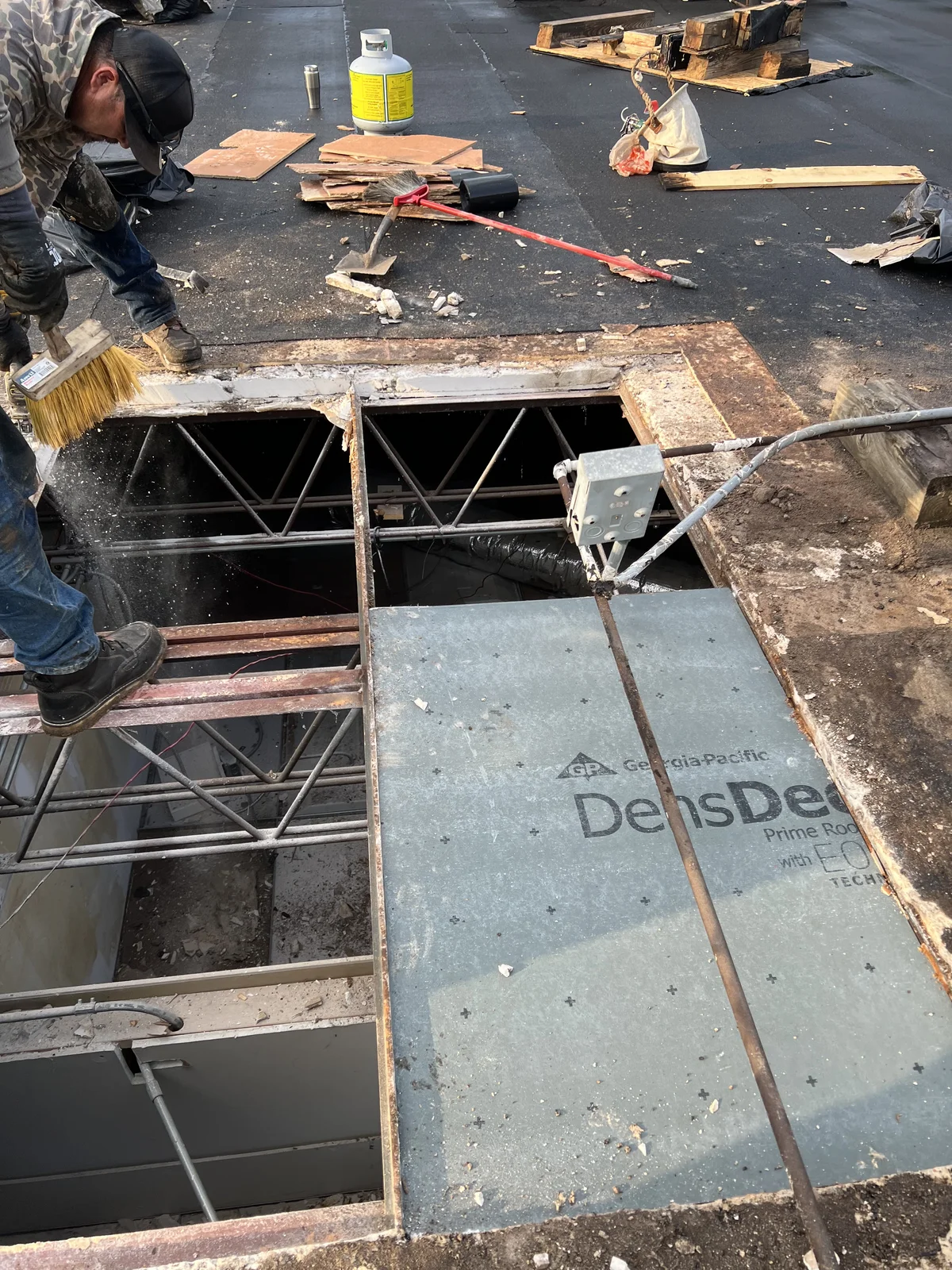
Cover board going across open-web joists
A Roof You Measure In Acres
A distribution roof in Bedford Park is counted in acres, and every part of it sits over somebody’s inventory. We replace and repair those fields one section at a time, with tear-off and dry-in finished the same day, so the building keeps shipping underneath and no stretch of deck is left open overnight over stored product. The schedule gets built around your docks, with whoever runs the building at the table from the first meeting.
Big Fields, Worked One Section At A Time
A house roof gets priced in squares, a hundred square feet apiece, and a roofer can take in the whole thing from the top of a ladder. The warehouse roofs in this village are counted in acres. From the hatch you see membrane running off toward a distant parapet, a scatter of drains, a few rooftop units, and very little that tells you how water actually moves across it.
That scale changes how a job gets run. Nobody strips an acre of roof at once over a building full of pallets. We break the field into sections sized to what one crew can tear off, insulate and close up in a single working day, and each section is watertight before anyone climbs down. The next morning starts on the next one.
Tear-Off And Dry-In On The Same Day
The whole schedule hangs on that rule. Whatever gets opened in the morning is dried in by the end of the day, so no part of the deck sits exposed overnight above stored product. When the forecast looks shaky, the day’s section shrinks. We would rather finish one bay early than leave half of another under a tarp and hope the rain holds off.
It also means you keep operating. Racks stay loaded and the forklifts keep moving, and the only change most people inside notice is a noisy stretch of ceiling for a day before the crew moves along to the next bay.
Working Around The Docks
Distribution buildings run on dock schedules, and a roofing job that ignores them ends up in the way of trucks. Before any material arrives we sit down with whoever runs the building, whether that is a facility manager, a tenant’s operations lead or the owner, and settle the logistics in writing.
- Staging. Where material and the dumpster sit so neither one blocks a trailer lane or a door you load from every day.
- Crane or hoist placement. Which side of the building lifts material to the roof, and on which days that side runs quiet.
- Crew parking. Out of the yard, and well clear of drivers backing up to a door.
- Deliveries. Booked outside your dock rush, so a roofing truck never competes with a load that has to go out.
None of that is complicated. It only has to be agreed before day one and handed to the crew lead, so nobody is improvising in the yard while a driver waits.
Getting In Past The Rail Crossings
Getting to a Bedford Park building has its own rhythm. The rail crossings around 65th and 71st can hold a truck for longer than anyone would like, and Cicero carries heavy truck traffic for most of the working day. So our crews stage early, before the roads fill up, and material deliveries are booked outside the hours your docks are busiest. A boom truck idling in the trailer lane at nine, with a driver waiting to back in behind it, is exactly the morning we plan around.
Where The Water Sits Too Long
Big warehouse fields are close to flat, and their drains are spread far apart. When a drain is clogged with debris, or was undersized for the area of roof that feeds it, water ponds around it after every rain. That standing water keeps working on the seams nearest the drain until one of them opens. We look for those ponding marks around each drain, clear what is blocked, and flag any drain that is simply too small for its share of the roof.
On a replacement, drainage is the thing worth correcting while the field is open. A new membrane laid over the same low spot will age the same way the old one did.
The Deck From Underneath
Some of the best information about a warehouse roof is inside the building. Stand on the floor and look up, and you can see the steel joists and the underside of the deck across the whole bay. Rust streaks, stained deck panels and drips at the joists show where water has been getting through, often long before anybody found a puddle on the floor. We walk the inside before we write up the roof.
When a section comes off during a replacement, the deck is visible from both sides at once, which is the clearest look anyone ever gets at it. The photo at the top of this page shows that stage on one of our jobs: cover board going across open-web joists while a roofer sweeps the deck edge.
The Owner Sets The Plan
Angelo Ristich runs the work himself. He came up under his father Frank and is the one who sits down with your facility people to lay out sections and delivery windows. Flat roofing has been the center of the business since Guardian opened in Alsip in 2013, with TPO, EPDM, coatings and metal flashings as daily work.
Warehouse jobs in this village follow the same approach as our warehouse roofing across the south suburbs. Finished low-slope projects are in the gallery, and building details, a roof plan or a few photos from the hatch can come through the contact page.
In Brief
Acre-scale fields replaced in daily sections, each one torn off and dried in before the crew leaves.
Staging, hoist location, crew parking and deliveries agreed with the building before day one.
(312) 590-4853Pricing
A first number on the phone from satellite measurements, then a straight price once we have walked the roof and seen the deck from inside. Mon to Sat, 9 to 5.
How A Phased Reroof Runs
Walk Both Sides
The field and its drains from above, the joists and deck from the floor. Then the section plan gets drawn.
Set The Logistics
Staging, hoist, parking and delivery windows agreed with whoever runs the building, around the dock schedule.
One Section A Day
Strip, insulate and close up what the crew can finish by evening. Nothing stays open overnight.
Close Out
Drains cleared and running, edges and flashings tied in, and the staging area left the way we found it.
Other work in the village: plants and production buildings go to industrial roofing, and a single-ply field that only needs its details rebuilt goes to TPO roof repair. Water already coming through the ceiling starts with commercial roof leaks, and if you want the roof’s condition documented before committing to anything, book commercial roof inspections. The Bedford Park page covers the rest of the village, and the same crews work Oak Lawn and Chicago Ridge too.
What Warehouse Owners Ask Before A Reroof
Do we have to empty the building?
No. The roof comes off and goes back on one section at a time, and every section opened in the morning is dried in before the crew leaves. Stored product stays where it is, the docks keep running, and nothing sits under an open deck overnight.
How do you work around our dock schedule?
We meet with whoever runs the building before any material shows up. Staging, the crane or hoist location and crew parking all get placed away from the doors you use most, and deliveries are booked outside your dock rush so a roofing truck never blocks a trailer.
What happens if weather turns during the job?
The day’s section gets sized to the forecast. A smaller section finished and dried in beats a bigger one left half open, so on an uncertain day the crew takes on less roof. Anything opened that morning is closed before the weather arrives, and the next section waits.
Why does water pond around our drains?
Usually the drain is clogged with debris, or it was undersized for the area of roof feeding it. Water standing around a drain works on the nearby seams every time it rains until one lets go. We clear the blockage, and on a reroof we correct the drainage while the field is open.
Can you learn anything from inside the building?
Quite a bit. Looking up at the steel joists and the underside of the deck, rust streaks and stained panels show where water has been getting through. We walk the floor before we write up the roof, and during a tear-off we get to see the deck from both sides.
How do we get a price on a building this size?
A first number can start on the phone from satellite measurements. On a warehouse we always confirm it with a walk of the roof and the inside, and then you get a straight price covering the sections, the drainage work and the schedule we agreed on together.
Tell Us How The Building Runs
Send the address, the rough size of the roof, and how the docks and storage work day to day. A satellite measurement gets you a starting number quickly. After we walk the roof and look at the deck from the floor, you get a straight price and a section plan that keeps the building shipping the whole way through.
Guardian Roofing Systems has worked out of Alsip since 2013. Angelo took the business over from his father Frank and still runs the jobs. The company holds an A+ with the BBB and a HomeAdvisor Elite Service award, is licensed and insured in Illinois, and answers commercial calls the same business day.