
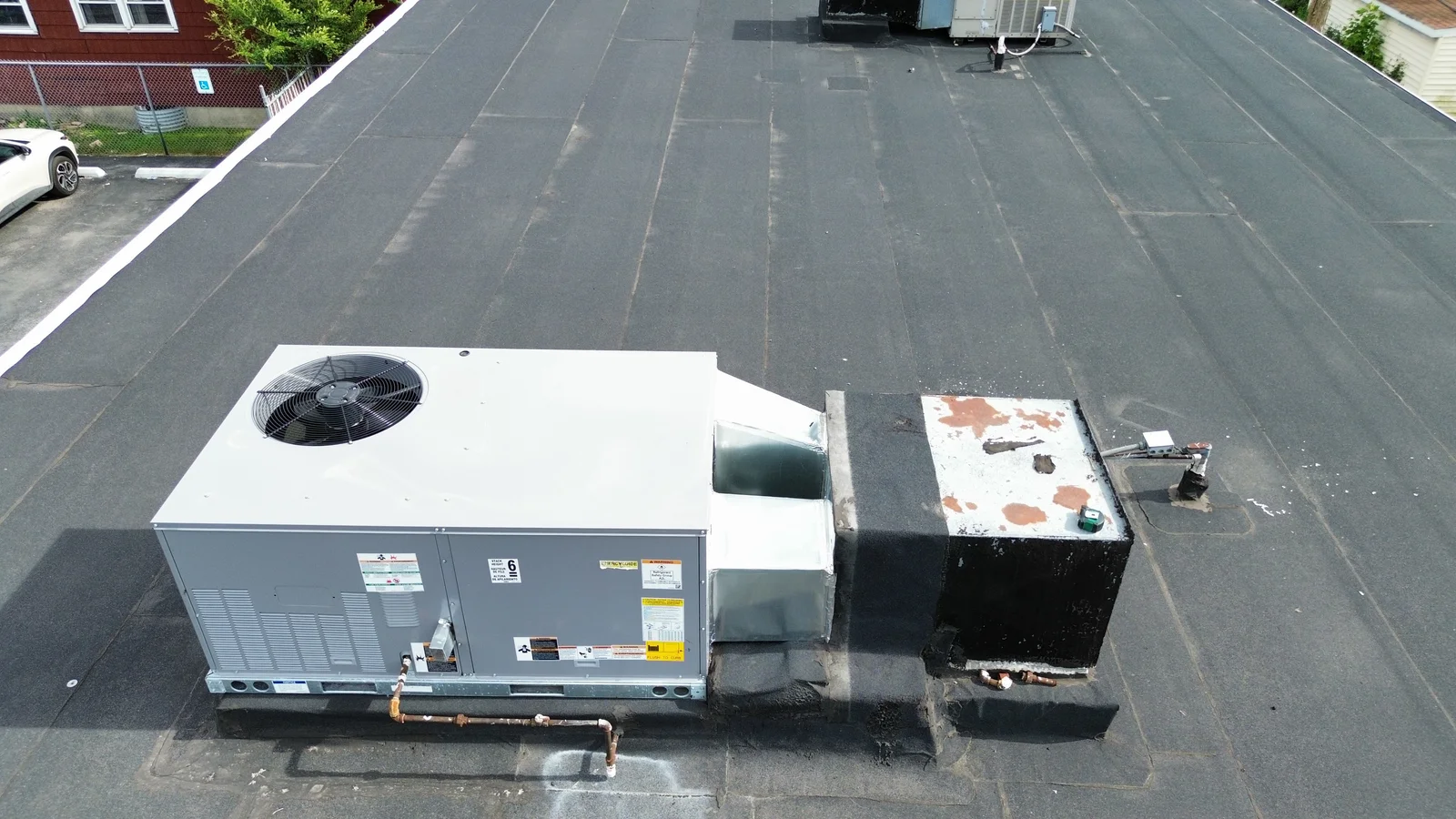
Rooftop unit on a dark membrane field
Replacing An Acre Of Roof Over A Building That Never Closes
Most flat roofs in the Elk Grove Village industrial park sit over people who are working: machining, cold storage, print, distribution. When the membrane has run out of repairs, the building still has to ship the next morning. We replace these roofs one section at a time, with every section closed up before the crew leaves, material staged clear of the dock doors and the tear-off timed around your shifts. Nobody inside should have to plan their week around the roof.
When A Warehouse Membrane Has Nothing Left To Patch
On a big roof, the open field in the middle usually outlasts everything around it. On the buildings along Busse Road, Higgins and Devon, an aging roof leaks from the same handful of places over and over:
- Curbs under rooftop units, where the flashing has been opened and resealed every time a unit was swapped.
- Seam laps opening along the paths service techs walk to reach the equipment.
- Drain bowls and scuppers rusted through, and pitch pans that have split.
- Spots where a mechanical contractor cut into the membrane and closed it back up with whatever was on the truck.
Each of those is a repair by itself. When they are spread across the whole roof and some of the patches are older than the current tenant’s lease, the membrane is giving the same answer in several places. A walk of the full roof plus a few cores into the insulation settles whether the next dollar goes to another round of repairs or to replacement.
Sections, Not The Whole Roof At Once
Acre-scale tear-off does not happen in a day, and nobody in this park wants the deck over their racking open overnight. So the roof gets divided into sections the crew can strip, insulate and seal between the morning and the end of the shift. Each one is watertight before anyone comes down the ladder. The next day starts on a fresh section. When weather is coming, the crew opens less roof, never more.
The order follows what is underneath. Areas over finished goods, control cabinets or sensitive production get scheduled into the most settled stretch of forecast. Office blocks and mezzanines are sequenced so the people at those desks know which day the noise will be overhead.
Keeping The Dock Doors Open
A roofing crew that parks a dumpster in front of a dock has stopped the building as surely as a leak would. The dumpster, the lift and the material go in a part of the lot that stays clear of the doors. Crane picks and deliveries are timed outside shift changes and the truck windows the building already runs on. When a tenant leases the space, we talk with the tenant as well as the owner, so the floor hears about the work from us before they hear it on the deck.
Tear-off odor and fumes get the same planning. Food, cleanroom or sensitive production under part of the roof changes when those sections are done, and that is settled before the first day.
The Insulation A Tear-Off Brings Up To Code
Taking a roof down to the deck puts it under current energy code, and buildings from the 1960s through the 1990s were insulated to a far older standard. What comes off is often thin fiberboard or whatever survived an earlier re-cover. What goes back is polyiso in two layers with the joints staggered, so board seams never line up and show through the membrane. Tapered board around the drains makes sure water actually gets to them. A cover board goes over everything, because foot traffic to the units will dent bare insulation into a low spot that holds water.
That insulation shows up on the price. It also changes what the building spends conditioning the floor underneath, and on a building with dock doors cycling all day that difference is real money.
Curbs Rebuilt Instead Of Worked Around
Every rooftop unit sits on a curb, and every curb is a hole in the roof. During replacement each curb gets new flashing up its sides to the system’s published detail. Where the old layout left water dammed behind a curb, a tapered cricket turns it around the unit. Before work starts, you hear which units have to be disconnected or lifted to flash properly, and we line that up with your mechanical contractor so nobody shows up to find a unit sitting on a pallet.
Paper For Whoever Owns It Next
A manufacturer warranty on these systems covers the whole assembly, and the manufacturer sends an inspector to confirm the fastening, the cover board and every flashing detail match the spec before it issues anything. We build to that spec, then hand over the warranty document with our own labor terms and a photo report of the job section by section. A property manager ends up with one file that answers what a buyer, a tenant or an insurer will ask. How we handle tear-offs in general is on our flat roof replacement page, and the gallery shows the crew’s roofing work on finished jobs. Building details can go in through the contact page.
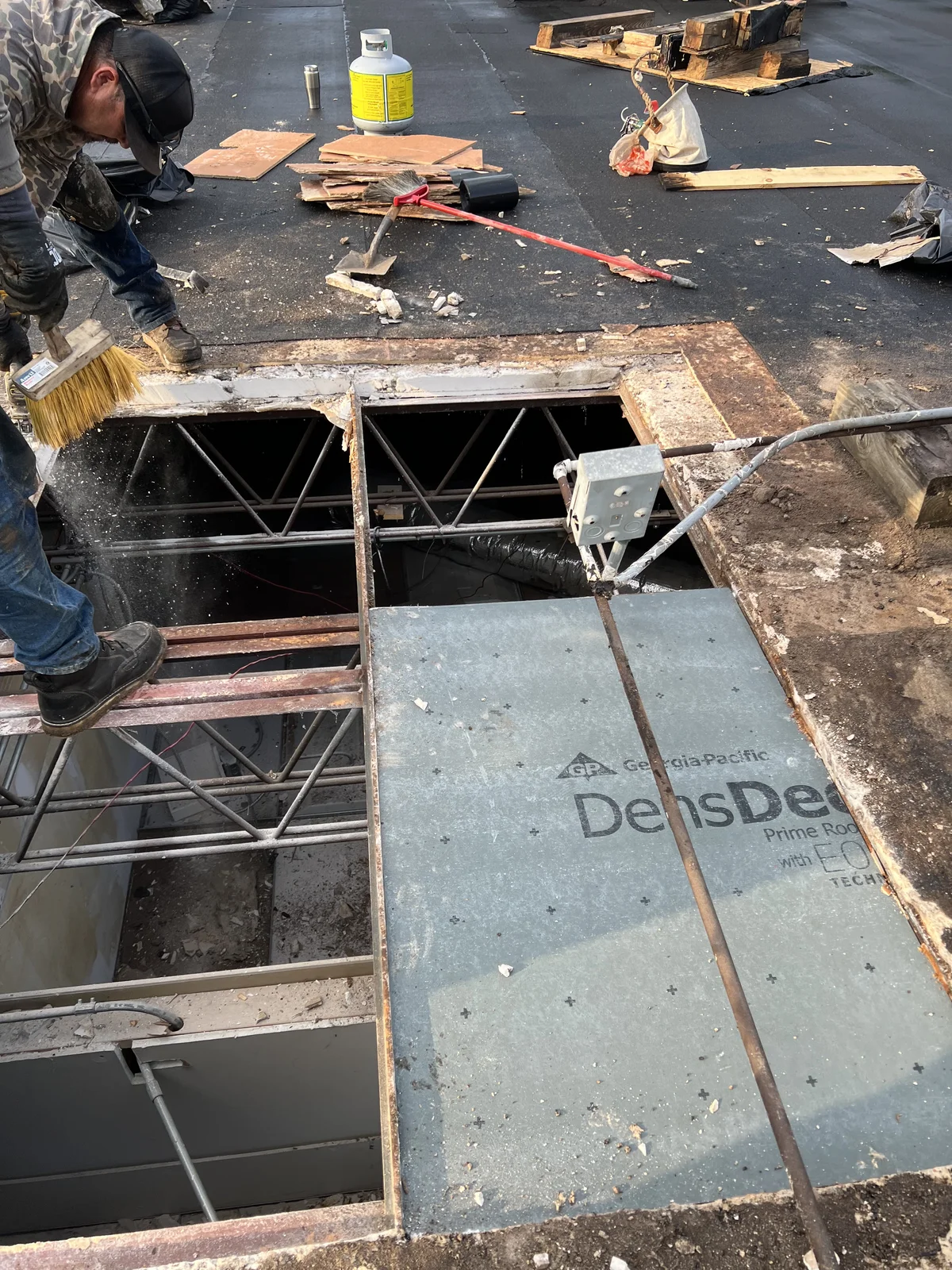
Cover board going down over the deck
Repair Or Replace Up Here
Leaks at a few curbs over dry insulation are repair work. Wet insulation under large parts of the field, seams failing in several areas and rusted drains together point to a tear-off.
Who Hears The Schedule
Owner, property manager and tenant all get the section plan before day one, and photos go out as each section closes.
Trips up here run as grouped routes from Alsip, with no travel charge.
(312) 590-4853How A Phased Tear-Off Crosses The Roof
Core And Map
Cores show where the insulation is wet, and the roof gets split into sections that can close in a single day.
Stage Off The Docks
Dumpster, lift and material set away from the doors, with picks timed around shifts and trucks.
Strip, Insulate, Seal
One section to the deck, two staggered layers of polyiso, cover board and membrane before the crew leaves.
Flash And Document
Curbs, drains and parapets finished to spec, with photos sent as each section is done.
Phased tear-offs are only part of our work in the village. Brick on the residential side, and on the office fronts some industrial buildings carry, is covered under tuckpointing repair for failed joints, and the short stacks on the 1960s ranches have their own page at chimney tuckpointing on ranch homes. Whole walls on those houses fall under brick tuckpointing, and the day-by-day process is on brick repointing. The Elk Grove Village page covers everything we do here.
What Facility Managers Ask Before The Tear-Off
Can the building stay open during a full roof replacement?
Yes. The roof is replaced in sections that are stripped and sealed within the same day, so no part of the building sits open overnight. Equipment and material are staged away from the dock doors, and crane picks are timed outside shift changes and truck windows.
Why does the insulation have to change when the membrane does?
Tearing a roof down to the deck brings it under current energy code, and most buildings in the park were insulated to a much older standard. The new assembly is two staggered layers of polyiso, tapered board at the drains and a cover board under the membrane.
What happens to our rooftop units during the job?
Each curb gets new flashing as its section is replaced. If a unit has to be disconnected or raised to flash it properly, you hear about it ahead of time, and we coordinate the timing with your mechanical contractor so the space below is not caught off guard.
We have food production under part of the roof. Does that change anything?
It changes the schedule. Tear-off odor and fumes are planned for before the job starts, so the sections over food, cleanroom or other sensitive work get timed with the people running that space. That gets settled during the roof walk, not after somebody complains.
How do you decide between replacement and another round of repairs?
We walk the whole roof and take cores wherever the insulation might be wet. Scattered leaks at curbs and seams over dry insulation are repair work. Wet insulation across large parts of the field means the next repair is money spent on a roof that is already finished.
What paperwork do we get when it is finished?
The manufacturer warranty document, our own labor terms and a photo report covering each section as it closed. The manufacturer’s inspector checks the finished details before that warranty is issued, so the file reflects a roof that already passed the inspection.
Tell Us When The Trucks Run
Send the address, roughly how big the roof is and what goes on under it: which bays hold inventory, where production runs, when the docks are busiest. Satellite measurements get a first number started while we are on the phone.
A walk of the roof then confirms the price and the section plan, and you get both in writing before any material is ordered. We work the industrial park and the houses east of it Monday to Saturday, 9 to 5, and a storm leak over inventory gets emergency patch response.