
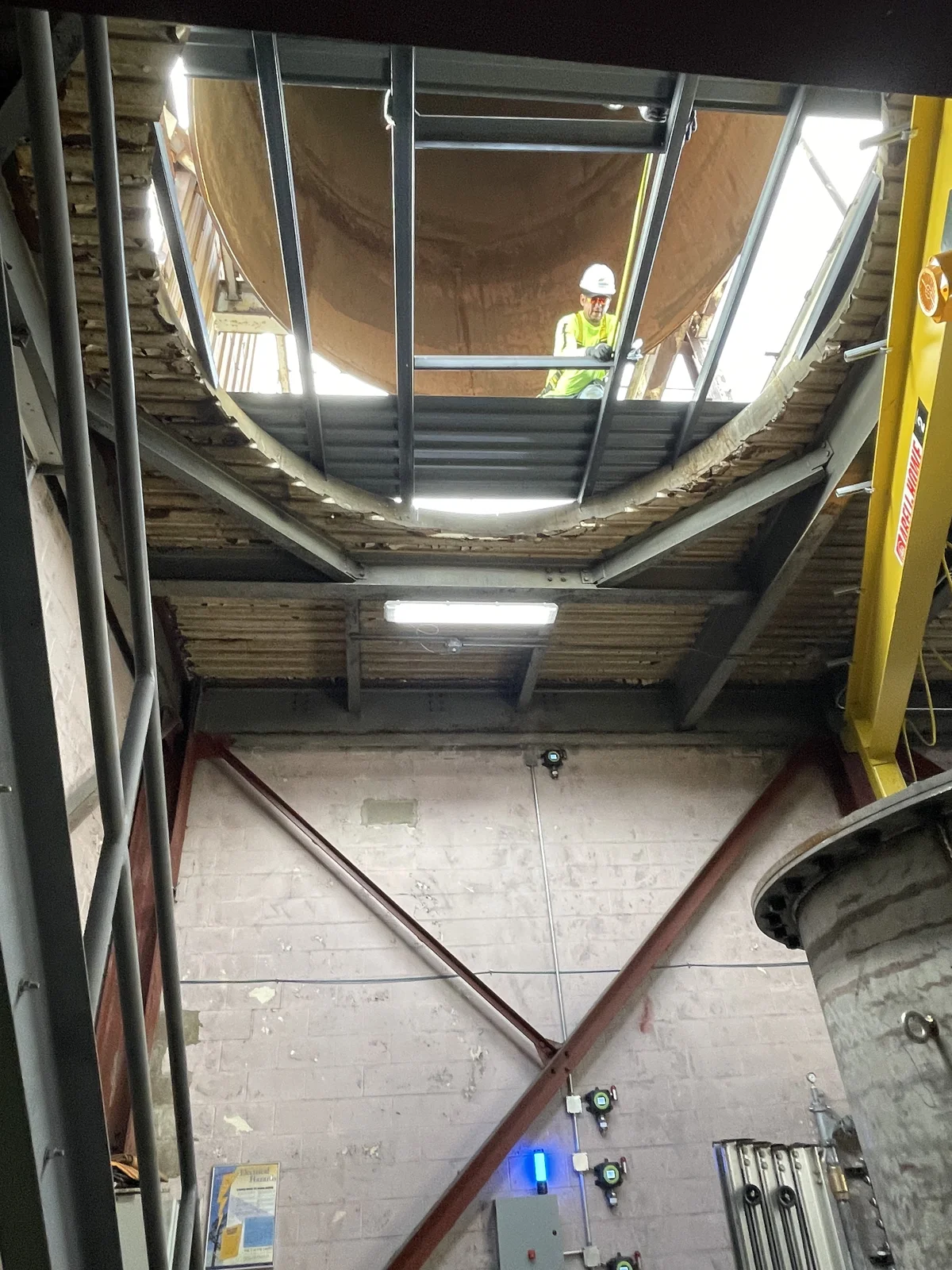
Steel-framed roof opening from below
A Plant Roof Carries Whatever The Building Makes
A roof over a bakery, a food plant or a cold storage box takes on the work happening below it. Grease from the exhaust fans settles on the surface and eats at it, and every new production line brings another equipment curb to flash. Under the cold rooms, moisture pushes up into the insulation all year. We roof these buildings around what actually goes on underneath them, on a schedule the plant can live with.
What A Working Plant Does To The Roof Above It
Two industrial buildings put up in the same year can look completely different on top. How a plant roof wears depends far more on what the building vents and chills than on its age, so the first thing we ask on any industrial call is what runs under the roof. The answer tells us where to look before we ever climb the ladder.
The Grease Ring Around Every Exhaust Fan
On food plants and bakeries, the first thing we look for is the ring. Years of grease exhaust settle on the roof surface around each fan, and the material inside that circle softens and breaks down faster than the field around it. You can usually spot it from the ladder before stepping onto the roof: a darker stained band centered on the fan, sometimes with the surface already crazed or tacky underfoot.
That ring does not stay cosmetic for long. Once the surface goes, the seams and flashing inside it follow, and a roof that is sound across most of its area can be letting water through in a neat circle under every stack. The repair is cutting out the degraded material and rebuilding that area with new membrane. After that comes a conversation with whoever maintains the fans and hoods, because the ring comes back if the exhaust keeps landing in the same place at the same rate.
Curbs And Process Exhaust Are Where The Hours Go
Industrial roofs are crowded. Equipment curbs, process exhaust stacks, pipe supports and conduit all pass through the membrane, and each one is a detail flashed by hand. On a plant roof the open field is the easy part. The time goes into the curbs.
Each curb gets flashed up its full height and terminated so water cannot get behind it. Process exhaust gets detailed for what it actually discharges, since heat and residue from a stack treat the membrane around it differently than a plain vent pipe does. When a new line goes in and a fresh curb is cut into the roof, that detail deserves the same standard as the original job, and on older plants those later additions are the first places we check.
Metal flashings get the same scrutiny as the membrane. A counterflashing that has pulled away from a curb wall, or a storm collar that has slipped down a stack, lets water in at exactly the spot a membrane patch cannot reach.
Cold Storage Soaks From The Inside
Cold storage buildings fail in a way that fools nearly everyone. A freezer or cooler under a low-slope roof sets up a vapor drive, with warm humid air pushing toward the cold deck every hour of every day. If the vapor retarder was cut or damaged during some old repair, that moisture collects inside the insulation. The membrane on top can look perfect while the insulation below it sits saturated.
Wet insulation stops insulating, so the refrigeration works harder to hold temperature. By the time water finally shows inside, the wet area usually covers far more roof than anyone guessed from the first stain.
Finding Water The Surface Will Not Show You
A soaked cold storage roof does not reveal itself from the ladder. We find it one of two ways. The first is an infrared scan on a clear evening, after the deck has given up the heat of the day, when wet insulation shows up on the camera as a pattern that dry insulation does not make. The second is cores pulled in a grid across the roof: small cuts down through the membrane and insulation, patched as we go. A grid shows where the wet area starts and where it stops, and that boundary decides how much roof actually has to come off.
Timing matters for the scan. A cloudy night, or a roof still holding the afternoon sun, muddies the picture, so we pick the evening instead of letting the calendar pick it. Where the camera shows a suspicious pattern, a core or two at its edge confirms what the image suggests before anyone marks that section of roof as wet and prices its removal.
Insulation Sized To The Room Below
When a cold storage roof is replaced, we do not copy whatever went on the warehouse next door. Insulation thickness and the vapor retarder are detailed to the actual operating temperature of the space underneath. A cooler and a deep freezer are different buildings as far as the roof is concerned. And a retarder that runs continuous across the field but breaks at every curb and penetration fixes nothing, so those transitions get the same care as the curbs on a process roof.
Sanitation Windows, Nights And Weekends
Food plants run on schedules nobody outside the building gets to change. Sanitation windows and production runs set the calendar, and a roofer who shows up whenever suits the crew becomes the plant manager’s problem. We plan the work around those windows, and night or weekend work is on the table when the operation requires it. Before anything is opened above a production area, we settle with plant staff what gets covered, moved or shut down.
A Second-Generation Shop Out Of Alsip
Angelo Ristich learned this trade under his father Frank, then took the company over and modernized it. Guardian Roofing Systems has worked Cook County since 2013, carries an A+ with the BBB and holds a HomeAdvisor Elite Service award. Low-slope work is the specialty: TPO, EPDM, coatings and metal flashings. The broader service is on our industrial roofing page, finished work sits in the gallery, and plant details can go through the contact page.
Where We Look First
The grease ring around each exhaust fan. Every equipment curb and process stack. On cold buildings, whether the insulation is wet under a membrane that seems fine.
Infrared on a clear evening or cores in a grid, whichever the roof calls for.
(312) 590-4853On The Plant Clock
Work planned around sanitation windows, with nights and weekends available. Pricing begins on a phone call with satellite measurements, and a walk of the roof settles it.
Four Stops On A Plant Roof
Read The Fans
The exhaust ring checked from the ladder, then on foot.
Work The Curbs
Every curb and process stack flashed by hand to one standard.
Test The Cold Side
Infrared or a core grid wherever a cooler or freezer sits below.
Fit The Window
Work set around sanitation and production, nights or weekends when needed.
More for the village: a big low-slope field over stored goods is the territory of warehouse roofing, and a single-ply roof whose details are giving out goes to TPO roof repair. Water already reaching the floor belongs on commercial roof leaks, and if you want the condition documented before deciding anything, start with commercial roof inspections. The Bedford Park page covers the whole village, and we work nearby in Burbank and Bridgeview too.
What Plant Managers Ask Before We Go Up
How do you handle the grease buildup around our exhaust fans?
We cut out the degraded material inside the ring and rebuild that area with new membrane. Then we point out how much grease is landing on the roof, because the ring returns if the exhaust keeps depositing it at the same rate in the same spot.
Our cold storage roof looks fine. Could it still be wet?
Yes, and that is the usual case. Vapor drive from the cold room pushes moisture into the insulation from below while the membrane on top stays intact. An infrared scan on a clear evening or a grid of cores is how we confirm it either way.
Why does the operating temperature matter for a new roof?
Insulation thickness and the vapor retarder should match what the room below actually runs at. A cooler and a freezer ask very different things of a roof, and copying the specification from a neighboring warehouse leaves the cold building open to the same moisture problem all over again.
Can you work during our sanitation window or overnight?
Yes. The plant sets the schedule, and we plan around sanitation windows and production runs. Night and weekend work is available when the operation requires it, and we agree with plant staff ahead of time on what gets covered or shut down before any opening above production.
Who flashes the curbs when we add new equipment?
We can, and it should match the standard of the original roof. New equipment curbs and process exhaust are hand-flashed details, and a curb cut in later without proper flashing is one of the first places an otherwise sound plant roof starts letting water through.
How do we get a real number for an industrial roof?
Call or send the building details. Pricing can start on the phone from satellite measurements, and on a plant of any size we confirm it by walking the roof, checking the exhaust areas and curbs, and testing for moisture wherever cold rooms sit below.
Start With What The Building Makes
Send the address and what happens inside: baking, freezing, processing or storage. Mention where the exhaust fans sit, whether any rooms run cold, and when the operation can tolerate work overhead.
From there you get a walk of the roof, a moisture check wherever the cold side calls for one, and a real number for the work. Guardian is licensed and insured in Illinois, and emergency patching runs around the clock if a leak reaches production first.