
Find The Real Hole, Weld It Shut, Prove It Held
Most TPO leaks are not mysterious. They are a puncture nobody reported, a weld that opened at the edge, or flashing that gave up where a rooftop unit meets the deck. We find it with a probe and a systematic walk, then repair it with heat, the way the membrane was built to be repaired.

Where membranes fail first
What Fails On A TPO Roof
Single-ply membrane does not usually fail across the field. It fails at specific, findable places. Punctures come first: a dropped tool, a dragged condenser skid, a screw backed out of a rooftop unit and left lying under a sheet of ice. TPO is reinforced, so a puncture often looks like a slit the width of a pencil, invisible from ten feet away and perfectly capable of dumping water into a ceiling for months.
Seams come second. A properly welded seam almost never opens in the middle, but it can open at the edge if the original weld ran cool, ran too fast, or was made over a dirty sheet. Chicagoland gives a roof roughly a hundred and twenty degrees of annual temperature swing, and every cycle works a marginal weld a little further open.
Third is everything vertical. Pipe boots crack at the top where the clamp sits. Curb flashings at rooftop units pull down when somebody stands on them during service. Corner details at parapets split because that is where the membrane gets asked to bend the most. Old sealant at the termination bar dries, shrinks and opens a line straight into the wall.
Why The Wet Spot Is Not Where The Hole Is
The single biggest reason a repair fails is that somebody patched directly above the ceiling stain. Water that gets through a membrane lands on insulation or the deck and travels: along a flute in a metal deck, along a seam in the cover board, along a conduit run. Thirty or forty feet of lateral travel is completely normal. Your stain in the northeast corner of the warehouse can easily come from a split boot at the middle of the roof.
So we do not chase the stain. We map the roof, note the deck direction, walk every penetration and every seam in the drainage path uphill from the interior location, and probe. Probing is exactly what it sounds like: a rounded steel tool run along the edge of every seam with steady pressure. A sound weld does not move. A cold weld or an unwelded stretch lets the probe in immediately.
Where the leak has been going for a while, we cut a core: a small plug taken through membrane, cover board and insulation to see whether the layers underneath are saturated. That tells you whether you have a repair or a bigger conversation.
Welded Repairs Versus The Caulk Gun
TPO is a thermoplastic. It can be re-melted, which means a patch of the same membrane can be welded into the existing sheet and become part of it. That repair does not have a lifespan separate from the roof. It is the roof.
What a lot of crews do instead is run a bead of sealant over the split and call it fixed. That holds for a season, maybe two. Then the sealant shrinks, the UV chews it, ice pries it, and you have the same leak plus a black smear that makes the real repair harder.
Done properly, a repair goes like this:
- Area cleaned and, where the membrane is weathered, prepped so the weld actually takes. Aged TPO develops a surface layer that has to come off or the patch never bonds.
- Round or radiused-corner patch cut from matching membrane. Square corners peel; that is not an opinion, it is what happens.
- Hand welded with a hot-air gun, tacked, then welded fully with consistent pressure from a silicone roller.
- Probed cold. Every inch of the new weld gets the same steel probe treatment the rest of the roof got.
- Terminations and boots rebuilt rather than re-caulked where the detail itself is the problem.
Rooftop Units, Curbs And The Traffic Nobody Tracks
On a commercial building, the roof is a mechanical room with a view. HVAC techs, refrigeration guys, satellite installers and window washers all get up there, and none of them are thinking about your membrane. Most punctures we find on Chicago-area roofs are service traffic damage: a torn sheet where a tool bag got dragged, a slit next to a condenser where a panel got set down on its corner.
Around rooftop units specifically, the failure points are the curb flashing where the membrane turns up, the pitch pockets around refrigerant lines, and the gas line supports that sit right on the membrane with no sleeper under them. We rebuild those details rather than patching over them.
Emergency Leaks And Chicago Weather
Water coming through a ceiling on a Friday night does not wait for a work order. We run emergency response for exactly that situation, including in weather most crews will not go up in. There is a review on our record from a Chicago three-flat where the crew was on the roof the next morning in blizzard conditions, shoveling ice off the deck before patching. A winter emergency patch is a stabilization, not a finished repair.
When Repair Stops Being The Right Call
We would rather repair your roof than sell you a new one, and most of the time repair is the right answer. But there is a line. When a roof has several active leaks at once, when the membrane has gone chalky and brittle, or when core cuts come up wet across multiple areas, the repairs stop being maintenance and start being a payment plan on a roof you do not own yet. At that point we lay out the numbers for both paths and let you decide. The TPO roof replacement page covers that side of it.
Angelo Ristich supervises this work himself, because on a repair the diagnosis is the job. Anybody can weld a patch. Knowing where to put it is the part his father Frank spent a career teaching him. See flat roof work in our gallery, or send building details through the contact page.
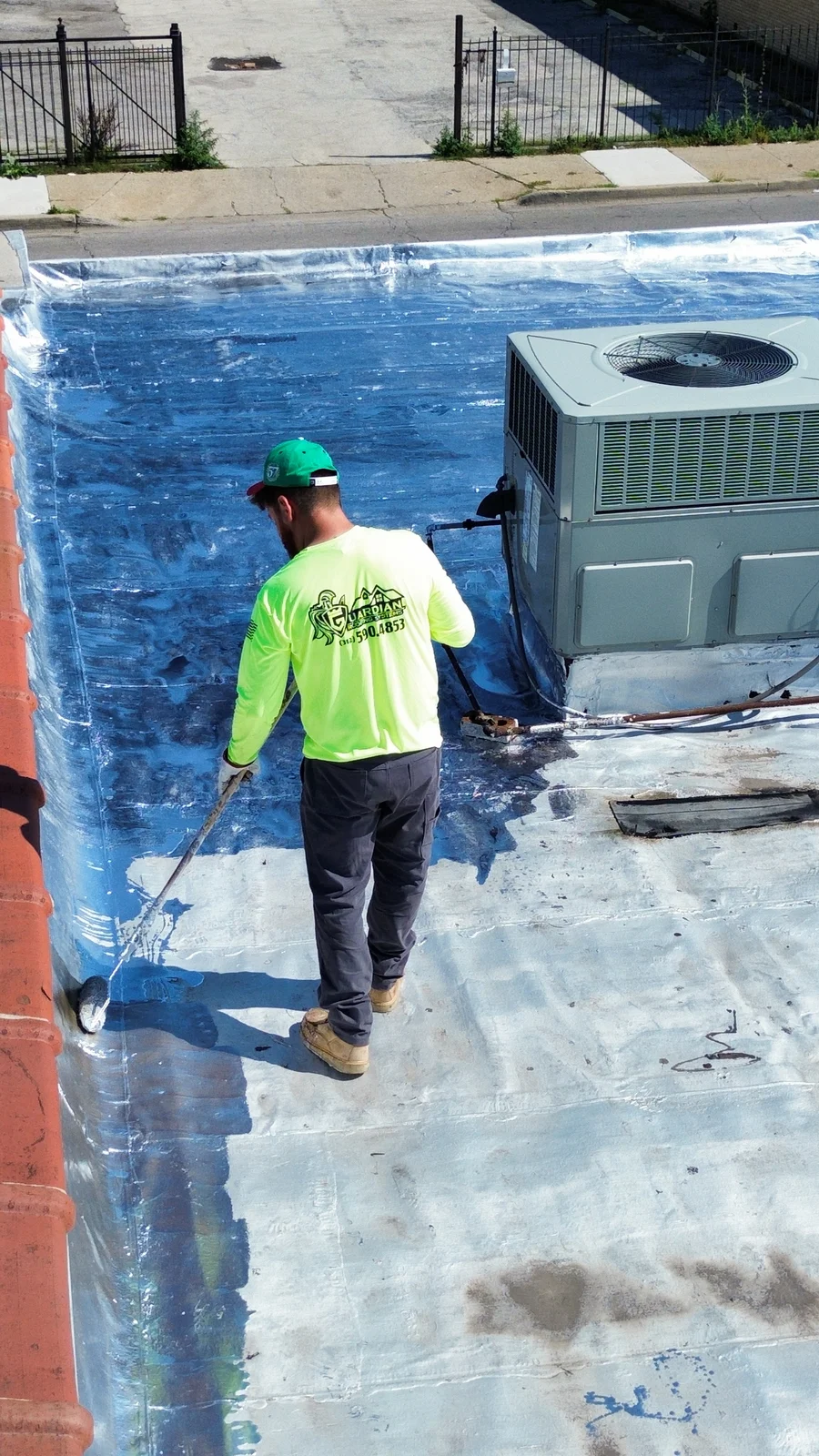
Coating rolled corner to corner
The Short Version
Probe-tested seams, not a visual guess. Welded patches from matching membrane, never a bead of sealant over a split.
Emergency response when water is coming in. Core cuts to check for wet insulation before we quote anything bigger.
(312) 590-4853How A Repair Call Goes
Where It Shows Inside
You tell us where the water lands and when. We note deck direction and drainage so we hunt uphill instead of straight up.
Walk And Probe
Every penetration, curb and seam in the suspect zone. Steel probe on the welds, core cut where insulation may be wet.
Weld It Closed
Surface prepped, radiused patch cut, hot-air welded and rolled. Details rebuilt where the detail is what failed.
Test And Report
New weld probed cold, drains cleared, photos of what we found and fixed sent to you with the invoice.
Related work: leak on a low-slope roof that is not TPO? Flat roof repair. Not sure what is coming in where? Commercial roof leaks. Membrane past patching? TPO roof replacement. New building or full assembly? TPO roof installation. We take repair calls across Harvey, Joliet and Villa Park.
Membrane Repair Questions
How fast can somebody get on my roof?
For active water coming into a building, same day or next morning is the goal, weather permitting. Non-emergency repairs get scheduled within the week in most cases. Call and describe what you are seeing and we will tell you honestly where you land in the queue.
Can a TPO patch really last as long as the roof?
A hot-air welded patch fuses into the existing sheet, so yes, it is a permanent part of the membrane. The limit is not the patch, it is the age and condition of the surrounding sheet.
Somebody already sealed it with caulk and it still leaks. Now what?
Common situation. We remove the sealant, clean the membrane back to a weldable surface, and repair it with heat. It takes longer than a fresh repair because of the cleanup, and occasionally the mastic has degraded the membrane enough that the patch needs to be larger.
Why do you need to cut a hole in my roof to check it?
A core cut is a two-inch plug through the assembly that shows whether the insulation under the membrane is dry. Without it, nobody can tell you if you have one leak or a saturated roof. We weld a target patch over every core before leaving, so the roof is closed the same day.
Will you work with the property manager and insurance if a storm caused it?
Yes. We document with photos, write up what the storm did versus what was already worn, and deal directly with managers, tenants or adjusters as needed. Our roof insurance claims page explains how we handle the documentation side.
Do you offer maintenance so this stops happening every year?
We do, and on buildings with regular rooftop service traffic it pays for itself. A scheduled walk twice a year catches punctures and opening seams while they are cheap, clears drains before spring, and gives you a written record of roof condition.
Water Coming In? Call Before It Spreads
Describe where it is landing and how long it has been going. We will tell you whether this is a same-day patch or something that needs a proper look, and give you a straight price either way.