
Warehouse Roofing Priced By The Acre, Not The Guess
A warehouse roof is a hundred thousand square feet of low slope membrane with your inventory sitting under it. One open seam over the wrong rack costs more than the whole repair. We work the big fields around Alsip, Bedford Park and the I-55 corridor, and we phase the work so the docks keep running.
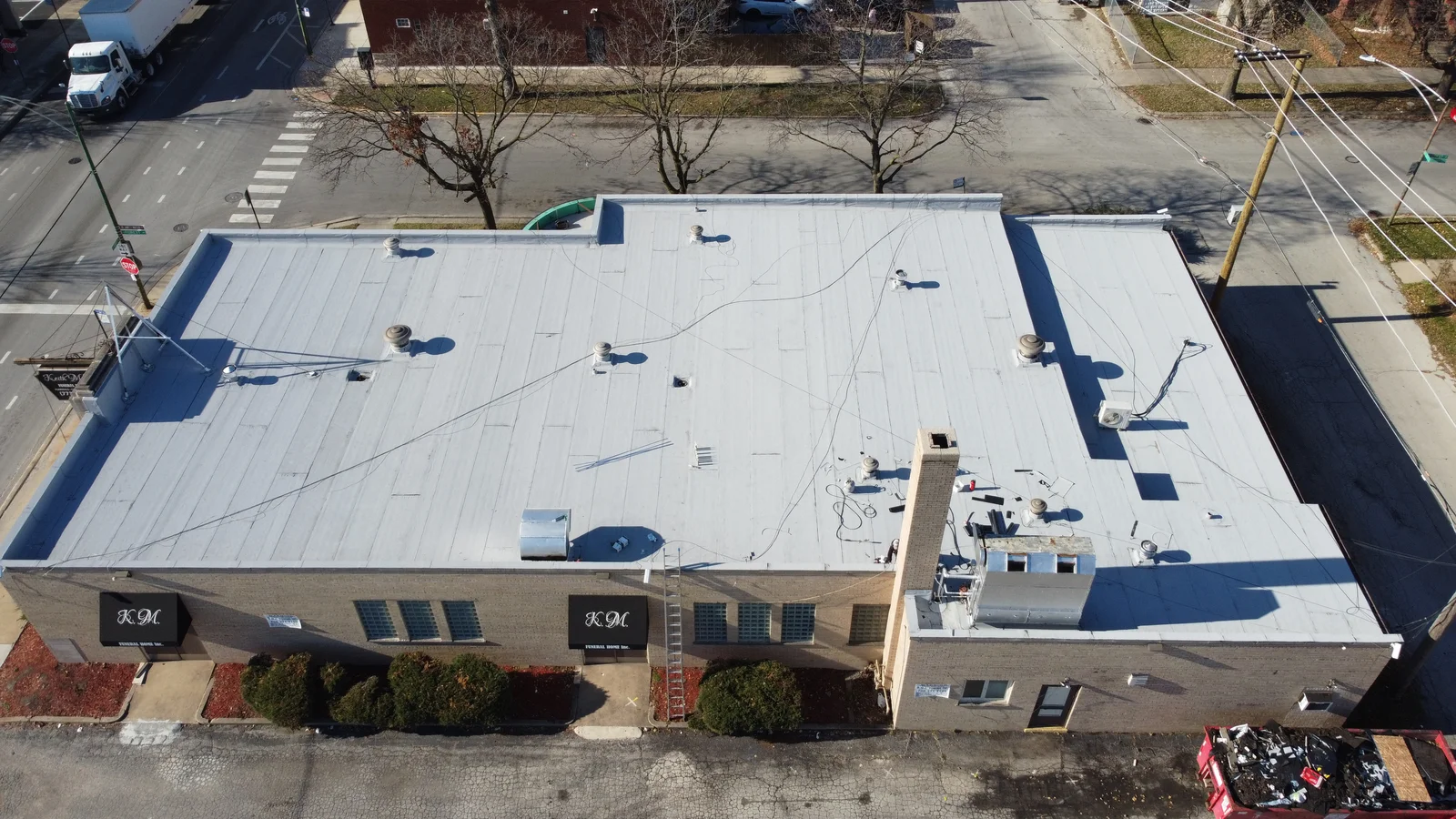
Commercial field, coated end to end
Big Fields Fail Differently
On a house, the roof is small enough that anything wrong with it shows up fast. On a warehouse, an open seam can sit there for two years without anyone noticing, because the water lands on a slab in an aisle nobody walks down, or it soaks into insulation and never makes it to the deck until it does. By the time a leak announces itself over a rack, the wet area in the insulation is usually many times bigger than the hole that caused it.
That is the core of low slope roofing at scale: the failure is slow and quiet, and the cost is in what got wet. Warehouse roofs also have almost no pitch, which means water sits instead of running. Ponding around a low spot or a clogged drain adds weight and degrades membrane faster under UV. A Chicago winter freezes that pond, and freeze-thaw works the seams under it every night.
So when we inspect a distribution or storage building, we are looking for the quiet stuff: seam separation, fastener backout showing as small bumps in the field, open laps at the perimeter, ponding rings, crushed insulation under old foot traffic paths, and drains that have not been cleared since the last tenant.
Skylights, Smoke Vents And Everything Cut Into The Deck
Warehouses are full of holes that houses do not have. Skylight panels for daylighting, smoke and heat vents required by code, exhaust fans, roof hatches, and long runs of conduit and gas line on blocks. Every one has a curb, and curbs leak long before fields do.
- Skylight curbs and the panels themselves. Older acrylic and fiberglass panels go brittle and yellow, crack at fastener points, and leak around the frame long before anyone puts them on a capital plan.
- Smoke vent curbs and their spring hardware. These have to stay operable for code, so flashing work around them cannot seal them shut, which is a detail a lot of roofers get wrong.
- Fan and hatch curbs, where the flashing gets damaged by anyone servicing the equipment above it.
- Pitch pans and equipment supports on blocks, which shift with thermal movement and open up the sealant around them.
- Expansion joints, which on a long building are doing real work and need a cover system that can actually move.
Skylights deserve a specific mention because they are also a fall hazard. A brittle panel will not hold a person, and warehouse roofs get walked by HVAC techs, communications contractors and anyone else with equipment up there. If your panels are past their life, replacing them fixes a leak and a safety problem in the same visit.
Coating Restorations At Warehouse Scale
Tearing off a hundred thousand square feet of roof is a capital project with a long approval chain. Restoring it with a coating is a maintenance expense that can often happen this quarter. Where the existing membrane or metal deck is structurally sound and the insulation underneath is dry, a coating restoration is frequently the right call: the surface gets cleaned, seams and details get reinforced with fabric and mastic, wet areas get cut out and replaced, and then the whole field gets a reflective coating that adds years and drops summer cooling load in the building.
Where a coating is the wrong call, we say so. Coating over wet insulation traps the water and turns a repair into a tear-off two years later at a higher price. We check moisture before quoting a restoration, and if a section of the building is saturated, that section gets opened and rebuilt while the sound sections get coated. Splitting a building that way is normal on large roofs.
Phasing Around Logistics Operations
A distribution building does not stop for a roofer. Trucks are at the docks, pickers are on the floor, and the racks below the work area are full. So the plan starts with your operation, not our crew size.
In practice that means sectioning the roof into areas that match what is underneath, and working over aisles that can be cleared or racks that can be tarped while that section is open. It means staging material and the dumpster away from dock doors and truck lanes. It means we never open more roof than we can close before weather. And it means coordinating with your safety people on access, tie off points and who is allowed on the roof while we are working.
Off-hours and weekend work is available where the operation runs around the clock. Angelo schedules the sequence with your facility manager before mobilization so nobody is discovering a conflict at seven in the morning with a crane on site.
Protecting What Is Under The Roof
Inventory protection is the whole reason a warehouse owner calls a roofer, and it deserves more than a line in a proposal. Before we open any section we want to know what is under it. Paper goods and electronics get tarped or moved. Racks under an active work area get covered. Interior drains get checked so that a sudden storm during an open phase has somewhere to go besides your floor.
If you have already taken water damage, we document the roof-side cause with photos and dates, which is exactly what an insurance claim needs. Hail and wind events across Cook and Will counties produce a lot of warehouse claims, and the claims that get paid properly are the ones with a documented scope.
Straight Numbers On Large Roofs
Satellite measurements give us accurate square footage on a big building fast, which means you get a realistic range early instead of waiting a week for a proposal. From there an on-roof inspection with moisture checks firms the number. We price repairs as repairs, restorations as restorations, and tear-offs only when the building actually needs one, with the photos to back up which category you are in. Financing help is available on capital scopes.
See completed commercial fields in the gallery, or set up a walk through the contact page. We work warehouse and distribution buildings in Bensenville, Romeoville and Joliet and across the Cook, DuPage and Will county industrial corridors.
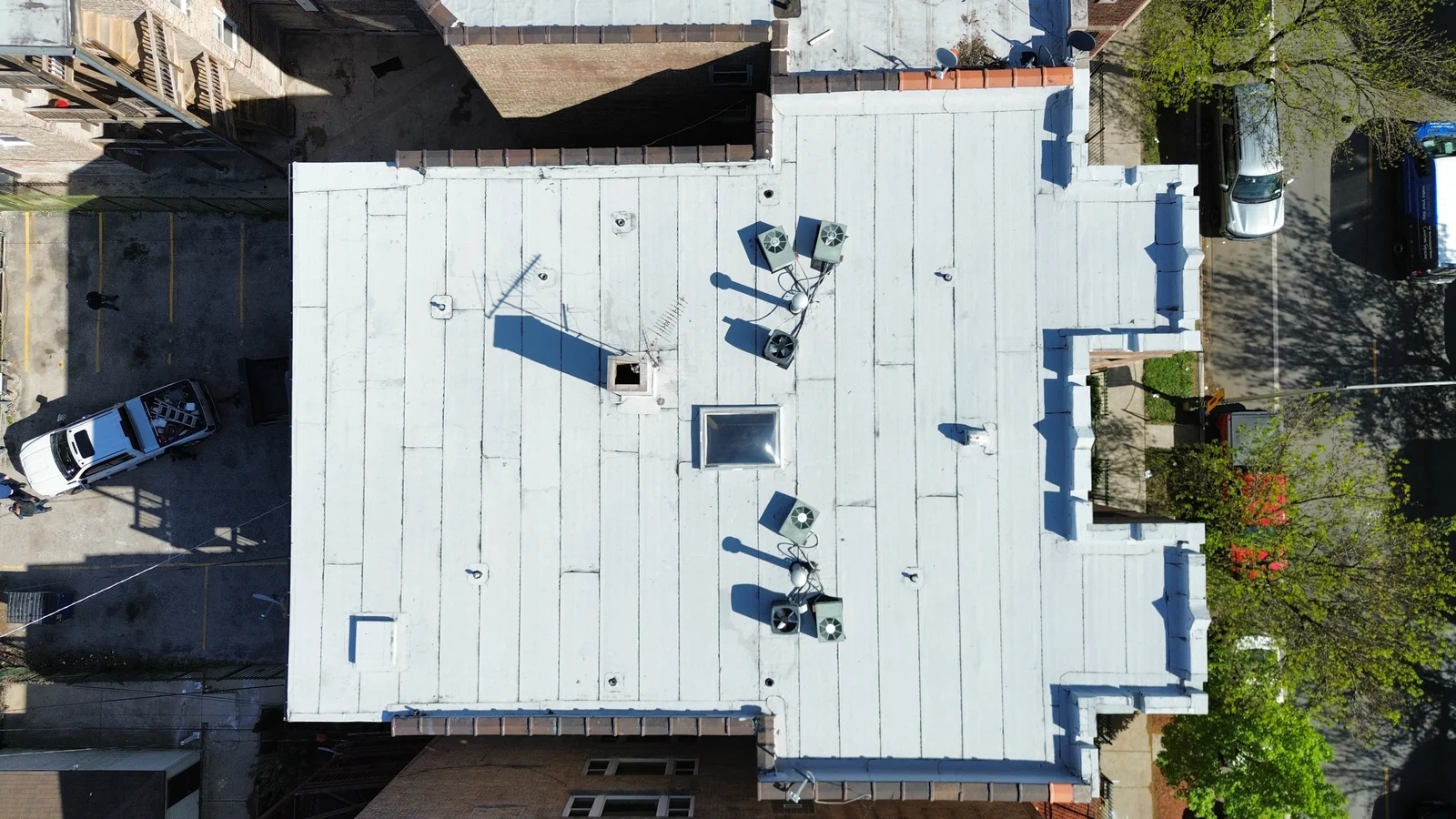
Big field, one system
The Short Version
Seam, fastener and ponding survey across the whole field. Skylight, smoke vent and hatch curbs checked and reflashed without sealing vents shut.
Moisture verified before any coating. Wet sections opened and rebuilt, sound sections restored. Phased around docks and shifts.
(312) 590-4853How A Warehouse Project Runs
Survey The Field
Full walk with moisture checks, seam and fastener survey, drain and ponding map. Photos tied to a roof plan you can keep.
Split Sound From Wet
Saturated areas get opened and rebuilt. Sound areas get restored or coated. You see which is which before you spend.
Sequence The Sections
Work areas matched to what sits below. Staging clear of dock doors and truck lanes, never more roof open than we can close.
Close And Document
Final walk with the facility manager, magnet sweep, drains cleared, warranty and photo record handed over for the building file.
Related work: membrane systems are covered under TPO roofing replacement and commercial flat roofs. Chronic water gets diagnosed through commercial roof leaks. Metal deck buildings tie into metal roof repair. We cover industrial buildings in Bensenville, Romeoville and Joliet.
Warehouse Roof Questions
Can you coat our roof instead of replacing it?
If the insulation under it is dry and the membrane or deck is structurally sound, usually yes, and it is a fraction of the cost. We check moisture before quoting it. Coating over wet insulation traps the water and costs you a full tear-off in two years, so we will not do that.
Do we have to shut down operations?
No. We section the roof to match what sits below, work over areas that can be cleared or tarped, and stage away from dock doors and truck lanes. Weekend and off-shift work is available where the building runs around the clock.
Why does water show up so far from the leak?
Low slope roofs have almost no pitch, so water spreads across the top of the insulation until it finds a fastener hole or a deck seam. The wet area in the insulation is often many times larger than the actual opening in the membrane, which is why we survey the whole field rather than chasing the drip.
Our skylight panels are yellowed and cracking. Is that urgent?
It is both a leak and a safety issue. Brittle panels will not hold the weight of an HVAC tech who steps wrong. Replacing them addresses both at once, and on most buildings it is a straightforward line item rather than a capital project.
Can you flash around smoke vents without affecting the code requirement?
Yes, and it matters. Smoke and heat vents have to stay operable, so the flashing work goes around the curb and hardware without sealing anything shut. It is a detail careless crews get wrong and inspectors catch.
Do you handle roofs over 100,000 square feet?
Yes, phased. Very large fields get split into sections with a sequence tied to your operation and your budget cycle, so the worst area gets addressed now and the rest follows on a schedule you approve rather than all at once.
Put A Number On Your Field
Call Guardian Roofing with the address and the square footage. Satellite measurements give you a realistic range on the phone, and a walk with moisture checks turns it into a scope your ownership can approve.