
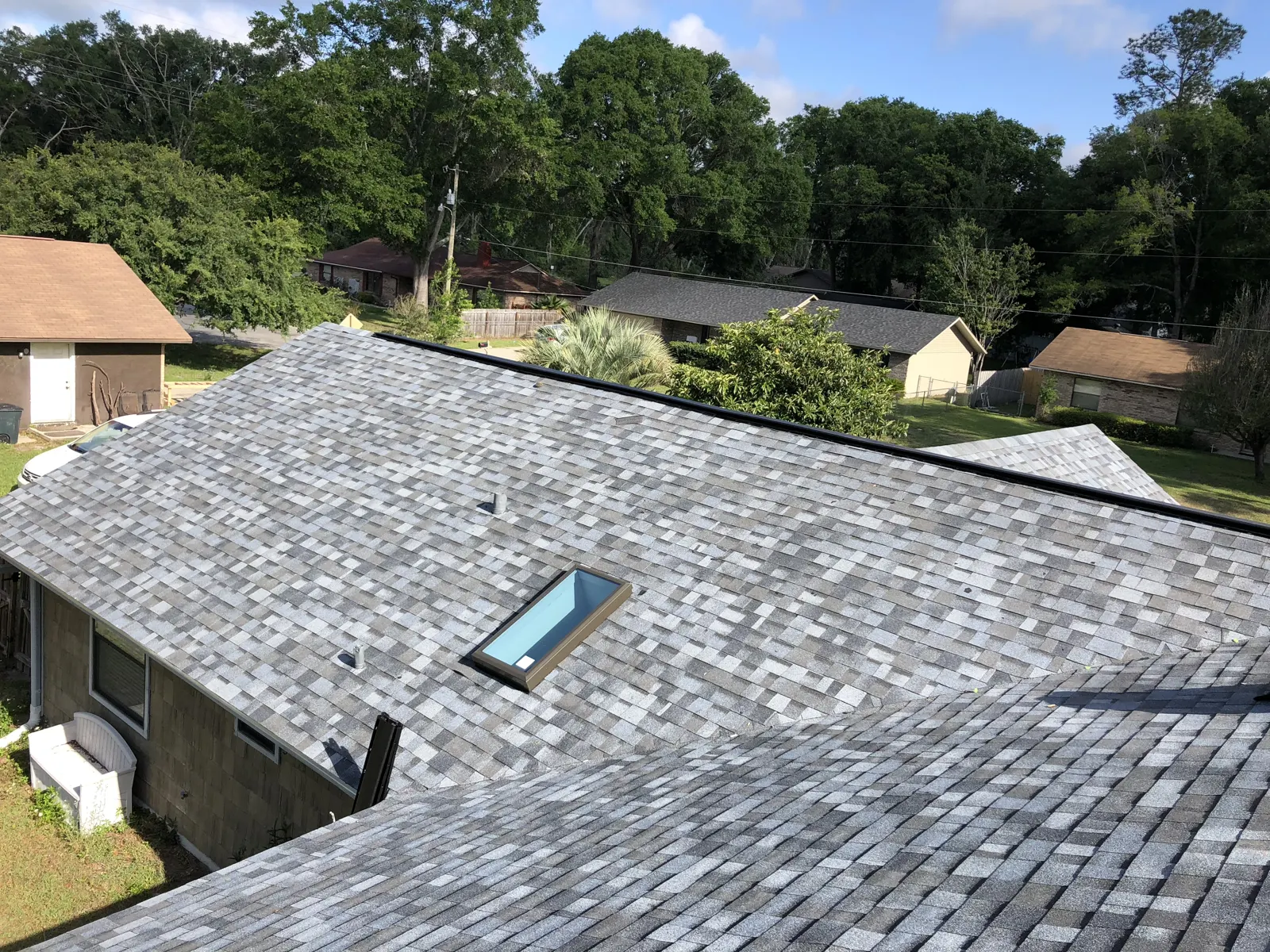
Gray shingle slope · Skylight and vent check
Hail Does Its Real Damage Where You Cannot See It
A hailstorm rarely punches a hole in a shingle. It bruises the mat underneath, knocks the granule coat loose, and leaves a roof that looks perfectly normal from the driveway and starts leaking two winters later. We find it, mark it, and prove it before the claim window closes.
What A Hailstone Actually Does To A Shingle
An asphalt shingle is three things stacked together: a fiberglass mat, asphalt saturating that mat, and a layer of ceramic granules on top doing the sunscreen job. Take away the granules and ultraviolet light starts eating the asphalt directly. That is why hail damage is so easy to miss and so expensive to ignore.
When a stone hits, it does two things at once. It knocks granules loose in a rough circle, and it fractures the mat underneath. Press a thumb into a fresh hail hit and it feels soft, like a bruise on an apple, because the fiberglass has broken and the asphalt around it has been driven down. That soft spot is the damage. It is not a hole, and water will not come through it this month. But the shingle has lost its ability to flex through Chicagoland freeze-thaw cycles, and within a season or two the fracture opens.
Why Invisible Hail Becomes A Winter Leak
Here is the timeline we see over and over in Cook County. Hail comes through in May. The homeowner walks the yard, sees nothing obviously broken, and moves on. Then November arrives, water sits in those fractures, freezes, expands, and pries the crack wider. Repeat that fifty times over one Illinois winter and a mat fracture becomes a split. The following spring somebody has a stain on a bedroom ceiling and no idea it started eighteen months earlier.
By then the claim is a fight. Most Illinois policies tie reporting to when the damage occurred, not when you noticed it, and carriers keep hail maps showing exactly which dates dropped stones on your zip code. If we inspect two years later, you are arguing about which of four storms did it and whether the roof was just old.
That is the reason to get up there after a hail event even when nothing looks wrong. An inspection costs you nothing and takes under an hour.
Test Squares And How We Prove It
An inspection that ends with somebody saying “yeah, you have hail” is worth nothing to an adjuster. The industry standard is the test square, and it is what we mark on every hail inspection:
- A ten by ten foot square chalked on each slope, marked at the corners so it photographs clearly.
- Every hail hit inside that square circled and counted. Most carriers work off a threshold of hits per square before they call the slope damaged.
- Squares on all four elevations, because hail comes in on a wind direction. The north slope can be untouched while the west slope is destroyed.
- Directional hits noted. Damage concentrated on one exposure with clean slopes elsewhere is the signature that separates real hail from foot traffic and manufacturing defects.
- Photos with a measuring device in frame so hit diameter is documented, not described.
The distinction that gets claims denied is hail damage versus wear. Blistering, which happens on aging shingles from trapped moisture, looks like hail to an untrained eye and gets an adjuster to close the file. Blisters are sharp-edged and empty. Hail hits are soft, bruised, and random in placement. We photograph the difference in a way that makes it obvious to somebody who was not on the roof.
The Soft Metals Tell The Truth
Shingles are debatable. Metal is not. Aluminum and painted steel record hail permanently, and adjusters know it. Before we ever look at a shingle we walk the soft metals.
Gutters and downspouts show dents you can feel with a flat palm. Aluminum fascia wrap dimples. Roof vents and turbine caps take clean round dings. Furnace stacks, valley metal, drip edge, condenser fins, even the grill lid on the deck all take the same beating. If your gutter run is dimpled along its whole length, no adjuster is going to argue that hail did not fall on your house that day.
We photograph all of it, and we do it before anybody replaces a bent gutter, which is the same rule that applies to all storm damage repair: document before you clean up.
Meeting Your Adjuster On The Roof
When your carrier sends somebody out, Angelo goes up with them. Not because adjusters are the enemy, most of them work from the same standards we do, but because a slope gets missed when one person walks a roof alone with a clipboard. Being up there together means the test squares are already chalked and any disagreement about scope happens face to face rather than in a letter three weeks later.
If the approved scope comes back short of what the storm actually did, we document the gap and file a supplement with photos. That process is spelled out on our roof insurance claims page. What we never do is inflate a count or add damage that is not there.
Repair, Or The Whole Slope
Light hail on a young roof with a handful of hits in one area is a repair: replace the damaged shingles, match as closely as the manufacturer allows, done. Widespread bruising across a slope is not repairable, because you cannot patch a mat fracture and you cannot selectively replace forty scattered shingles without breaking the seal on eighty more. At that point the honest answer usually means a full shingle roof replacement with the carrier covering the storm-related portion.
We tell you which one you have before you file anything. Finished hail work is in the gallery, and we run hail inspections regularly in Oak Lawn, Frankfort and Naperville after every spring event. Reach us on the contact page and we will get you on the schedule while the evidence is fresh.

Bruised slope stripped to underlayment
Before You File
Get the roof looked at first. Knowing whether you have a real claim beats filing one that gets denied and sits on your record.
Test squares on every slope, soft metal evidence photographed, Angelo on the roof with your adjuster. Inspection costs nothing.
(312) 590-4853How A Hail Claim Gets Built
Ground Walk
Gutters, downspouts, fascia wrap, vents and the condenser. Soft metals dent permanently and set the date of loss.
Test Squares
Ten by ten chalked on each slope, every hit circled and counted, measured photos on all four elevations.
On The Roof Together
Angelo meets your adjuster up top. Evidence is already marked, so scope gets settled there instead of by letter.
Repair Or Slope
Scattered hits get repaired. A bruised mat across the slope gets replaced properly, with the warranty in your name.
Related work: if the same storm brought wind, lifted tabs and creased shingles fall under wind damage repair. Water already inside means storm damage repair comes first. Once the carrier is involved, see roof insurance claims. We inspect after every hail event in Oak Lawn, Frankfort and Naperville.
Hail Damage Questions
The hail was pea sized. Can that really hurt my roof?
On a newer roof, usually not much. Most carriers start taking it seriously around one inch, and wind speed matters as much as stone size. On a fifteen year old roof with thin granule coverage already, smaller stones do real harm.
How can you tell hail damage from normal aging?
Hail hits are soft to the touch, roughly round, randomly scattered, and concentrated on the slopes facing the storm. Aging shows up as uniform granule loss, curling edges and blistering, spread evenly across every slope including the ones hail never touched. Directional concentration is the tell.
I found granules in my gutters. Is that hail?
Not by itself. Every asphalt roof sheds granules, heavily in its first months and steadily after that. What matters is a sudden pile after one storm when the gutters were clean before, especially alongside dented downspouts. Granules alone are a reason to look, not a diagnosis.
How long after a hailstorm can I still file?
That depends on your policy language, and Illinois carriers vary. Some hold you to a year or two from the date of loss, others are more flexible if the damage was genuinely hidden. Either way it gets harder the longer you wait. Call within weeks, not years.
Will filing a hail claim raise my rates?
Weather claims are generally treated differently from liability claims, and hail is usually rated regionally rather than against you personally, but we are roofers and not your agent. Ask your agent that question directly before you file. What we can do is tell you whether you have real damage, so you are not filing on a hunch.
Can you match my existing shingles for a partial repair?
Sometimes. Color lots shift, discontinued lines happen, and a ten year old roof has faded past anything new off the truck. We will show you the match before we install it. If the difference is going to be obvious from the street, we say so and talk about doing the whole slope instead, which many policies address under a matching provision.
Find Out What The Hail Actually Did
An hour on the roof tells you whether you have a claim, a repair or nothing at all. We will give you the honest version, including when the answer is that your roof is fine.