
Inspection walk · Every curb checked
Know What Your Roof Is Doing Before It Tells You
Two walks a year, spring and fall, with photos, moisture readings and a written picture of what needs money this year and what can wait. Property managers get something they can forward. Owners get a capital number that is real. Buyers and brokers get a certification on short notice.
Spring And Fall, For Good Reasons
Twice a year is the cadence that works in this climate, and the timing is not arbitrary. Chicagoland winters do specific damage, and Chicagoland summers do different damage, so you want eyes on the roof right after each one.
The spring walk is a damage assessment. Ice worked at every seam and flashing for four months, snow load flexed the deck, and freeze-thaw pried at anything that was already marginal. Whatever the winter broke, we want to find it in April when it is a repair, not in July when a summer storm turns it into an interior loss.
The fall walk is preparation. Drains and gutters get cleared before the leaves come down and block them. Open seams get sealed before they are under six inches of snow. Loose metal gets fastened before the first real wind event. Anything that needs doing gets done while it is still fifty degrees and the roof is dry, which is the last comfortable window we get.
What A Real Inspection Report Contains
Plenty of companies will “inspect” your roof for free and hand you a one-page sales pitch. That is not a report, that is a quote with a clipboard. Here is what you should get from an inspection worth paying for, and what we actually deliver.
- Photographs of every deficiency, keyed to a roof plan so you know where each one is. Not five hero shots, but documentation of each specific problem.
- Moisture readings where the surface suggests trouble, with core samples when readings say the insulation may be wet. Numbers, not guesses.
- Condition of each component listed separately: field membrane, seams, flashings, curbs, penetrations, drains, edge metal, parapets, hatches.
- Housekeeping and hazard notes. Abandoned equipment, debris, cut conduit, tools left by another trade, anything that will cause a leak or an injury.
- A prioritized action list split into three buckets: fix now, fix this year, and watch. So you know what is urgent and what is a line item for next year.
- A remaining-life opinion and a budget forecast, so you can plan a replacement year instead of being surprised by one.
That last piece is what building owners tell us they never get anywhere else. Knowing your roof has roughly six years left, and what a replacement costs at current prices, is the difference between a planned capital project and an emergency that eats a year’s maintenance budget.
Documentation Boards And Managers Can Use
If you manage property or sit on a condo board, you already know the problem: you need to explain a roof expense to people who have never been on the roof. A verbal report from a contractor does not survive that meeting.
Our reports are built to be forwarded. Clear photos, plain descriptions without trade jargon nobody outside roofing uses, and a cost picture that separates urgent from optional. Drop it into a board packet or an owner’s email and it holds up without you having to translate it.
Over a few years, that record is worth more than any single inspection. When you can show that the same seam has been photographed three times and is getting worse, the replacement decision makes itself, and nobody accuses anybody of guessing.
Pre-Purchase And Roof Certification Inspections
Buying a building, selling one, or closing a deal where the lender wants the roof signed off. That is a different job with a different clock, and it usually lands on someone’s desk with a deadline already attached.
We do these regularly and we move fast when a closing depends on it. A real estate broker came to us needing a roof certification on short notice for a deal in motion, and Angelo got up there and got it done in time. Real estate does not wait for a two-week scheduling queue, so we do not run one for these.
A pre-purchase inspection is more thorough than a maintenance walk because there is no history to lean on. We core the roof to find out how many systems are up there and whether the insulation is dry, check every detail, and give the buyer a straight remaining-life opinion and a replacement cost. If the roof is fine, you get that in writing. If it is three years from failing, you get that in writing too, and it becomes a negotiating number.
What A Program Actually Saves
Roof maintenance sounds like an expense until you price the alternative. A pipe boot that has split costs very little to replace during a scheduled walk. The same boot ignored for two seasons soaks insulation across a wide area, rusts the deck below, ruins ceiling tile and whatever sits under it, and turns into a section replacement plus interior repairs.
Roofs on a program also last longer on identical materials. Clear drains mean no ponding, sealed details mean no water under the membrane, and small repairs made on time mean the system reaches the age the manufacturer designed it for instead of dying early. Most manufacturer warranties also require documented maintenance, and plenty of owners find out about that clause at the worst possible moment.
Buildings we inspect also get faster help when weather hits. We already have the roof plan, the photos and the history, so when a storm comes through Cook County we know what we are driving to instead of starting from scratch. Full system work is on the commercial roofing page, and active water goes to commercial roof leaks.
We run inspection programs across the south and west suburbs, including Cicero, Harvey and Bensenville. Work we have documented is in the gallery, and you can get on the schedule through the contact page or by phone.
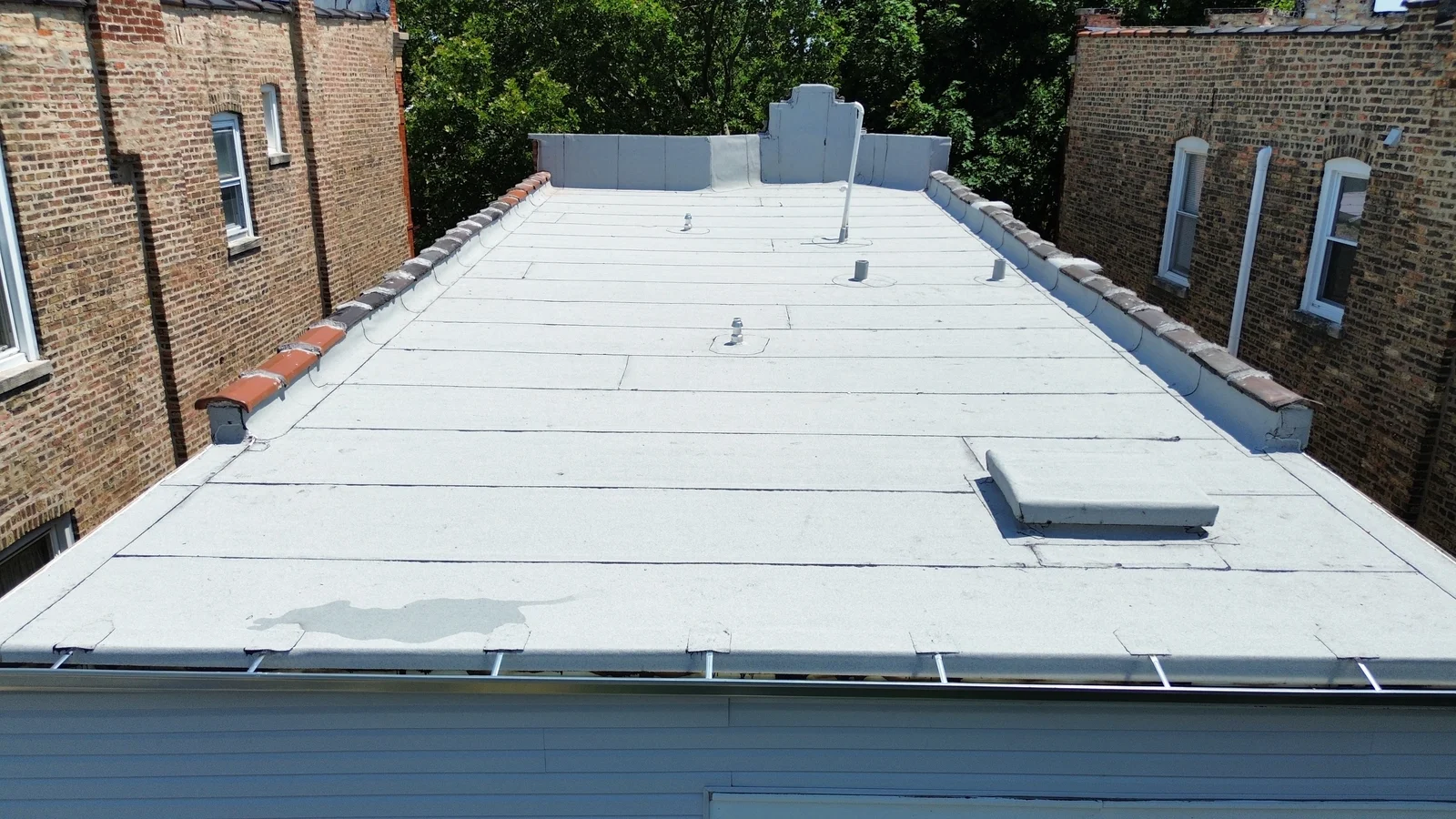
Hatch flashed, field sealed
The Short Version
Spring and fall walks. Photos keyed to a roof plan, moisture readings, prioritized action list, remaining-life and budget numbers.
Pre-purchase and certification inspections handled on short notice when a closing is waiting.
(312) 590-4853What An Inspection Looks Like
History First
Age, system, past repairs, known leaks. Ten minutes of file review saves an hour of guessing on the roof.
Walk Every Detail
Field, seams, curbs, penetrations, drains, edges, parapets. Photographed and located, not summarized.
Read The Moisture
Meter readings where the surface looks suspect, cores where the readings say the insulation may be wet.
Report And Prioritize
Fix now, fix this year, watch. Plus a remaining-life opinion and a replacement number for the budget.
Related work: everything we install is on commercial roofing, with low-slope detail on commercial flat roofs. Already leaking? Commercial roof leaks. Managing a building with tenants? Multi-family roofing. Inspections run regularly in Cicero, Harvey and Bensenville.
Inspection Questions
How often should a commercial roof be inspected?
Twice a year in this climate, spring and fall, plus a look after any severe storm. Roofs with heavy rooftop equipment or constant service traffic benefit from more, because every trade that goes up there is a chance somebody cut something and did not seal it.
Do you need roof access keys or an escort?
Tell us your access procedure and we follow it. Hatch, ladder, escort requirement, sign-in, certificate of insurance on file, whatever your building requires. We lock everything back the way we found it and confirm when we are off the roof.
Can you inspect a roof you did not install?
Most of the roofs we inspect were put on by somebody else. We report what is there honestly, including when the previous work was done well. An inspection that finds nothing wrong is a legitimate result and we will hand you that report without inventing a problem.
How fast can you turn around a roof certification for a closing?
Fast. We have done short-notice certifications for brokers with a deal on the clock. Call with the address and the date you need it by and we will tell you straight whether he can make it work.
Will you find things just to sell repairs?
No, and the report format is designed to make that obvious. Items are split into fix now, fix this year, and watch. If most of your list is in the watch column, that is what the report says. Manufacturing urgency would cost us the maintenance relationship, which is worth far more than one padded repair.
Does an inspection help with a manufacturer warranty?
Yes, and in many cases it is required. Most commercial membrane warranties oblige the owner to maintain the roof and keep records. Documented twice-yearly inspections are exactly the paper trail that keeps a warranty claim from getting denied on a technicality.
Put Your Building On The Schedule
Call with the address and roughly how big the roof is. We will tell you what an inspection covers, what it costs, and when he can be there. Closing on a deadline gets moved up.