
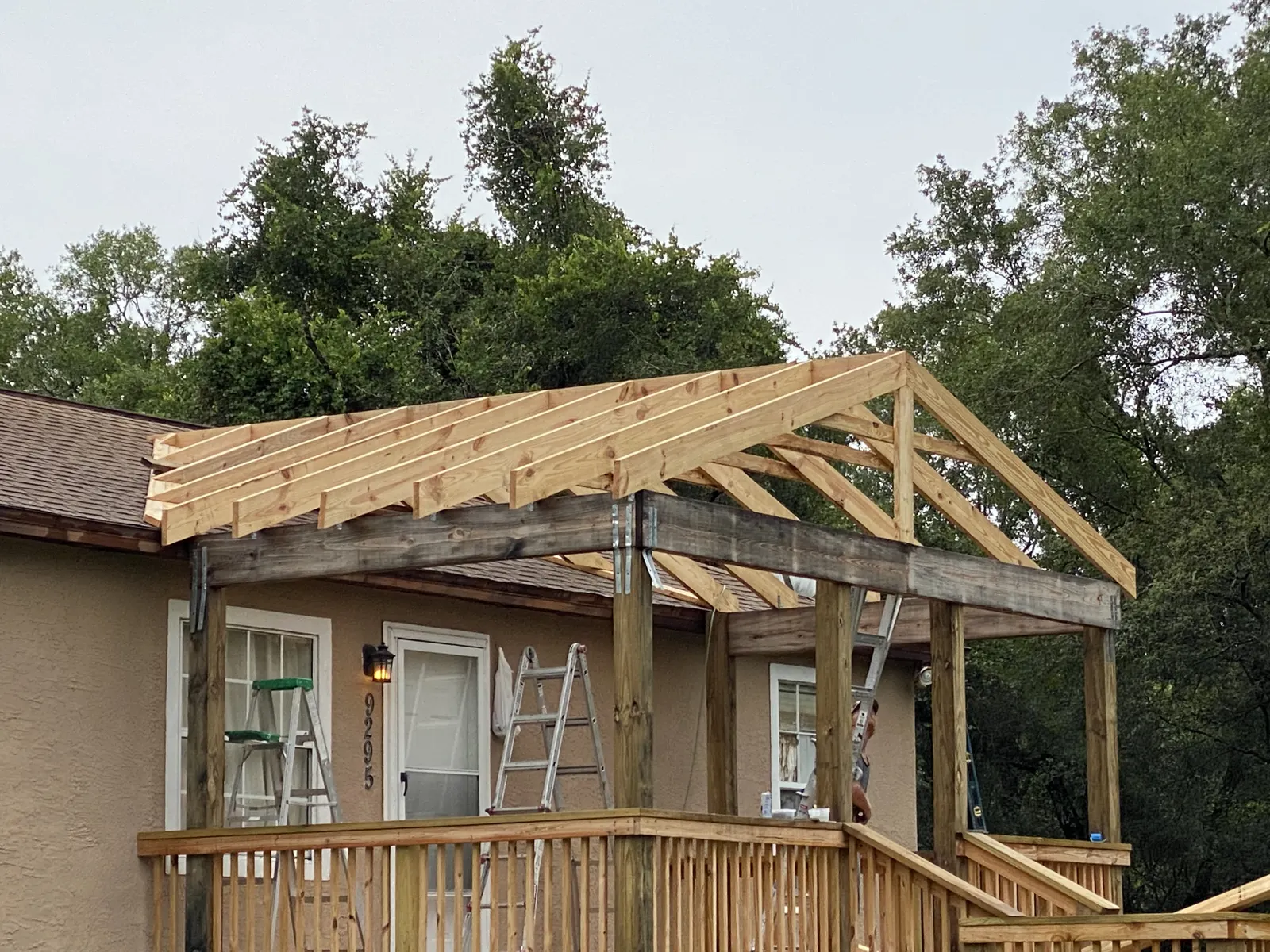
Framed back up before anything got covered
Wind Does Not Attack The Middle Of A Roof
It goes after the edges. Ridge caps, rake edges, the first course above a gutter, anywhere a shingle has a free corner it can get under. Measure the perimeter of a house out here and you have measured the part of the roof that is actually at risk, and on these rooflines that number is large.
Straight-Line Wind Out Of The West
Weather arrives here off open country with nothing in its way to slow it down. A straight-line blow out of the west goes for the ridge caps and the rake edges before it touches anything else, and a roof carrying that much exposed edge is handing it that many more places to start. Nearly every wind call we take up here fits that description, and it is worth unpacking because it explains why the damage looks the way it does.
Wind does not push a roof down. It pulls it up. Air moving fast across a slope drops in pressure over the surface while the attic underneath stays at ordinary pressure, and the difference lifts. On a sealed shingle field in the middle of a plane there is nothing for that lift to grab, so it does nothing. At a ridge, a rake, an eave or the edge of a dormer, the air has to change direction, the pressure spikes, and any shingle corner that is not fully bonded becomes a handle.
That is why one shingle missing at a rake edge is a much bigger deal than three missing in the middle of a field. The edge failure is the start of a zipper. Once the wind has a corner, the next storm takes the next one, and it works up the rake and into the field from there.
Ridge Caps Are The First Thing We Look At
Cap shingles sit on the peak folded over a ridge, exposed to wind from both sides at the highest point on the house, and they are held by less than anything else on the roof. On a Barrington house with multiple intersecting gables there is a lot of ridge, and hips too, and every one of those lines is a row of caps.
What we find after a blow, in roughly this order:
- Caps lifted and reseated crooked, still up there but no longer sealed, which the homeowner cannot see from the ground at all.
- Caps gone entirely, leaving the nail line and the top course of the field shingles open to whatever comes next.
- Rake edge shingles peeled back in a stair pattern climbing the gable end.
- The starter course above the gutter lifted, which is the one that matters most because everything above it was relying on that bond.
- Ridge vent sections pried loose or shifted sideways along the peak.
None of that leaks immediately in dry weather. It leaks the next time it rains hard with wind behind it, which around here is usually soon.
Cedar Lifts, And Then The Underlayment Starts The Real Damage
A lot of the estate stock west and north of town was built or reroofed with cedar shakes, and wind treats them differently than it treats asphalt. Cedar in northern Illinois cups, splits and grows moss on the north-facing planes as it ages, and a cupped shake is already lifted at the butt before the wind ever arrives. The storm just finishes the motion.
What follows is the part owners do not expect. A missing asphalt shingle exposes underlayment that is designed to be a secondary barrier for a while. A lifted or missing shake exposes whatever is under a cedar roof, and on the older installations that is felt over spaced sheathing with gaps between the boards. Wind gets under the felt, tears it along the board gaps, and now water has a straight path to the attic through openings that were never meant to be closed by anything except the shakes themselves.
So on a cedar roof after a wind event we are not only counting missing shakes. We are looking at what is left holding water out, and that assessment is frequently the thing that turns a repair conversation into a conversation about the cedar-to-architectural conversion that most of these roofs eventually need anyway. That job lives on shingle roof installation.
Three In The Morning Is A Tarp, Not A Scope
Failures that happen at three in the morning get patched first, with the scope figured out afterward. There is no version of that call where somebody stands in your driveway with a clipboard measuring the house while water runs into the second floor.
A night response is narrow on purpose. Get up there safely, get the open area covered and fastened so it survives the rest of the storm rather than becoming a sail, get anything loose off the roof so it does not end up through a window, and get out. Our tarping and emergency patch service reaches this town on the same terms as the suburbs nearest the shop. Daylight is when we actually read the roof: walk every plane, count what came off, photograph it, write the scope.
Owners sometimes worry the emergency work will complicate an insurance claim. It does not. Stopping water from entering the building is the thing you are supposed to do, and the photographs we take before and during the tarp are part of what documents the loss in the first place.
Matching A 1990s Second Roof, Or Redoing The Slope Whole
Barrington has a lot of houses from the 1990s and 2000s that are now on their second roof, and a wind repair on one of those turns into a matching problem fast. Asphalt shingle lines change. Colors get discontinued, blends get reformulated, and the same product name from twelve years ago is not the same shingle today. On top of that, the shingles already on the house have weathered, so even a perfect color match out of the wrapper reads lighter than its neighbors.
When damage is scattered across a slope in small amounts, we will usually pull replacement material from a less visible plane and put the imperfect match where the house does not show it. That trick works once or twice on a roof, not forever.
When a slope lost its rake edge and a stack of courses with it, redoing that whole plane is frequently the more honest answer. You get a uniform surface with a clean edge detail instead of a patched seam running up the most wind-exposed part of the roof. We tell you which one we are recommending and why, with the shingles in hand, standing on the roof. A straight price follows the decision, not the other way around. Storms that brought stones as well as wind get read differently, and that walk is on hail damage repair.
Wind Scatters The Job Before We Get There
What separates a wind call from ordinary roof work is that the mess arrives first: shingles, caps and torn felt are already spread across the lawn, the beds and the drive by the time we pull up, so picking the property clean is part of the repair rather than something that happens at the end of it.
When The Wind Damage Becomes A Claim
Not every wind repair is worth putting through insurance and we will say so. A dozen caps off a ridge is often a straightforward repair. A slope stripped along the rake, a torn underlayment field, or damage on several planes at once is a different size of problem.
What carries a wind claim is the same thing that carries a hail claim: photographs taken the way an adjuster needs them, slope by slope, with the plane identified and the missing or lifted material visible in context, plus a written scope that says what the repair actually requires rather than a number on a page. We photograph before the tarp goes on, during, and again in daylight, because a claim filed a week later still needs to show what the roof looked like the night it happened.
We are not your adjuster and we do not tell anybody what a loss is worth. We document it and we stand on the roof with the adjuster when he comes out. The full walk-through of that process is on roof insurance claims. Finished work is in the gallery, and photos of your damage can come straight to us through the contact page. Wind work across the rest of the map is on the wind damage repair page.

Where Wind Takes A Roof
Ridge caps, hip lines, rake edges, the starter course above the gutter, ridge vent sections and lifted cedar with torn felt underneath.
Tarped at night, walked and photographed in daylight, priced once we know what the whole roof lost.
(312) 590-4853Why Barrington Waits For A Run
Non-urgent wind work rides the grouped schedule out of our Alsip shop, so a crew is already up this way for the week and the drive costs you nothing. A roof that is open does not wait for it.
How A Wind Call Runs
Stop The Water
Open areas covered and fastened so the tarp survives the rest of the storm. Loose material off the roof before it goes through glass.
Walk It In Daylight
Ridges, hips, rakes and eaves on every plane. Lifted caps count the same as missing ones.
Check What Is Under It
Torn felt, split sheathing or a wet deck changes the repair from shingle work into carpentry. We look before we quote.
Repair Or Redo The Plane
Scattered loss gets matched material. A stripped rake usually gets the whole slope, and we say which before we start.
If the same storm brought stones, start at hail damage repair. Gutters torn loose or overflowing go to gutter repair, a slope past patching becomes shingle roof installation, and the claim itself runs through roof insurance claims. The whole picture of what we do up here is on the Barrington page.
After The Wind Comes Through
Only a few shingles came off. Can that really matter?
It matters a great deal when they came off an edge. Wind works by lifting, and it needs a free corner to grab. One shingle gone at a rake or a ridge gives the next storm a handle, and the loss works its way up the edge and into the field from there.
Nothing is missing but the ridge looks a little crooked. Is that damage?
Very likely. Cap shingles get lifted and dropped back down out of line, still on the roof but no longer bonded. From the ground that reads as cosmetic. On the roof it is an unsealed seam at the highest point of the house waiting for the next hard rain with wind behind it.
Will a tarp hurt my insurance claim?
No. Stopping water from entering the building is what you are supposed to do, and it is usually expected of you. We photograph before the tarp goes on, during, and again in daylight, so the emergency work documents the loss rather than hiding it.
My cedar shakes lifted but did not blow off. Is that a repair?
Depends on what is underneath. Old cedar was laid over spaced boards with felt between, and once wind gets under that felt and tears it along the gaps, water has a path the shakes were supposed to close. We look at what is left holding water out before we answer.
Can you match shingles on a roof put on in the 1990s?
Sometimes closely, rarely perfectly. Shingle lines get discontinued and blends get reformulated, and the material already on your house has weathered besides. When the loss is scattered we often pull matching shingles from a hidden plane and put the imperfect match where nobody sees it.
Something Came Off Last Night
Tell us what you can see from the ground and which direction the wind came from. If water is getting in, we cover it first and read the roof in daylight. You will get a real number once we know what the whole roof lost, not before.