

New membrane, clean field
TPO Membrane Roofs Installed Weld By Weld
Flat roofing is what this shop is built around. A TPO system is only as good as the insulation under it, the substrate it sits on, and the hot-air welds that tie the sheets together. We do all three the long way, and we run a probe over every seam before we hand the building back.
What TPO Actually Is
TPO stands for thermoplastic polyolefin. It is a single-ply sheet, usually white, with a polyester scrim reinforcement running through the middle. That scrim is why a TPO sheet resists tearing when a hailstone hits it or a foot lands wrong. The sheets come in rolls, rolled out across the roof and joined at the overlaps.
The joining is the whole story. A TPO seam is not glued and it is not taped. It is heat welded: a robotic welder or a hand gun runs down the overlap at a set temperature and speed, melting the two sheets into one another so the sheets fuse chemically. Done at the right temperature, the seam is stronger than the field of the sheet itself.
The alternative on older systems was a glued lap. Adhesive seams depend on a chemical bond holding across freeze cycles, UV exposure, and slight sheet movement. In Chicagoland they eventually stop holding. A welded seam has no adhesive layer to fail: the two sheets became one sheet.
Why White Membrane Earns Its Keep In Chicago Summers
A black roof surface in July in this region reads 160 to 180 degrees on an infrared gun in mid afternoon. A clean white TPO surface on the identical building reads 90 to 110. Every degree the roof deck does not absorb is heat that never gets into the top-floor ceiling plenum, and every hour your rooftop units are not fighting a superheated deck is compressor runtime you do not pay for.
Building owners with a top-floor tenant notice it first, usually as fewer complaints from the people working directly under the deck. Owners with rooftop condensing units notice it second, on the July and August bills. There is a longevity angle too: membranes that run cooler age more slowly.
The tradeoff people ask about is winter. Does a reflective roof cost you heat in January? Marginally, and far less than the summer savings. Any real thermal control in winter is happening in the insulation layer, not at the surface.
Insulation And Substrate: The Part Under The Sheet
The membrane keeps water out. The insulation package does everything else, and it is where a cheap flat roof bid hides its shortfall. We spec polyiso board to the R value the code and the building actually call for, laid in two staggered layers wherever the thickness allows so no board joint runs straight through to the deck. Single-layer insulation with aligned joints is a thermal shortcut and a condensation risk.
Over the polyiso goes a cover board, usually a high-density gypsum or a coated fiber panel. It gives the membrane a hard surface so foot traffic does not dish the foam, and it gives fasteners or adhesive a better substrate to grab. Skipping it saves money on install day and shows up five years later as a soft, dimpled roof that punctures the first time a service tech drops a wrench.
Before any of that, the deck itself gets read: metal deck for rust-through at the flutes, concrete for spalling and moisture, wood for rot at the perimeter and around old drains. Wet insulation from a leaking prior system has to come out, because laying new board over saturated old board traps that water permanently.
- Deck inspected and repaired before insulation goes down, with photos of anything we replace.
- Polyiso to spec, staggered joints, tapered packages where drainage needs building.
- Cover board over the foam so the membrane has something solid under it.
- Attachment chosen for the deck type and the wind zone, not for whichever is faster.
- Hot-air welded seams at controlled temperature, hand welded at every detail a robot cannot reach.
- New metal edge, new pipe boots, new curb and unit flashings. Reusing old sheet metal is how a two-year-old roof leaks.
Drainage Gets Designed, Not Assumed
Flat roofs are not flat. They are low slope, and if the slope is not there, standing water sits. Ponding water on TPO collects grit, grows algae, magnifies UV, and in a Chicago winter it freezes into a plate of ice that flexes seams every thaw. On an installation we check where water actually goes, not where the drains say it should. Sometimes the fix is a tapered insulation package building crickets between drains, sometimes a new drain or an added scupper.
Attachment, Wind, And Why Chicago Is Different
This is a wind town, and a low-slope roof is a wing when the pressure gets under it. Perimeter and corner zones see multiples of the uplift the field of the roof sees, so those zones get tighter fastener patterns or heavier adhesive coverage. On a fully adhered system the whole sheet is bonded, which costs more and performs better on tall or exposed buildings. We will tell you which we are proposing and why before you sign anything.
Thickness, Warranties, And What Actually Gets Registered
TPO comes in 45, 60 and 80 mil. Sixty mil is the sensible baseline for most Chicagoland commercial work. Eighty mil is worth the money on roofs that see regular foot traffic, on restaurants with grease exposure near exhaust, and on buildings where a service crew is up there monthly. Forty-five mil belongs on light-duty applications, and we will say so rather than quietly bidding the thin sheet to win a number.
Manufacturer warranties on TPO run in the fifteen to thirty year range depending on system, thickness and inspection. They only hold if the roof was installed to spec by a crew the manufacturer recognizes: welds within spec, correct fastener density, approved details at every penetration, and the paperwork filed. We register yours in your name and hand you the documentation.
Owner On The Roof, Second Generation
Angelo Ristich learned this trade from his father Frank, and he supervises flat roof work personally. On a commercial install that matters more than it does on a house: nobody in the building can see the roof, so the only guarantee that the details were done right is the person standing there while they were done.
Look at finished flat roof work in our gallery, or reach out through the contact page and we will walk your building.
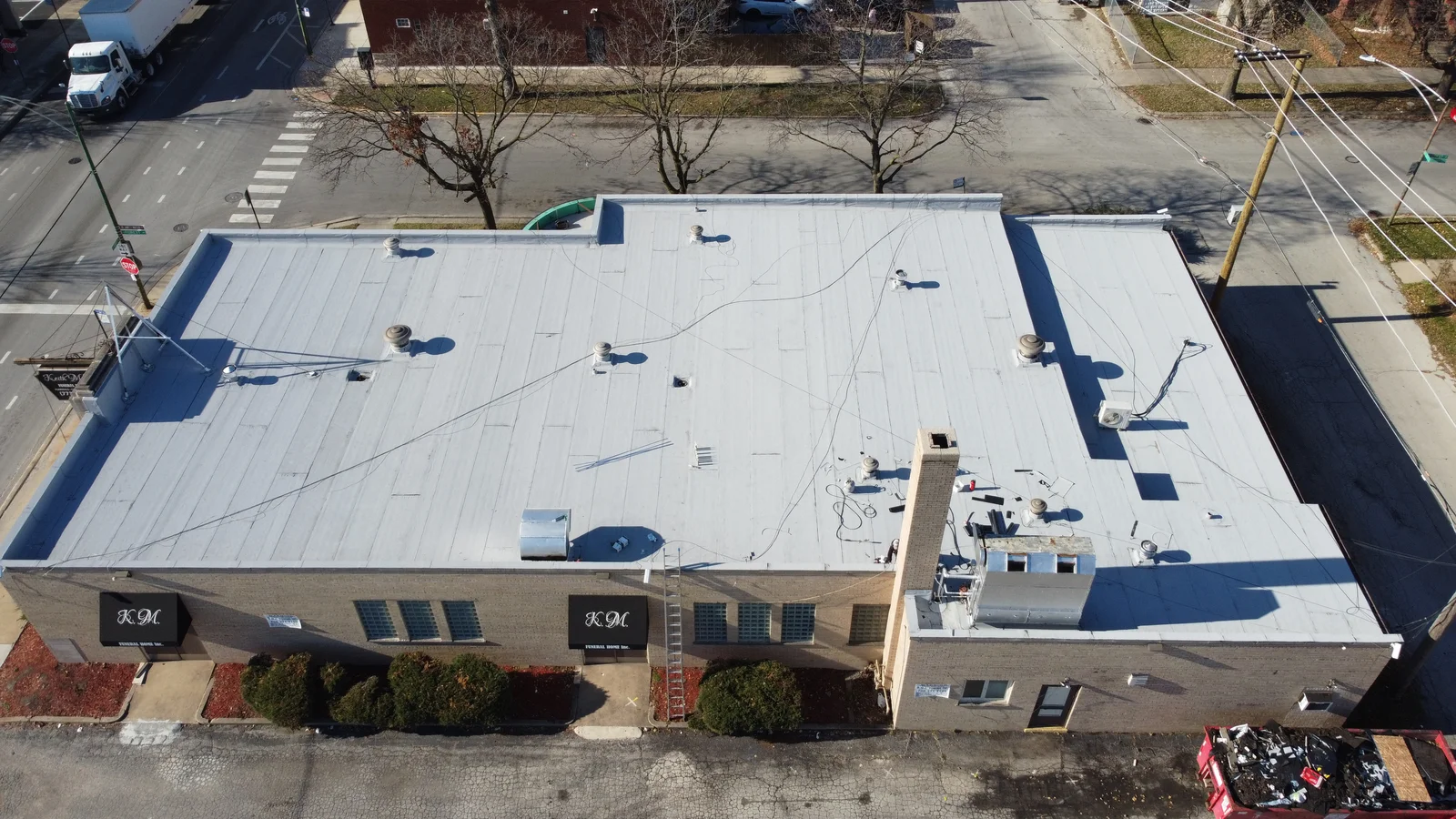
Commercial field, coated end to end
The Short Version
Heat-welded seams, never glued laps. Polyiso to spec with a cover board over it. New edge metal and new flashings at every penetration.
45, 60 or 80 mil chosen for the building’s real traffic. Warranty registered in your name.
(312) 590-4853How An Install Runs
Read The Building
Deck type, drainage, wind exposure, rooftop equipment. Satellite measurements get you a real number fast, then we walk it.
Strip And Dry In
Old system off, wet insulation out, deck repaired. We open only what we can close and dry before weather turns.
Build The Assembly
Polyiso staggered, cover board down, membrane laid and welded, edge metal set. Angelo on the roof for the details.
Probe And Register
Every seam probed by hand, drains cleared, roof walked with you, manufacturer paperwork filed in your name.
Related work: already have TPO that is holding up but leaking somewhere? Start at TPO roof repair. Old membrane at the end of its run? TPO roof replacement. Bigger picture on low-slope work: commercial flat roofs and flat roofing installation. We install membrane roofs regularly in Cicero, Bensenville and Romeoville.
TPO Install Questions
How is TPO different from EPDM rubber?
EPDM is black rubber with glued or taped seams. TPO is a reinforced thermoplastic sheet with heat-welded seams and a reflective white surface. EPDM still has its place, but on most Chicagoland low-slope work the welded seam and the summer heat reflection put TPO ahead.
Which mil thickness should my building get?
Sixty mil is the sensible default. Go to 80 mil if the roof sees regular foot traffic, if there is kitchen exhaust or grease exposure, or if service techs are up there monthly. We only put 45 mil on light-duty applications, and we tell you when we are proposing it.
Can TPO go over the existing roof instead of a tear-off?
Sometimes. Code allows a limited number of roof layers, and a recover only works when the existing system is dry and sound. See our TPO roof replacement page for how that decision gets made.
How long does a commercial TPO install take?
Depends on square footage, tear-off depth and how much rooftop equipment has to be flashed around. A small commercial building is often under a week. Larger buildings get staged in sections so we never leave open deck overnight.
Does my business have to shut down during the install?
Almost never. We stage in sections, coordinate the loud work and any crane time with your schedule, and keep entrances and parking clear. Fastening noise is real inside, which is why we plan that phase around your hours instead of ours.
Do you handle buildings outside Alsip?
We run flat roof work across Chicagoland within about 50 miles, covering Cook, DuPage and Will counties. Buildings in Chicago and the surrounding suburbs are the bulk of our low-slope schedule.
Put A Real Number On Your Flat Roof
Call Guardian Roofing, tell us the square footage and what is on the roof now, and get a realistic range while you are on the phone. If your existing membrane has years left, we will tell you that instead of selling you a new one.