
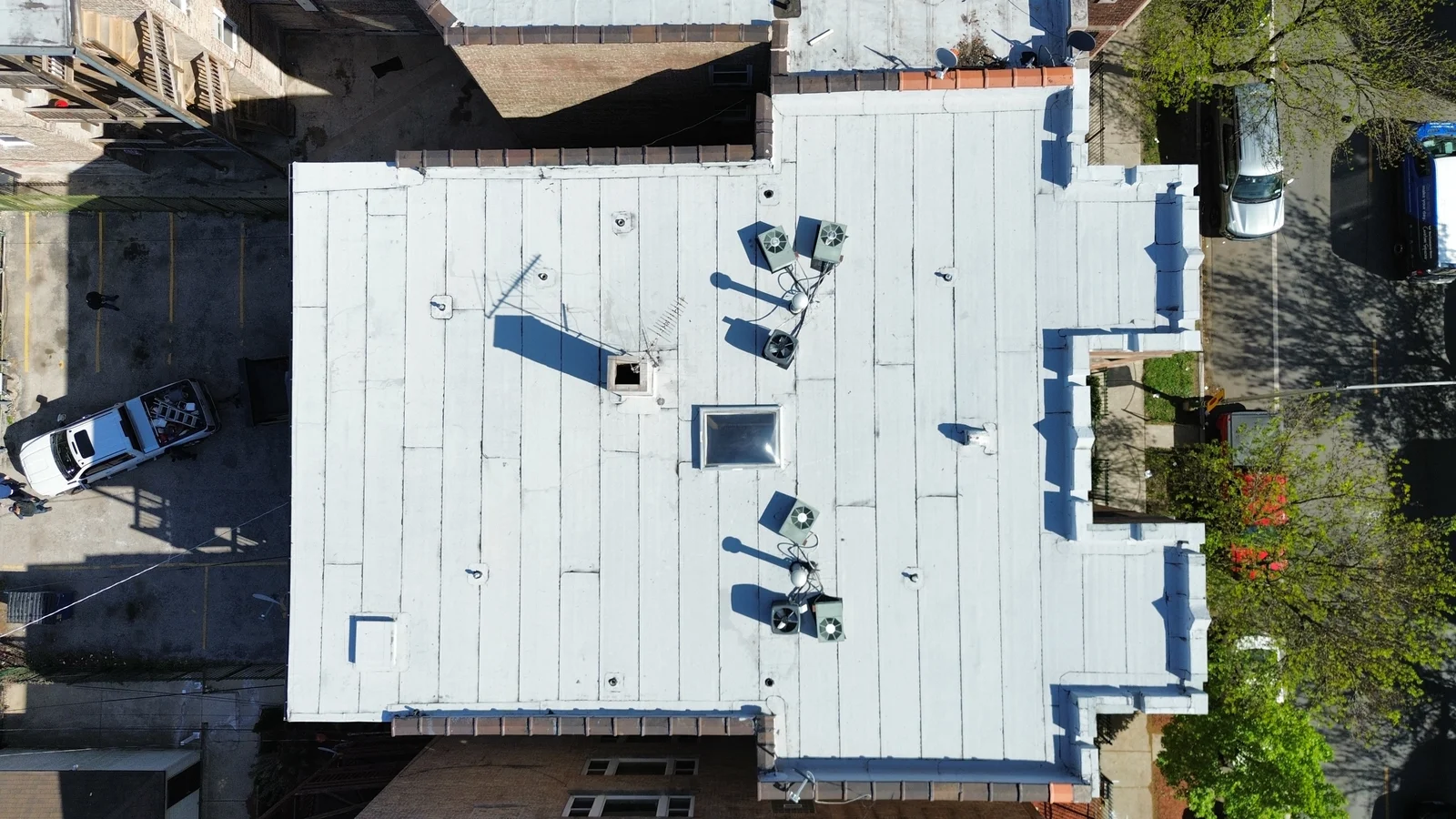
Four condensers on one building roof
One Roof Over Every Unit In The Building
If you own a multi-unit brick building, the roof is shared in the most literal way. A leak over the top floor turns into a tenant call, a ceiling repair and sometimes a second apartment on the way down. We plan these jobs around the people living underneath and report to the owner in photographs, whether you live in the building yourself or somewhere else entirely.
Roofing Over People Who Live Underneath
A house roof affects one household. A building roof affects every unit under it, and those tenants keep living there while the work goes on. So planning starts with the owner, before any material is ordered: which days we will be on the roof, and how the crew gets up there without disrupting anyone more than it has to.
On most of these buildings the way up is a roof hatch, sometimes at the top of a shared stairwell and sometimes through a top-floor unit. We settle access with you ahead of time so no tenant is surprised by a roofer at the door. Floors get covered where tools and material pass through, and the hatch is closed and checked every time we leave, because a hatch left loose becomes the next leak.
Keeping units dry during the job is the other half. We open only as much roof as we can close again before the crew leaves, and if weather turns, sealing the open section comes ahead of everything else. You get the work days in advance so a notice can go up in the hallway.
Parking matters too. A dumpster and a material delivery both need somewhere to sit, and on a building with tenant parking we sort that out with you in advance instead of leaving it to the crew on the morning of.
A Condenser For Every Unit
Look down on the roof of a multi-unit building and you will often see what the photo at the top shows: a set of air conditioning condensers, one per apartment. Each has its own line set running into the building, its own penetration through the roof and its own stand or pad. Each of those is a place water can get in.
We check every penetration, reseal or reflash the ones that are failing, and keep the line sets clear of the new surface. When a condenser stand sits on worn roofing, you hear about it before the job starts, so it can be planned with whoever services the units instead of discovered on the day.
Skylights and vents get the same treatment. Every hole through the roof is counted, photographed and flashed, since a building with one condenser per unit simply has more of them than a house does.
Parapets, Coping And Wet Brick
Brick buildings like these finish at parapet walls capped with clay tile coping, the same coping you can see around the edge in both photos on this page. The flat roof turns up the inside of that wall, and counterflashing cut into the mortar covers the top of the turn.
Old mortar loosens, and the counterflashing loosens with it. Brick here is porous, so water that slips behind that flashing or through a cracked coping joint travels inside the wall cavity and shows up a floor lower, often in a unit that seems to have nothing to do with the roof. A tenant reports a bedroom stain, and the actual cause is up at the parapet.
On every building we check the coping joints, the counterflashing and the base of each wall, and we photograph the masonry so you know whether a mason should be part of the fix along with the roof.
Coating The Field Or Tearing It Off
Not every building roof has to come off. When the membrane is still attached, dry underneath and worn only at the surface, a restoration coating over the field can keep it working without a tear-off, which also means no debris carried down past the tenants. The white roof in the second photo is that kind of job, coated wall to wall inside its parapets. When cores or soft spots say the insulation under a building roof is wet, coating over it only hides the problem, and you hear that from us before any coating is quoted.
Reports For An Owner Who Is Not There
Plenty of building owners do not live on site. You still need to know what is happening on top of your property, so you get pictures: the roof before we start, what turned up once the old surface was open, and the finished roof. Each set comes with plain sentences about what it shows, ready to pass to a business partner or your property manager without any translating. Kept on file, those dated pictures also answer the question the next time a buyer or an insurer asks about the roof.
If you want to see it in person, Angelo will meet you at the building and walk it with you.
When A Leak Starts At The Wrong Hour
Roofs do not leak on a schedule. Guardian provides emergency patch response when storms hit, and one of our Google reviews comes from Jimmy Proctor, whose Chicago three-flat began leaking on a Friday night. Our crew was out the following morning in a blizzard, shoveled the ice clear and patched it. A temporary patch like that buys the tenants a dry ceiling until the permanent repair can be done properly.
Guardian is family-run and second generation. Angelo Ristich took over the company from his father Frank, modernized it, and still deals with owners directly. Our multi-family roofing page covers the service across the area, the gallery has finished work, and the contact page is the place to send the building address.

White coating inside the parapet
Where Building Leaks Begin
Condenser line sets. Cracked coping joints. Loose counterflashing at the parapet. A hatch that does not close tight.
For The Owner
Access worked out before the first day. Units kept dry while the roof is open. Pictures at the start, the middle and the finish.
A rough number by phone from satellite measurements, confirmed on the roof.
(312) 590-4853How A Building Job Runs
Plan With You
Work days, hatch access and tenant notice settled before material is ordered.
Check The Edges
Parapets, coping, counterflashing and every condenser penetration looked over.
Close What We Open
No section left exposed when the crew goes home.
Report Back
Photos and plain notes sent to the owner, wherever the owner lives.
Nearby pages for the village: a house with a worn-out back roof goes to flat roof replacement, and an addition that never had a membrane goes to flat roof installation. Food-service buildings are on restaurant roof repair, larger business roofs on commercial flat roofs, and everything else we do here starts from the Bellwood page.
From Owners Of Multi-Unit Buildings
Do tenants have to leave while the roof is replaced?
No. People stay in their units. The work is noisy during the day, so we give you the schedule to pass along, and we only open as much of the roof as the crew can close before leaving. If weather turns, the open section gets sealed before anything else happens.
How do you get onto the roof?
Usually through the roof hatch, which on many buildings means going through a stairwell or a top-floor apartment. We arrange access with the owner in advance, cover floors along the route and close the hatch properly at the end of each day so it does not start leaking itself.
Why is water showing up on a lower floor and not the top?
Porous brick lets water travel. Once it gets past loose counterflashing or a cracked joint in the coping, it can run down inside the wall cavity and come out a floor lower. The stain tells you there is a leak somewhere, and the parapet is often where it started.
Do the rooftop condensers have to come off?
Not always. Each unit’s line set and penetration gets checked and sealed, and condensers on stands can often be worked around. If one has to be moved so we can roof underneath it, you know before the job starts, so whoever services the units can be scheduled.
I do not live in the building. How will I know the work was done?
Through photographs. You get the roof before work starts, the problems found once the old surface is open, and the finished roof, each with a short written description. If you would rather see the building yourself, Angelo will meet you there and go up with you.
What if a leak starts at night or on a weekend?
Call us. We provide emergency patch response when storms hit, and a temporary patch can keep water out of the units until the lasting fix is in. One review describes a crew arriving in blizzard conditions the morning after a Friday night leak on a three-flat.
Put The Building On Our Schedule
Send the address and what has been happening: which apartments have stains, how old the roof is if you know, and whether anyone has worked on the parapets or the coping recently. Tenant photos of ceiling stains are useful too. If a tenant has already reported a leak, tell us which unit and which room.
Angelo will walk the roof with you or your manager, and you get a straight price for the building. Guardian is licensed and insured in Illinois, BBB A+ rated, and a HomeAdvisor Elite Service award holder.