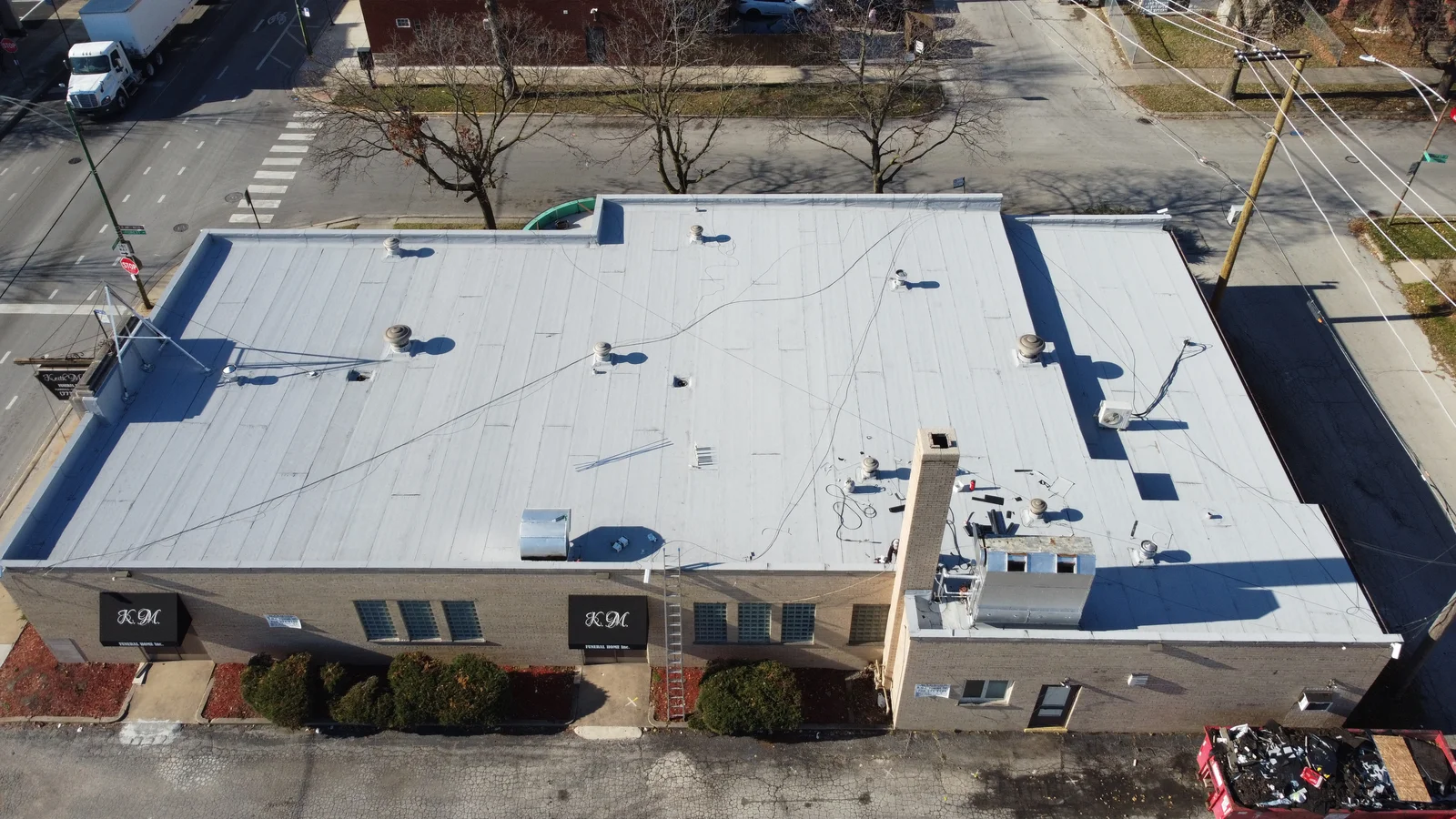
Commercial field, coated end to end
Flat Roofs Are A Drainage Problem First
Flat roofs are our specialty. Not because the membrane is hard to install, but because the parts nobody thinks about decide whether the roof lasts: where the water goes, how much insulation sits under it, and whether the system matches how the building is used. We get all three right before we roll anything out.
Nothing Is Actually Flat
A flat roof is not flat. It is low-slope, built to shed water toward drains or scuppers at a quarter inch of fall per foot. When that slope is right, water is off the roof in an hour and the membrane spends its life dry. When it is wrong, water sits, and standing water is what kills commercial roofs in Chicagoland.
Ponding does three things, all bad. It loads the deck with weight, roughly five pounds per square foot for every inch of depth. It bakes the membrane under a magnifying lens of water all summer. And in our winters it freezes, expands, and works at every seam it is sitting on. If you can see dirt rings on your roof after a dry week, you have ponding, and no membrane brand is going to save you from it.
Fixing Drainage, Not Just Covering It
Before we quote a new system we figure out where the water is failing to go. Sometimes it is simple: drains clogged with gravel and leaf litter, or a scupper the size of a mail slot serving half a roof. Sometimes it is structural, a deck that sagged between joists years ago and now holds a puddle every time it rains.
Tapered insulation is how we solve most of it. Polyiso board cut in a slope, laid out in a pattern that builds fall toward the drains, so the new membrane sits on a surface that actually sheds. It costs more than flat board on day one. It also stops the roof from dying ten years early, and it usually improves the building’s insulation value at the same time, which shows up on the heating bill in February.
- Tapered crickets between drains and behind curbs, so water gets pushed around rooftop units instead of pooling behind them.
- Drain sumps set properly, with the membrane dropped into the bowl rather than bridged over it.
- Additional drains or overflow scuppers where the original design was short, which is common on older Chicago industrial buildings.
- Deck repair where sag is structural, because insulation cannot fix a broken joist.
Picking A Membrane By How The Building Is Used
The three low-slope systems we install most all work. They fail in different ways, though, and the building tells you which one to use.
TPO is the default for open roofs on warehouses, retail and offices. White surface, heat-welded seams, and the reflectivity knocks real money off summer cooling on a big footprint. It is less happy on a roof with constant foot traffic and dozens of penetrations, because every detail is a weld somebody has to get right.
EPDM is rubber, and rubber moves. On buildings where thermal movement is the enemy, or where the roof has odd geometry and lots of transitions, EPDM handles it without splitting. It is black, so it does not give you the cooling benefit, but for a shaded roof or a building where winter heat retention matters more, that is a fair trade.
Modified bitumen is the choice when people walk on the roof. Restaurants with cooks going up to the exhaust hoods weekly, buildings with service techs on the units every month, roofs with decks and equipment. Multiple plies of asphalt sheet take abuse that a thin single-ply will not. Balcony roofs on Chicago apartment buildings get mod-bit for exactly this reason.
When A Coating Beats A Replacement
Restoration coatings are the most misunderstood product in commercial roofing. Sold wrong, they are paint over a dead roof and a waste of the owner’s money. Used right, they are the best value in the trade.
The test is whether the insulation under the membrane is dry. We take core samples and moisture readings. If the roof is wet underneath, no coating helps, and anyone who tells you otherwise is selling you two years. If the substrate is dry and the membrane is intact but aging, a silicone coating over prepped seams and details gives you real waterproofing, a reflective surface, and often a renewable manufacturer warranty for something in the range of half the cost of a tear-off.
The economics get better on big roofs. A tear-off on a warehouse means disposal of the old system, days of exposure, and a lot of labor. A coating goes on over a weekend with no open roof and no dumpster full of wet insulation. For an owner watching a capital budget, that difference is the whole conversation. We tell you honestly which category your roof falls into, because coating a wet roof comes back on us either way.
What Chicagoland Does To Low-Slope Roofs
Snow load is the obvious one. A flat roof holds every inch that falls, and a wet spring snow can put serious weight on a deck that was engineered decades ago. What does more damage is the freeze-thaw cycle underneath it: meltwater runs to the low spot, refreezes overnight, and pries at seams and flashings a fraction at a time all winter.
Then summer flips it. A black membrane on a July afternoon in Cook County runs well over 150 degrees at the surface. That heat cycling ages asphalt products, dries out sealants and works fasteners loose. A roof here sees a temperature range of roughly two hundred degrees across the year, and every detail on it has to survive that.
Which is why we do not do thin details. Extra plies at the curbs, proper termination bar at the walls, metal edge that is fastened rather than glued, and pipe boots that get replaced instead of caulked. Those are the spots that leak first, and they take five minutes longer to do right.
We work low-slope roofs across the south and west suburbs, regularly in Harvey, Romeoville and Joliet. Flat roof work we have finished is in the gallery, and if you want a specific opinion on your building, send the address and square footage through the contact page.

Before and after, one frame
The Short Version
Drainage first, then membrane. Tapered insulation to build real fall. TPO, EPDM or mod-bit chosen by how the building gets used.
Core samples and moisture readings before we recommend a coating. Dry substrate or no coating.
(312) 590-4853How We Approach A Low-Slope Roof
Read The Water
Where it ponds, where it should go, whether the drains and scuppers can handle a real Chicago downpour.
Core And Probe
Cores tell us how many layers are up there and whether the insulation is wet. That decides restore or replace.
Design The Build-Up
Tapered layout, insulation thickness, membrane type and thickness, and every detail at curbs, walls and edges.
Install And Test
Welds probe-tested, details inspected, drains flow-checked, and the whole roof photographed for your records.
Related work: the full commercial picture is on commercial roofing. Water coming through already? Commercial roof leaks. Single-ply repair detail on TPO roof repair and new membrane on flat roofing installation. Low-slope jobs run often in Harvey, Romeoville and Joliet.
Flat Roof Questions
There is always a puddle after it rains. Is that normal?
Water should be gone within about 48 hours. Anything still sitting after that is ponding, and it will shorten the life of whatever membrane is under it. The fix is usually tapered insulation or a drainage correction, not a bigger patch.
How many layers can go on before a tear-off is required?
Two roof systems is the practical ceiling, and we are cautious even at two. Every layer adds dead load and hides what is underneath. If cores show wet insulation at any layer count, it comes off, because building over wet material traps the moisture permanently.
Is a coating just paint?
No. A proper silicone or acrylic restoration is a monolithic waterproofing layer applied at a real thickness over prepped and reinforced details, and it can carry a manufacturer warranty. But it only works over a dry, sound substrate. Over wet insulation it is money burned, which is why we core first.
Does a white roof really cut cooling costs?
On a large open roof in Chicagoland summers, yes, noticeably. A reflective surface keeps the deck and the space below it cooler, so the units cycle less. On a small or heavily shaded roof the difference is minor and we will not oversell it as a reason to pick TPO.
Can you work on a flat roof in winter?
Repairs and emergency work, yes, all winter. Full membrane installation depends on the system and the temperature, since adhesives and welds have working ranges. We schedule replacements for weather windows we can actually finish in and tell you plainly if a job should wait for spring.
How long should a commercial flat roof last here?
Twenty to twenty five years for a well-detailed single-ply on good drainage, less if water sits or nobody clears the drains. Maintenance is the variable that moves that number most. Roofs we inspect twice a year outlive roofs nobody looks at by years, on identical materials.
Find Out What Is Under Your Membrane
Call Guardian Roofing, tell us the address and roughly how big the roof is, and get a straight price. If cores show the roof can be restored instead of replaced, that is what we will quote.