
Built Around The Rail Yards, Roofed The Same Way
Franklin Park grew up around freight. The Indiana Harbor Belt yard cuts through the middle of the village, industry lines the tracks and the O’Hare edge, and the houses went up in tight blocks so the people working those plants could walk to a shift. Roofing here means knowing both sides of that layout.
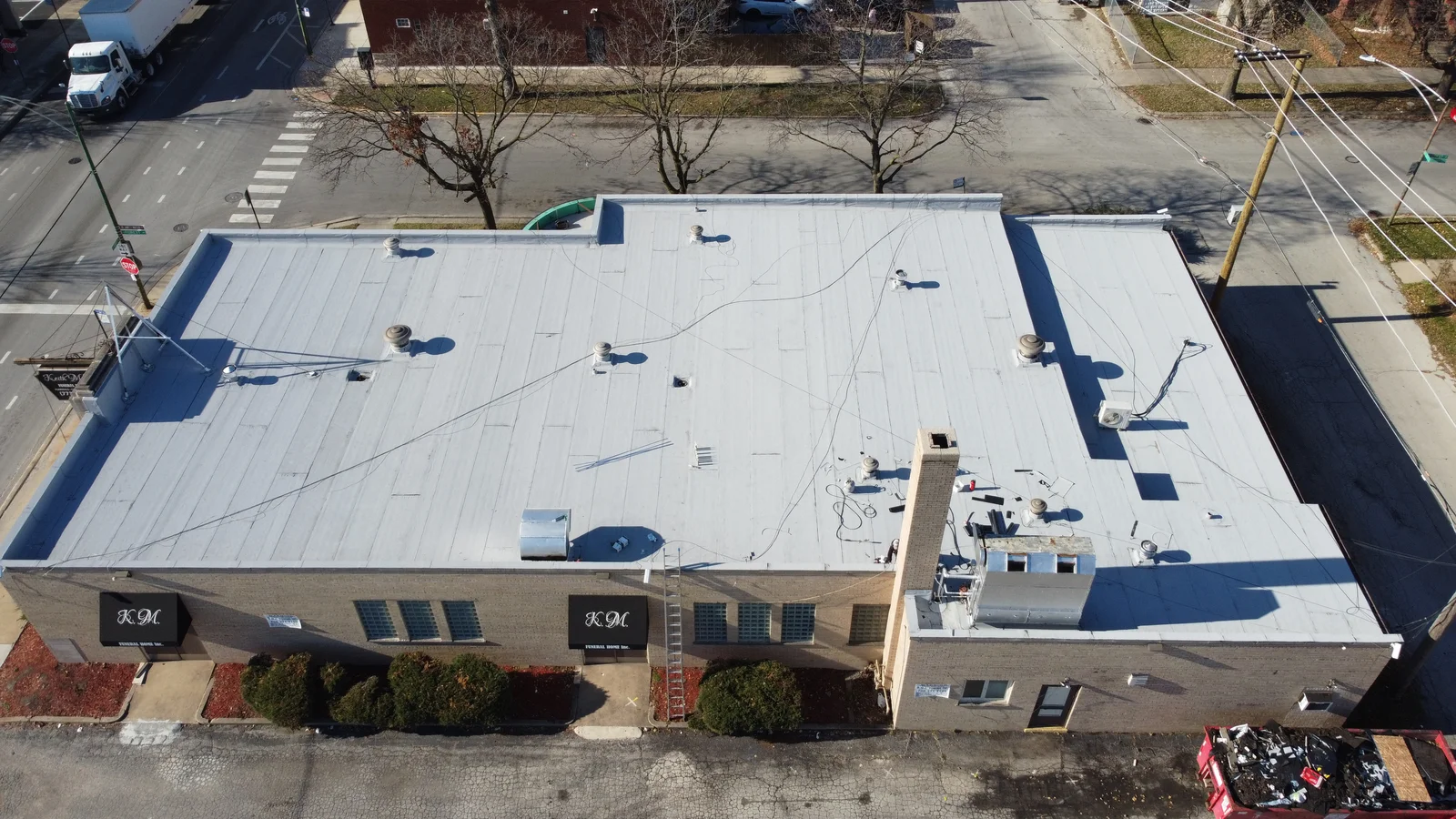
Commercial field, coated end to end
Industrial Roofs Along The Belt
The buildings packed around the Indiana Harbor Belt yard and out toward the airport are warehouses, freight terminals, machine shops and light manufacturing, most of them under wide low-slope decks. A lot of them have been added onto over the decades, which means one building can carry three different roofing systems that meet at transitions nobody detailed properly. Those transitions are where we find leaks far more often than the middle of any single roof.
Drainage is the other thing worth watching on these big flat decks. Interior drains clog with debris, deck deflection creates ponding areas that never dry out, and standing water finds any seam that has aged. Ponding water breaks down a membrane faster and puts real weight on the deck after a heavy rain. When we inspect here we check every drain and note where water is sitting, because fixing drainage is usually cheaper than replacing what the standing water eventually ruins.
What We Do On The Commercial Side
- Warehouse roofing on freight and distribution buildings, including phased work on very large decks.
- Industrial roofing for shops and plants where equipment, exhaust and foot traffic are hard on the membrane.
- TPO roof repair on seams and flashings, plus TPO installation when a deck is ready for a new system.
- Commercial roof leaks traced through the deck to the real source, with photos of what we found.
- Metal roof repair on the older steel-panel buildings scattered through the industrial blocks.
Anything large or long-term gets a commercial roof inspection with a written condition report you can put in a capital budget. We would rather map out three years of planned work with you than sell one emergency at a time.
The Houses The Plants Built
Franklin Park’s residential blocks are compact postwar housing: small frame and brick ranches, capes and story-and-a-halves built through the late 1940s and 1950s on modest lots, plus some newer infill. They were built efficiently and they have held up, but the roofs on them have been replaced two or three times, and the quality of those replacements is all over the map. We regularly find overlays, undersized flashing and vents cut in without proper flashing kits.
Our approach on these houses is boring on purpose. Tear off to the deck under shingle roof replacement, replace any bad sheathing at a price you agreed to in writing first, install ice-and-water membrane at the eaves and valleys, flash the penetrations correctly, and vent the attic so the new roof lasts as long as the shingle warranty claims. Smaller problems get handled as shingle roof repair when the field still has life, and gutter installation usually rides along, since the original runs on a 1950s ranch are undersized for the downpours we get now.
Wind Off The Open Ground
The yards, the runways and the wide industrial parcels leave a lot of open ground here, and open ground means wind with nothing to slow it down. On houses that shows up as lifted tabs and torn ridge caps on the exposed slope. On flat commercial roofs it shows up as edge metal peeling back or membrane billowing where the perimeter fastening was never right, and once the edge goes, a big section can follow in one storm. Perimeter detailing is the part of a commercial roof we look at hardest, and wind damage repair is one of the more common calls we take from this village.
Rooftop Equipment Is Half The Leak List
Every one of these buildings carries hardware up top: makeup air units, exhaust fans, condensers, refrigeration lines, conduit runs and the occasional dust collector. Each one sits on a curb, and every curb is a hole somebody cut in a perfectly good roof. Curb flashing is where we find a large share of Franklin Park leaks, usually because a mechanical contractor set a new unit on an old curb, or ran a line through the deck and sealed it with whatever was in the truck. Pitch pockets dry out and crack in about five years, and nobody goes up to look at them until a ceiling tile drops in the office below.
When we take on a building here we photograph every penetration and grade it, so you know which curbs are sound, which need new flashing and which are actively wet. We also ask who else gets on your roof. If your HVAC company is up there twice a year, foot traffic pads along their walking route cost very little and stop the punctures that come from dropped tools and dragged ladders. That coordination is cheap. Chasing a leak through a suspended ceiling and a rack of inventory is not.
Straight Answers From The Owner
Guardian Roofing Systems is second generation. Angelo Ristich learned the trade from his father Frank, runs the company now, and is on the job in person rather than sending a salesman and disappearing. On a commercial building that means your maintenance contact talks to the person who was actually on the roof. On a house it means the same.
We are BBB A+ rated, hold a HomeAdvisor Elite Service award, and stay licensed and insured in Illinois. Routine residential work can be priced from satellite measurements while you are on the phone, financing help is available if a full roof is a stretch this year, and every commercial scope gets walked before it gets quoted. The gallery shows the work, and the contact page gets you a callback the same business day.

Starter courses on a residential install
Franklin Park At A Glance
Rail-yard and O’Hare-edge industry under wide flat decks, plus compact postwar workers’ housing on the village blocks.
Mon to Sat, 9 to 5, with emergency patch response when storms hit.
(312) 590-4853Where Else Our Trucks Land
Franklin Park sits at the north end of the west Cook County territory we run. Melrose Park is directly south with a nearly identical mix of industry and older housing, Berkeley and Bellwood follow the Mannheim Road line further down, and Broadview anchors the bottom of it. Maywood and Westchester are on the same weekly loop. Because we already have flat-roof crews working the industrial belt in these towns, an emergency patch on a Franklin Park warehouse rarely means waiting for a truck to come across the metro. The full map lives on the service areas page.
Franklin Park Roofing Questions
Water pools on our warehouse roof after every rain. Is that a problem?
Yes. Standing water shortens membrane life, stresses seams and adds weight to a deck that may already be deflecting. Sometimes the fix is clearing and reworking drains, sometimes it is tapered insulation to build proper slope. We measure where the water sits before recommending either, because guessing here is expensive.
Our building has additions with different roof systems. Can they be tied together?
They can, and the transitions between them are where we start looking. Different membranes need specific detailing where they meet, and a lot of older buildings here just have mastic smeared over the joint. We detail those transitions properly, or if the systems are close in age we look at bringing the whole roof under one system.
Wind tore the edge metal off one side of our roof. Is that an emergency?
Treat it as one. Once perimeter edge metal is compromised, the next strong wind can get under the membrane and peel a large section in minutes. We secure the edge right away, then price the permanent repair. Perimeter fastening is the detail that decides whether a flat roof survives a storm.
Somebody put a new roof over my old one. Does that need to come off?
Almost always, yes. An overlay hides the deck condition, adds weight, and traps whatever was wrong underneath. When we tear off an overlaid Franklin Park ranch we usually find soft sheathing and flashing that was never replaced. Doing it right once costs less than doing it cheap twice.
Does the wind exposure here mean I need a different shingle?
Not a different shingle so much as correct installation. Wind ratings depend on nailing pattern, starter strip at the eaves and rakes, and proper ridge cap. Most wind failures we repair are installation shortcuts, not product failures. We nail to the manufacturer’s high-wind pattern as standard practice.
Can you schedule around our shipping and receiving hours?
Yes, and we plan it before mobilizing. Docks stay clear, material and dumpsters get staged where they do not block truck traffic, and disruptive phases get scheduled with your operations contact. Freight buildings cannot stop moving product for a roof, and they should not have to.
Get Eyes On The Franklin Park Roof
Call Guardian Roofing, tell us whether it is a warehouse deck or a house on a village block, and get a straight answer with a real number behind it. Or send the details through the contact page and we will call you back the same business day.