
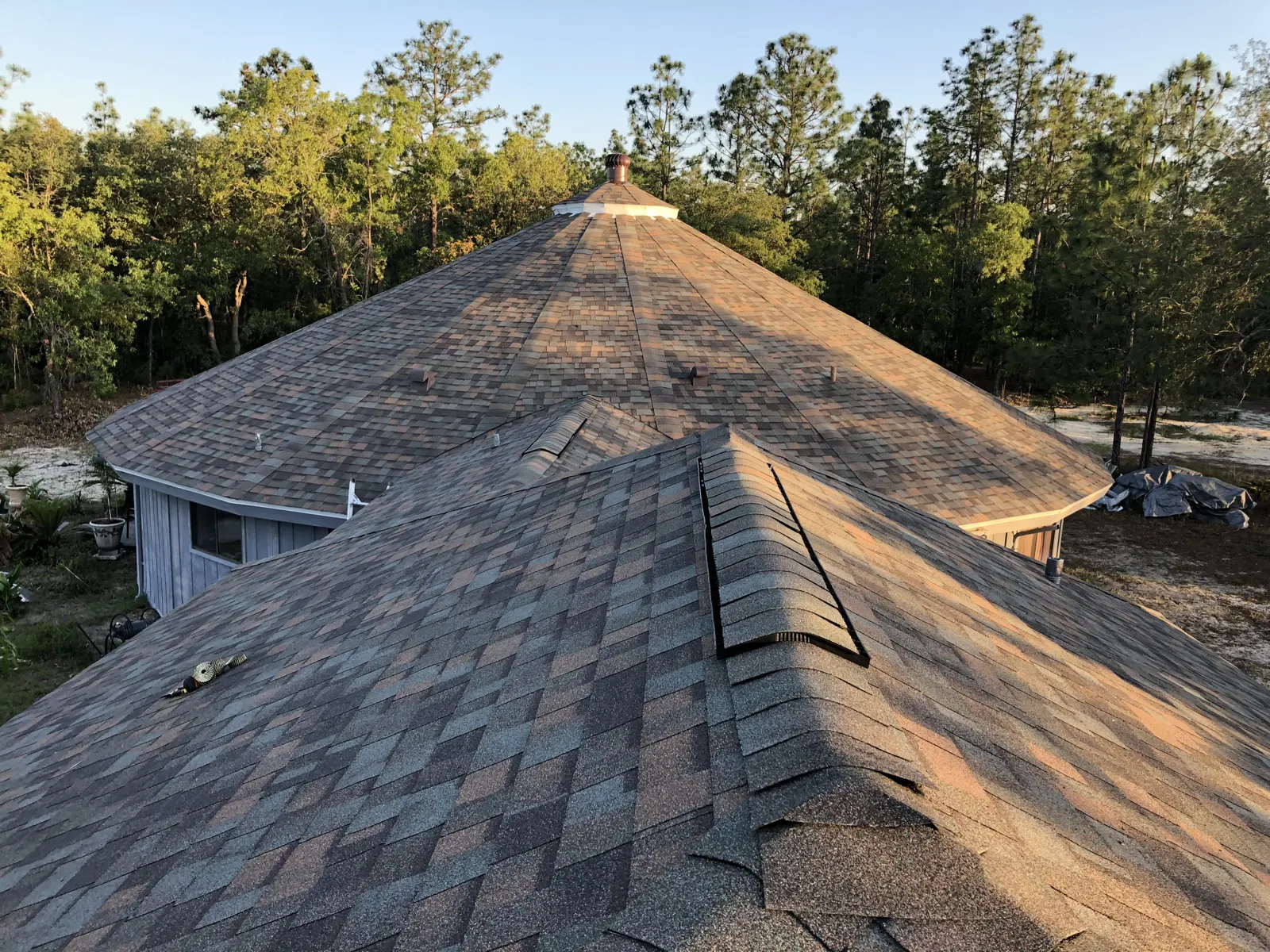
Last of the light on a finished field
Most Of This Work Starts By Taking Cedar Off
A lot of the estate stock west and north of the village was built or reroofed in cedar shakes, and those roofs are at the end of the line. What goes on after they come off is a different roof from the inside out, and the deck work is where the honesty shows.
What Is Under The Shakes Decides The Whole Job
Cedar shakes were never nailed to a solid deck. They were nailed to boards laid with gaps between them, because a wood shake roof was designed to breathe from underneath and dry out between rains. That spaced sheathing did its job for decades. It is also the reason a cedar-to-shingle conversion is not a matter of stripping one material and laying another.
Asphalt shingles need continuous support. Every nail has to land in wood, and the field has to be flat enough that the courses lie down instead of telegraphing every board edge through the surface. So before the first bundle goes up, we sheet over the spaced boards with new plywood. That covers the gaps, gives every fastener something to bite, and stiffens the entire roof structure in a way the old boards never did on their own.
This is the single biggest number in a Barrington cedar conversion, and it is the one that gets left off quotes written from the curb. A contractor who has not been on your roof does not know whether the boards under your shakes are sound, spaced wide or spaced tight. We write the sheathing into the scope before we start, so it is never a surprise added halfway through the tear-off, and so the price you agreed to is the price of a finished roof rather than the price of the easy half.
While the deck is open we are also looking at what the old roof hid. Cedar in northern Illinois cups, splits and grows moss on the north-facing planes, and once the underlayment below it starts to go, water has been reaching wood for a while. Soft boards, stained rafter tails and rot around a valley get called out with photographs while the roof is bare, which is the only honest moment to have that conversation.
Keeping The Look The Street Expects
Almost nobody in Barrington who loses a cedar roof goes back to cedar. Cedar costs several times what a heavy architectural shingle costs, it needs maintenance most owners never do, and in twenty years it is in the same shape that started this conversation. The question is not usually whether to convert. It is whether the conversion is going to look like a compromise from the road.
It does not have to. Shake-profile and wood-blend architectural shingles are built for exactly this house: heavier than a three-tab, laid with a thick butt edge and a varied color blend that reads as depth and shadow instead of a flat sheet. On a big multi-gable roof seen from a distance across a lawn, that shadow line is doing most of the work your eye reads as texture. A dark wood-tone blend on a steep gable keeps the estate look the neighborhood expects at a fraction of cedar’s cost.
Some owners still want the real thing back, and that is a fair thing to want. Whether your deck and framing can carry another cedar roof is a structural question with a straight answer, and you will get ours on the roof with the old material in hand rather than in a pitch.
The Nineties Builds Are Up Now
The other half of our installation work here is not cedar at all. It is the custom stock built through the 1990s and 2000s, the houses with the turrets and the dormers, now due for their second roof. The first one was usually a decent architectural shingle and it has done its thirty-odd Chicago winters honestly.
These are different jobs from a cedar conversion. The deck under them is already solid plywood, so the tear-off is one layer to a surface we can usually reuse. What takes the time on these houses is the geometry rather than the substrate: more intersecting valleys than most crews see in a month, dormer cheeks that die into main slopes, turret roofs where every course has to be cut on an angle that changes as it climbs. One of these houses can carry more linear feet of valley metal than a whole block of Alsip bungalows.
We will tell you when a roof does not need replacing yet. If what you actually have is one slope that took a storm, that is wind damage repair or hail damage repair, not an installation, and we would rather say so than sell you a roof a year early.
The Shortcuts A Steep Multi-Gable Roof Invites
Complicated rooflines are where crews take shortcuts nobody sees from the ground, and on a house set back off the road nobody is going to see them from anywhere. That is the whole reason Angelo supervises the complicated ones himself. He learned the trade from his father Frank, took the company over in 2013 and modernized how it runs, and the part he did not modernize is being on the roof when the hard details get built.
- Valleys get rushed. A woven or closed-cut valley that is not laid with the right offset looks fine the week it goes on and starts weeping the first spring the ice sits in it. On a roof with this many valleys, one lazy one is a leak.
- Dormer cheek flashing gets face-nailed instead of step-flashed course by course, because step flashing is slow and it is buried when the siding goes back. It is also the only version that works.
- Turrets get cut short. Every course on a conical or many-sided turret needs its own angle, and it is faster to force the last few courses than to keep cutting.
- Ice and water shield gets stretched thin at the eaves and skipped in the valleys, which on a big roof with deep overhangs is exactly backwards.
- Ventilation gets ignored. On these houses the attic run is long, and intake at the soffit has to match exhaust at the ridge or the new roof bakes from underneath.
None of that is exotic. It is all standard work that takes longer than the shortcut, which is why the supervision matters more here than it does on a simple gable in the south suburbs.
Four Hundred Feet Of Driveway Is Part Of The Scope
A tear-off on a house set well back from the road is a logistics problem before it is a roofing problem. Where the dumpster goes determines whether your asphalt survives the week. Where the trucks stage determines what the turf looks like in May.
So we plan it before the truck arrives. The dumpster sets on plywood, staging stays off soft turf, beds and shrubs that took twenty years to fill in get tarped, and we run magnets over the drive and the lawn edges at the end of every working day rather than once at the end of the job. If there are horses on the property, noise and staging get talked through before the first bundle goes up, not after somebody’s morning goes sideways.
Scheduling works the same way. A full tear-off and install is a multi-day job, so we tell you which days the crew is yours before it starts rather than leaving you guessing which morning the trucks show up. Finished work from around the area is in the gallery, the rest of what we do up here is on the Barrington page, and the shingle installation service itself is written up in general on the shingle roof installation page.

The Short Version
Cedar conversions with new plywood over the spaced sheathing, second roofs on 1990s builds, steep multi-gable work with dormers, turrets and intersecting valleys.
Sheathing is written into the scope before we start. Angelo supervises the complicated rooflines himself.
(312) 590-4853No Travel Charge
Barrington work rides the grouped northwest Cook schedule out of the Alsip shop. No travel charge for the drive.
Satellite measurements mean you can get a real number on the phone before anybody climbs a ladder.
From First Call To The Last Ridge Cap
Measure And Talk
Satellite measurements give you a real number on the phone. Then we walk the roof, because the deck decides the rest.
Scope In Writing
Sheathing, valley metal, ventilation and flashing spelled out before anybody climbs. Financing pre-approval help if the roof is big.
Stage The Property
Dumpster on plywood, beds tarped, access agreed. Horses and long drives get planned around, not worked around.
Strip, Sheet, Lay
Shakes off, deck opened and photographed, plywood down, then shingles. Magnets over the drive at the end of every day.
Elsewhere in town: a storm that took one slope goes to hail damage repair or wind damage repair. Water coming over the eave instead of through the roof is gutter repair. If the damage looks like it belongs to a carrier, start at roof insurance claims. Photos of finished work are in the gallery, and the fastest way to start is a message with a few pictures.
What Owners Ask Before A Tear-Off
Do you have to put new plywood over my whole roof?
If you are coming off cedar, yes. Shakes were nailed to boards with gaps between them, and asphalt shingles need a solid deck so every fastener lands in wood. We sheet over the spaced boards, which also stiffens the roof. On a house that already has plywood under an asphalt roof, we reuse it and only replace what is soft.
Will a shingle roof look wrong on a house built for cedar?
Not if the shingle is chosen for it. Shake-profile and wood-blend architectural shingles are laid with a heavy butt edge and a varied color blend that reads as shadow and depth from the road. On a steep multi-gable roof seen from across a lawn, that shadow line is doing most of the work your eye reads as texture.
How long does an install take on a big multi-gable house?
Longer than a simple gable, and we will give you the number for your roof rather than a general one. What drives it is geometry: intersecting valleys, dormer cheeks and turrets all have to be cut and flashed individually. We schedule Barrington work in grouped runs so a crew stays up here for the stretch instead of coming and going.
What happens if you open the roof and find rot?
You see it before it gets covered. We photograph bad boards, stained rafter tails and rot around valleys while the deck is bare and talk it through with you then. Nothing gets buried and billed later. The bare deck is the only honest moment to have that conversation, so we have it there.
Can you match the shingle on a roof that is only partly bad?
Sometimes, and we will tell you straight when the match will be obvious. If one slope took a storm and the rest of the roof has life left, replacing the slope can be the right call. If the color has weathered well past anything current, we say so and you decide whether you can live with it.
Why does ventilation come up during a roof installation?
Because on these houses the attic run is long, and intake at the soffit has to match exhaust at the ridge or the new roof cooks from underneath. We check attic ventilation and insulation depth as part of the inspection, and if the balance is wrong the fix belongs in the install rather than in a callback two summers from now.
Does the dumpster have to sit on my driveway?
It sits where we agree before the truck arrives, on plywood either way. On a long drive we pick the spot that keeps weight off the softest asphalt and off turf. Beds and shrubs get tarped, and we magnet-sweep the drive and lawn edges at the end of every working day rather than once at the end.
Tell Us What Is On The Roof Now
Cedar, asphalt or something somebody added along the way, plus how old you think it is. We can price off satellite measurements and give you a real number on the phone, then walk the roof before anything gets written down as final.