
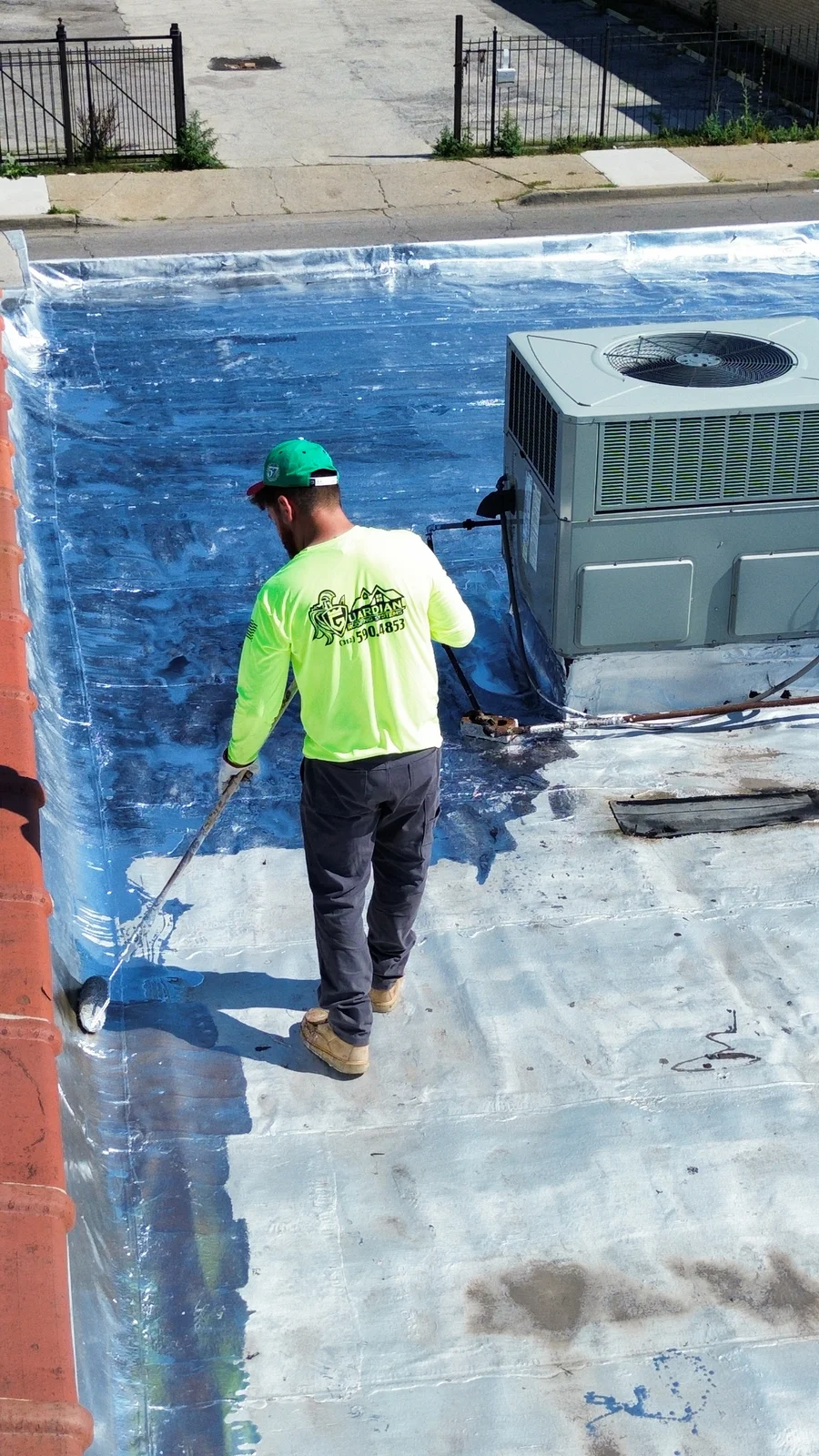
Silver topcoat rolled over a blue base
Coat It Or Replace It? The Insulation Decides
The commercial and light industrial buildings along the rail line and out toward Mannheim Road almost all sit under flat roofs. Before we price one, we find out what is under the surface. That answer, far more than the age of the roof, decides between a restoration coating and a new membrane.
Reading A Commercial Flat Roof Before Pricing It
A flat roof can look worn out at first glance and still have a sound field, or look decent and be holding water in its insulation. The surface is a poor witness on its own. We walk the whole roof, probe anything that gives underfoot, and look hard at drains, edges and every piece of equipment before anybody talks about which system goes down next.
When The Field Is Sound Enough To Coat
A restoration coating belongs over a membrane that is still doing its job: dry insulation underneath, seams that are holding, and details that can be repaired first. On that kind of roof we clean the surface, rebuild the flashings that have failed, then apply a basecoat followed by a reflective topcoat. The photo up top is one of our crew rolling the silver topcoat over the blue base, working right up against a condenser.
On the right roof, coating gets you more years with a lot less disruption than a tear-off. Over wet insulation it is the wrong call, because the coating seals the moisture in and the roof keeps deteriorating under a surface that looks brand new. Wet sections we find come out and get replaced before anything is coated, or the conversation moves to a new membrane.
When It Needs A New Membrane
Soaked insulation under large parts of the field, a surface full of splits and blisters, or an old coating already peeling off the top all point toward replacement. In that case we tear off to the deck, swap out any damaged insulation and decking we uncover, and put down a new membrane system with fresh flashing at every curb, wall and edge. You get photos of what came off, so the scope makes sense to whoever approves it.
Plenty of roofs land in between: a dry field with one wet corner around an old unit, or a sound membrane with flashings that gave up years ago. Those get a split answer. The wet section comes out and is rebuilt, the details are redone, and the rest of the field gets coated, with each part priced as its own line.
Drains, Scuppers And A Village That Drains Slow
Bellwood sits flat and drains slow, and a commercial flat roof is only as good as the openings that empty it. We pull the strainer on each drain, clear whatever has built up in the bowl and make sure the ring holding the membrane down is tight. At the edge, the scupper boxes have to stay open to the outside, because a scupper that is half blocked lets a downpour stand on the roof instead of leaving it.
Water that sits for days marks where the roof has settled or where a drain stands higher than the field around it. During a recover or a replacement, tapered insulation and crickets can steer that water toward the drains. On a coating job we at least clear the path and tell you where water will keep collecting. We follow it past the edge too, down the leaders to grade, because water dumped against an old foundation ends up in a basement or a storeroom.
Commercial Leaks Travel Before They Show
Water in a commercial building seldom comes down where it got in. It slips under the membrane at a curb or a flashing, runs along the deck or the top of the insulation, and finds a seam or a fastener hole somewhere else entirely.
That is why we trace from the roof and photograph the path rather than patching wherever a ceiling tile is stained. Finding the real entry point is the whole job; the stain only tells us which part of the roof to start walking.
Tenants, Deliveries And The Workday
A commercial roof job happens over businesses that still have to run. We sit down with the owner or manager about dock and delivery times, where a dumpster and a material lift can go without blocking a bay or a front door, which tenants need notice, and which hours are off limits for noise or the smell of coating.
On a building with several tenants we can work the roof in sections, finishing above one space before moving on to the next, so nobody has a crew overhead for longer than their part of the roof takes.
Angelo Runs The Job
Angelo Ristich learned roofing working beside his father Frank, took over the company and brought it up to date, and he is on these jobs while they happen. You deal with him on the scope, the schedule and the punch list. For a first number we measure the roof by satellite while you are still on the phone, then confirm it on the walk. Guardian is BBB A+ rated, holds a HomeAdvisor Elite Service award, and carries Illinois licensing and insurance.
Owners with buildings elsewhere in the county can start on our commercial flat roofs page. Coated and replaced roofs we have finished are shown in the gallery, and the contact form takes building size, roof age and any leak history.
Before We Price It
The whole field walked, soft areas probed, every drain and scupper opened, and every curb and wall flashing photographed.
Then a straight answer on coating versus a new membrane, with the reason written down.
(312) 590-4853Same Crews, Same Photos
The crews and photo reports that work Bellwood houses also run our commercial roofs. Rough pricing starts from satellite measurements before anyone sets up a ladder.
The Order We Work A Commercial Roof
Measure From Above
A satellite measurement during the first call gives you a number to plan around.
Find What Is Wet
Soft spots probed, drains opened, flashings checked from one edge to the other.
Pick Coat Or Replace
The insulation and the details make the call, and the report explains why.
Finish With Photos
Every rebuilt detail photographed and tied to its spot on the roof.
Also in Bellwood: a restaurant with rooftop units and kitchen fans is covered under restaurant roof repair, brick apartment buildings under multi-family roofing, and the low-slope roofs behind houses under flat roof replacement, or flat roof installation when there was never a real membrane up there. The Bellwood page covers the whole village, our commercial roofing page covers membrane and metal flashing work in general, and the industrial strip along Roosevelt in Broadview gets the same crews.
Questions Building Owners Bring Us
How do you decide between a coating and a new roof?
By what is underneath. If the insulation is dry, the seams are holding and the flashings can be rebuilt, a coating over the existing membrane makes sense. Insulation that holds water means a coating would seal it in, so those areas, or the whole roof, get replaced.
Can you coat a roof that already has a coating on it?
Sometimes. If the old coating is still bonded, it can be cleaned and recoated once the failed details are rebuilt. If it is peeling, blistered or flaking, it has to come off first, because new material only holds as well as the layer it sits on.
Water sits on our roof for days. Is that a leak?
It can become one. Standing water points to a clogged drain, a blocked scupper or a section that has settled. We clear the openings first, then look at whether tapered insulation or crickets, added during a recover or a replacement, would move the water off for good.
Will our tenants have to close while you work?
We plan the job so they can stay open. Beforehand we go over delivery times, door and dock access, which tenants need notice and which hours are off limits. On larger buildings we work the roof in sections, finishing over one space before moving to the next.
Why is the leak nowhere near the damaged part of the roof?
Water travels. It enters at a curb, a seam or a flashing, runs under the membrane or along the deck, and drops out wherever it finds an opening. We trace it from the roof and photograph the path we find.
Can part of the roof be coated and part replaced?
Sometimes. If cores show wet insulation in one area and dry insulation in the rest, the wet section gets torn off and rebuilt and the sound remainder can take a coating. We mark both areas on the photos so you can see which part of the price covers which part of the roof.
Send The Building, Get A Number Back
Send the address, what the building is used for, and what you already know about the roof: the last time anyone was up there, where the leaks show, and whether it has been coated before. A rough number can start from satellite measurements on the first call.
After the walk you get photos, a plain recommendation between coating and replacement, and a straight price on the option that holds up. Guardian is licensed and insured in Illinois, and anything sent through the contact page gets a call back the same business day.