
People hear “price over the phone” and assume it means a number pulled out of thin air, followed by a guy showing up later to tell you it doubled. Fair suspicion. Plenty of outfits work exactly that way, and it is why homeowners in Alsip and the south suburbs have learned to brace before anybody opens a folder.
That is not what we are doing. When you call us at (312) 590-4853 and we give you a range in ten minutes, that range is built on aerial measurement data down to the square foot, on material pricing we buy at every week, and on labor rates for a crew that has been running Chicago roofs since 2013. My father Frank taught me to measure before opening my mouth. The satellite just measures faster than a tape does.
What follows is the whole workflow. What the aerial data actually gives us, what it physically cannot see, where the number tightens, and the specific conditions that move a phone price after somebody gets on the roof. If you know how the sausage is made you can tell the difference between a real number and a sales tactic, no matter who you end up hiring.
What The Aerial Data Actually Gives Us
The measurement reports we pull are generated from high-resolution aerial imagery flown over Cook County, plus stereo photogrammetry that reconstructs your roof in three dimensions from overlapping images shot at different angles. It is the same category of data insurance carriers use when they scope a hail claim, which is not a coincidence.
Here is what comes back on a typical Chicago bungalow or two-story:
- Total roof area in squares. A square is 100 square feet of roof surface, the unit every roofer prices in. A standard Chicago bungalow usually lands between 14 and 22 squares. A big Beverly foursquare can hit 30. This number is accurate within about 2 percent, which on a 20-square roof is less than half a square.
- Pitch of every facet. Reported as rise over run, so 6/12 means six inches of vertical rise for every twelve horizontal. Pitch drives both material waste and labor, because past 7/12 the crew needs roof jacks and planks and everything slows down.
- Linear footage of ridges, hips, valleys, rakes, and eaves. This matters more than people expect. Ridge and hip footage sets your cap shingle count. Valley footage sets your ice and water shield. Eave and rake footage sets drip edge and starter course.
- Facet count. A simple gable roof has two facets. A cut-up Victorian in Oak Park might have fourteen. Every additional facet means more cuts, more waste, more flashing detail, and more hours.
- Penetration locations. Plumbing stacks, furnace flues, bath fan terminations, and skylights show as objects in the imagery.
With those five data sets I can build a materials list that is genuinely close. Shingle bundles, underlayment rolls, ice and water shield, ridge vent, cap, drip edge, pipe boots, nails, and disposal volume all key off numbers on that report. Nothing about that step involves guessing.
The Math Behind The Range We Quote You
Say the report comes back at 21.4 squares on a 5/12 pitch, six facets, 62 linear feet of ridge, 38 feet of valley, 148 feet of eave.
Materials get calculated first. Shingles at 21.4 squares plus waste, and waste is a real line, not padding. A simple gable roof runs about 8 percent waste. Six facets with 38 feet of valley pushes it to 12 or 13 percent, because every valley cut throws away part of a shingle. So we are buying roughly 24 squares of material to cover 21.4 squares of roof. A contractor who quotes you exactly 21.4 squares of material either does not understand waste or plans to come up short on the last day.
Ice and water shield comes next. Illinois code and plain Chicago sense both say you carry it from the eave edge up past the interior wall line, which on most houses means two courses of 36-inch membrane, sometimes three on a low pitch or a deep overhang. Plus the full valley run. On this roof that is around 340 linear feet of membrane.
Then tear-off and disposal. Twenty-one squares of one-layer architectural shingle is roughly 5,000 pounds of debris. Two layers is closer to 9,000 and it changes your dumpster size and your dump fees. The aerial report cannot always tell me layer count, which I will get to.
Labor comes off pitch, facet count, and access. A 5/12 six-facet roof with a driveway to stage from is a two-day job for our crew. Same square footage at 9/12 with a fenced yard and no driveway is three days with fall protection setup, and that difference is real money.
Add the venting line, the flashing line, the permit where the village requires one, and you have a range. Not a single number. A range, because there are four or five things the satellite genuinely cannot see, and I would rather tell you about them upfront than surprise you on day one.
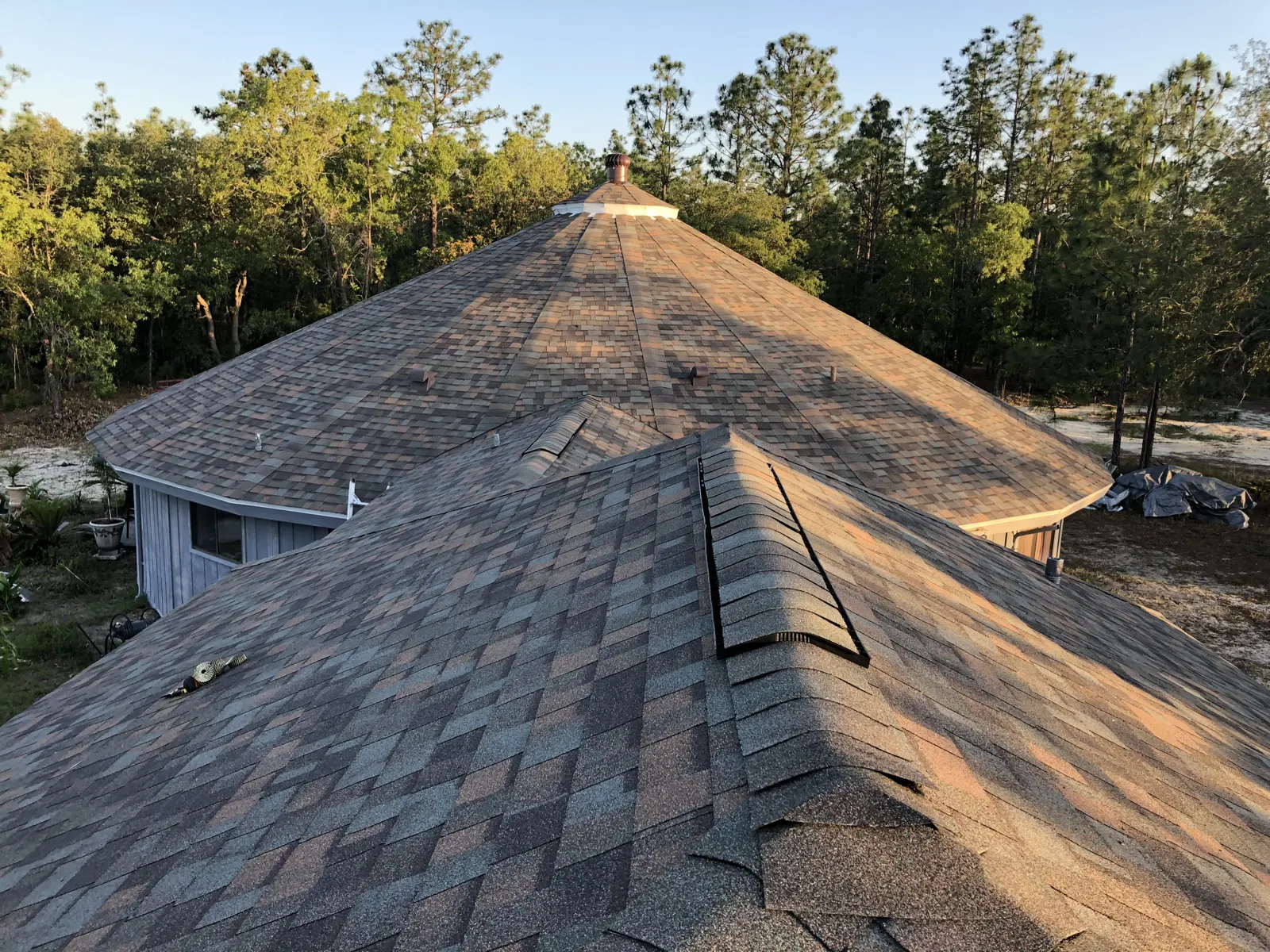
Five Things The Satellite Cannot See
This is the honest part, and it is the part most phone quotes skip.
Deck condition. Aerial imagery shows me the top of your shingles. It tells me nothing about the plywood or the 1×6 board sheathing underneath. On a Chicago house built before 1950 you are often looking at board decking with gaps, and after a few decades of freeze-thaw and one or two prior tear-offs, some of those boards are soft. We do not know until the old roof comes off. Every honest quote in this trade carries a per-sheet deck replacement rate stated in writing, and every honest roofer tells you that number before you sign rather than after they find rot.
Layer count. Sometimes the shadow line at the rake edge tells me there are two layers up there. Often it does not. A second layer means double the tear-off labor and double the disposal weight, and in Illinois you cannot legally go over two layers anyway. If your house has never been torn off since it was built, assume there is a second layer until proven otherwise.
Existing ventilation. I can count the box vents or spot a ridge vent from above. What I cannot see is whether your soffits actually have intake, or whether somebody insulated the attic in 1988 and buried every soffit bay under blown cellulose. Exhaust without intake is worse than no venting at all, and that discovery changes the venting line on your quote.
Flashing and masonry condition. Chimney counter-flashing, step flashing at a dormer wall, and the condition of the mortar joints those flashings tuck into are close-up items. On a Chicago brick chimney the flashing is often fine and the mortar is shot, and that is a masonry conversation, not a roofing one.
What is going on inside. Active leak staining, a sagging ridge line telling you a rafter is compromised, previous repair work done badly. None of it shows from a plane at 3,000 feet.
Straight talk on our own track record. On a post-1960 house with plywood decking and one layer of shingles, the phone range holds probably nine times out of ten. Those roofs are predictable. The plywood is usually sound, the layer count is usually one, and the aerial data covers everything that matters.
On a pre-1940 Chicago bungalow or a two-flat with board decking, the range holds maybe six or seven times out of ten, and when it moves it is almost always deck replacement. That is why we quote those houses as a range with the per-sheet rate spelled out, so if we pull eight sheets of bad decking you can do the arithmetic yourself instead of taking my word for it.
On flat roofs the phone number is looser still, and I say so. Aerial imagery gives me square footage on a flat roof but tells me almost nothing about what is under the membrane. Wet insulation weighs a lot, holds water for years, and cannot be roofed over. On any flat roof replacement we treat the phone number as a starting bracket and we cut cores or do a moisture scan before anybody signs anything real.
Why We Bother With Phone Pricing At All
Because most people calling a roofer are trying to answer one question: is this a four thousand dollar problem or a nineteen thousand dollar problem. They need that answer to decide whether to file a claim, whether to call their lender about financing, whether to keep patching for another season, or whether to tell their realtor the roof is fine.
Making somebody sit through a 90-minute in-home appointment to learn a number they could have had in ten minutes is a sales tactic, not a service. That long appointment exists so a closer can build rapport, run a presentation, and put a discount that expires tonight in front of you. We do not run that play. Angelo gives you the number, and if you want to think about it for three weeks, think about it for three weeks. The roof is not going anywhere and neither are we.
The other reason is triage. If you call in October with a leak and the phone math says your shingle roof replacement is a $14,000 job you are not ready for, we can talk about what a proper repair buys you and whether it is worth doing this year. That is a useful conversation to have on the first call rather than the fourth.
What We Ask You On That Call
The aerial data does half the work. The other half comes from five or six questions, and how you answer them tightens the range considerably.
- How old is the roof, and do you know if it has been torn off before? Even a rough answer helps. Closing paperwork or a permit record is better.
- Are you seeing water inside, and where? A ceiling stain in a bedroom below a valley is a different conversation than a stain along an exterior wall, which usually points at ice damming.
- Any missing shingles or granule piles in the gutters? Granule loss tells me where the shingle is in its life. Missing tabs after a windstorm might be an insurance path.
- Is there a driveway we can stage the dumpster on, and how tight is the lot? Chicago lots that run 25 feet wide with a garage in back change the labor picture in a way no satellite reports.
- Is the attic finished? A finished attic or a cathedral ceiling changes venting strategy entirely, because there is no attic space to ventilate.
- Do you have a skylight, and has it ever leaked? Skylights are a real line item and old ones should be replaced during a tear-off, not flashed around.
Six questions and a measurement report gets us to a number I am comfortable defending. If your answers point to something complicated, I will say the phone number is soft and we should get on the roof before you plan around it.
How Commercial And Flat Roofs Break The Model
Everything above assumes a house. Commercial work runs different, and phone pricing on a warehouse or a strip center is a rougher tool.
Square footage from aerial data is still accurate. But a 30,000-square-foot commercial roof has parapet walls, roof drains and overflow scuppers, curbed rooftop HVAC units, gas line supports, and often three decades of layered patches from four different contractors. Membrane thickness, insulation R-value and saturation, deck type, and how the drains are actually functioning are all things you learn on the roof with a knife, not from a photograph.
On commercial we give a budget bracket on the phone so a property manager can plan a capital line, then we do a real walk with core cuts. Our commercial roof inspection process includes moisture survey, drain assessment, seam probing, and photo documentation, and it usually reshapes the number in one direction or the other. Sometimes down, because a roof somebody wrote off as failed turns out to be a sound membrane with bad flashing details and it can be repaired for a fraction. That happens more than owners expect.
The Bad Version Of Phone Pricing, And How To Spot It
Since we are being honest about the method, you should know how the same tool gets abused, because a lot of companies in this market use aerial measurement to sound precise while doing the opposite.
The first tell is a single number with no range and no conditions. “Your roof is $11,400.” No square count, no pitch, no mention of deck contingency. That number is engineered to feel decisive. It is decisive right up until the tear-off starts and a change order appears.
The second tell is a price that is dramatically lower than everybody else on the same measurement. If four contractors are working from the same 21.4 squares and three land between $13,000 and $16,000 and one says $8,900, the cheap one is not more efficient. He is planning to skip something, and the usual candidates are ice and water shield coverage, synthetic underlayment swapped for 15-pound felt, reusing old flashing instead of replacing it, or leaving the ventilation exactly as broken as he found it. Those omissions are invisible from the ground on the day the job finishes and expensive four winters later.
The third tell is a price that only exists today. Storm-chase outfits work Cook County hard after every hail event, and the expiring discount is their core move. A roof is a fifteen thousand dollar decision on a house you will own for another decade. Any price that cannot survive you sleeping on it for a week was never a real price.
The fourth tell is refusing to put the deck rate in writing. Every roofer knows some percentage of decking on an old house will be bad. A contractor who will not state the per-sheet number in advance is preserving his own flexibility to name a number later, when you have a house with no roof on it and very little negotiating position.
When the phone range does move, it moves for a short list of reasons and almost always for the same three.
Decking. The most common by a wide margin. On a 1920s bungalow we might pull four sheets or we might pull eighteen. At a stated per-sheet rate this is arithmetic you can follow, and we photograph every board we replace so you are not taking anybody’s word for the count.
Hidden second layer. Adds tear-off hours and disposal weight. On a 20-square roof a surprise second layer typically adds a day and a second dumpster pull.
Ventilation correction. If we open the eaves and find every soffit bay packed with blown insulation, the fix is baffles and often new intake vents. It is real work and real material, and it is also the single highest-return item on most Chicago roofs because it is what stops the ice dam cycle from cooking your shingles from underneath.
Less common but real: a compromised rafter or ridge board showing sag, chimney masonry too deteriorated to hold new counter-flashing, or a skylight that has been leaking long enough to rot the curb around it. We show you all of it with photos before we do anything about it, because owner-supervised means Angelo is standing there when the decision gets made, not a foreman calling a manager who calls you.
Two other things move the number that have nothing to do with the roof itself.
If storm damage is in play, the number stops being a market price and starts being a scope conversation with an adjuster. What we do there is document thoroughly and price to the same aerial standard the carrier uses, so that when they scope 21.4 squares and we scope 21.4 squares we are arguing about line items instead of arguing about measurements. Illinois also prohibits a contractor from paying or absorbing your deductible, and anybody offering to is telling you something about how they run their business.
If you are paying out of pocket, financing pre-approval usually matters more than shaving a few hundred off the price. We help clients get pre-approved before we finalize scope, because knowing your monthly changes what makes sense. Sometimes it means doing the roof right instead of doing the cheap version twice.
Once the scope is written, our phone range and our written number usually land close together, because the call established the bracket and the written scope removed the unknowns one at a time until there was nothing left to be surprised by.
Getting Your Number
We run this workflow across Cook, DuPage, Will, Kane, and Lake counties, from Chicago bungalow belt tear-offs to Naperville hip roofs to flat two-flat decks in Berwyn and Cicero. Same aerial data, same math, same honest list of what the imagery cannot see.
Call (312) 590-4853 with your address and we will pull the measurement and walk you through it on that call. You can see the work first if you would rather look before you talk, our job photo gallery has real Chicagoland roofs with the details visible. Or send the address and your six answers through the contact page and we will call you back with the number.
Second generation, owner-supervised, and you deal with me directly the whole way. If the roof does not need replacing yet, that is what I will tell you, and you can reach us again in a few years when it does.