
The Leak Is Never Directly Above The Drip
Water gets in at one spot and comes out somewhere else entirely. That is why chasing a commercial leak with caulk usually fails twice before it works. We trace it properly, stop the water fast enough to protect what is under it, then fix the actual cause instead of the symptom.

Documented from above
Why Commercial Leaks Are Hard To Find
On a house with a pitched roof, water usually shows up close to where it got in. On a commercial building it does not. A membrane roof sits over insulation, over a deck, often over a steel bar joist system and a suspended ceiling. Water enters at a seam, runs along the top of the deck to a low point, follows a joist twenty feet sideways, finds a conduit penetration, and drips onto a desk on the far side of the room.
So the ceiling stain tells you almost nothing about where the roof failed. Anyone who climbs up, looks at the spot directly above the stain and slaps mastic on whatever is there is guessing. That is how buildings end up with a dozen black patches and a leak that never went away.
How We Actually Trace It
We start inside. Where is the water showing, when does it show, and does it correlate with rain, with snowmelt, or with nothing at all. A leak that only appears during a driving rain from the west is a wall or a flashing problem. A leak that shows up two days after a thaw is ice damming or a blocked drain. A leak that runs on a clear day is condensation or a plumbing line, and we will tell you that instead of selling you a roof repair.
Then we go up with the building layout in hand and work the suspects in order:
- Penetrations first. Pipe boots, vents, conduit, gas lines, anything somebody added after the roof went on. This is where the majority of commercial leaks live.
- Curbs and rooftop units. HVAC curbs, exhaust fans, hatches. Service techs cut and patch these constantly and rarely reseal them properly.
- Seams and laps, especially on older single-ply where heat welds have aged, and at any spot where two different systems meet.
- Walls, parapets and terminations. Failed counterflashing and open termination bar send water behind the membrane where it can travel a long way unseen.
- Drains and scuppers. A drain with a failed clamping ring leaks straight into the building every time it rains.
Where the source stays hidden, we water-test in sections, starting low and working up, so we can prove which detail lets it in before anybody cuts anything open.
Moisture Surveys For Roofs That Have Been Leaking A While
A leak that has run for a couple of seasons is no longer a leak, it is wet insulation. Water spreads under the membrane, and saturated insulation stops insulating, adds weight, and rots the deck under it. You cannot see any of that from the surface.
A moisture survey maps it. We use infrared scanning after sundown, when wet areas hold heat longer than dry ones and show up clearly, backed by a moisture meter and confirmation cores at the boundaries. What you get is a drawing of your roof with the wet zones outlined and measured.
That drawing changes the conversation. Sometimes it shows two hundred square feet of wet insulation around one bad curb, which is a section repair. Sometimes it shows a third of the roof soaked, which means a replacement conversation and a real number for a capital plan. Either way you can put the report in front of an owner or a board.
Interim Patching Versus The Real Fix
There is a legitimate place for a temporary patch. It is Friday night, water is coming into a warehouse over pallets of product, and it is seventeen degrees outside. Nobody is doing a proper repair in those conditions, and waiting until Monday costs you more in ruined inventory than the roof work will.
So we come out, get the water stopped, and go back and do it right when conditions allow. One of our reviews describes exactly that: a Friday night leak on a Chicago three-flat, crew on the roof the next morning in blizzard conditions, ice shoveled off and the roof patched.
What we will not do is leave a temporary patch in place and call the job closed. A patch buys weeks or months. It does not address the reason water got in, and it does nothing about wet insulation already sitting under the membrane. When we patch in an emergency, we tell you what the permanent repair is and what it will cost, and we schedule it.
Protecting What Is Under The Roof
For most of our commercial customers the roof is not the expensive part. The inventory is. The equipment is. The tenant’s ability to keep operating is. A leak over a server room or a stockroom is an operations problem that happens to involve roofing.
So we ask what is underneath before we plan anything. If it is product, we help you get containment up and tarps positioned so the drip is controlled while we work. If it is a tenant space, we coordinate access so nobody is doing demolition over a lunch rush.
You also get photos of everything we found and everything we did. That matters for your own records, for a landlord conversation, and for an insurance claim. Storm-driven damage may qualify, and we walk that process on the roof insurance claims page.
Response Times
Active water in an occupied building gets treated as an emergency. Call the number and you get a person, not a queue. From the Alsip shop we cover Cook, DuPage and Will counties. Buildings we already inspect regularly move faster because we know the roof before we arrive.
During a big storm event, when every commercial roofer in Chicagoland is fielding calls at once, we triage by what is at risk. Water pouring into an occupied space beats a slow drip into an empty stairwell, and we will be straight about where you sit in the line rather than promising an hour we cannot make.
We answer leak calls regularly in Chicago, Blue Island and Naperville. Repairs we have completed are in the gallery, and non-urgent leaks can go through the contact page with a couple of photos of the interior stain.
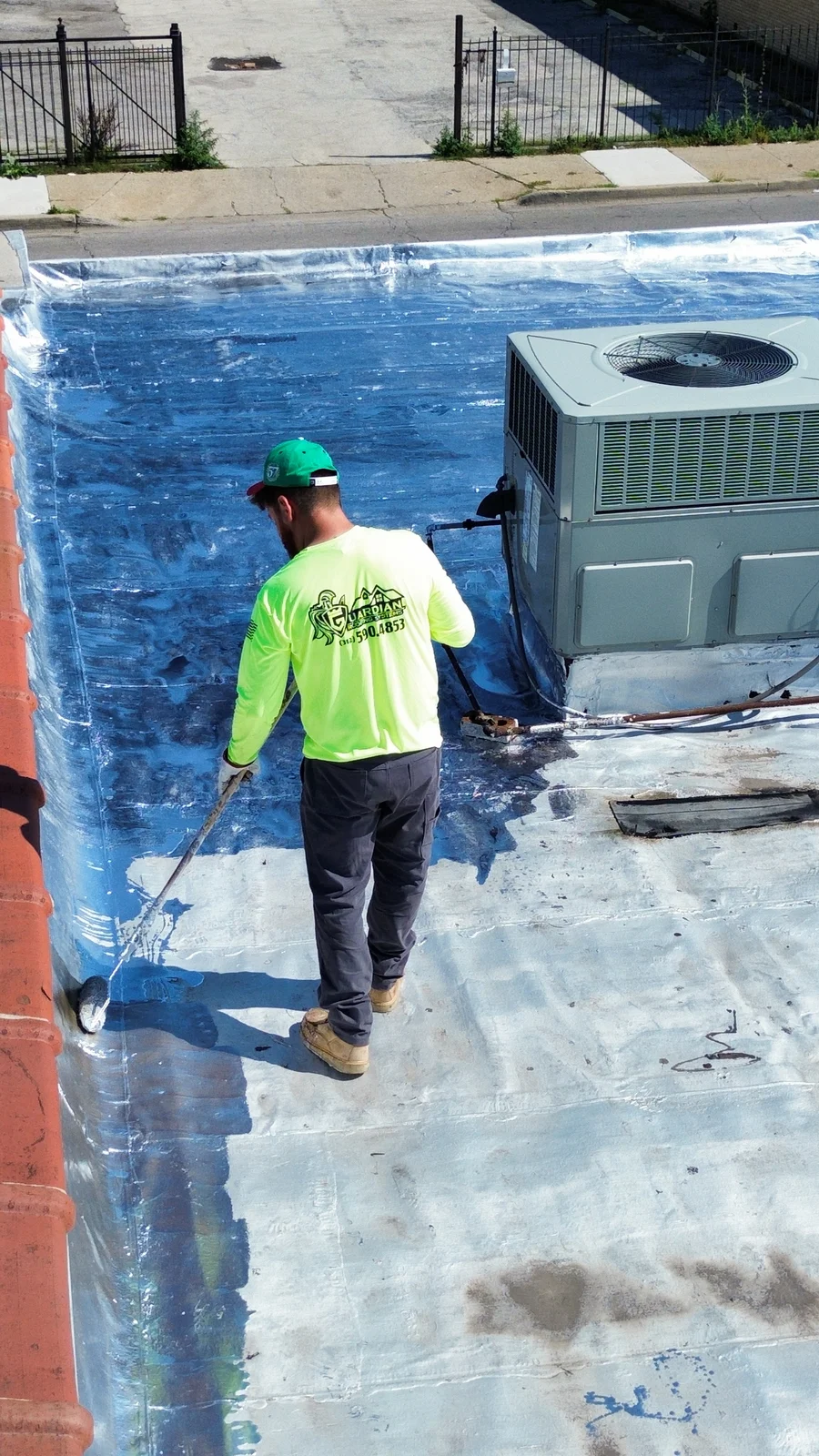
Coating rolled corner to corner
The Short Version
Water travels. We trace it from the inside out, water-test where needed, and prove the source before cutting anything.
Emergency patching to stop the damage now, permanent repair scheduled after. Infrared moisture surveys on roofs that have been leaking a while.
(312) 590-4853Leak Call To Closed Repair
Stop The Damage
Containment inside, temporary patch outside if weather demands it. Inventory and operations protected first.
Trace The Source
Interior clues, roof inspection in suspect order, water testing in sections until the entry point is proven.
Map The Wet
Infrared survey and cores where the leak is old, so you know how far the water spread under the membrane.
Repair And Report
Permanent fix, wet insulation removed where needed, and a photo record of the whole job for your files.
Related work: the systems we install are on commercial roofing and commercial flat roofs. Catch problems before the drip with commercial roof inspections. Storm the cause? Storm damage repair. Low-slope repair detail on flat roofing repair. Leak calls run weekly in Chicago, Blue Island and Naperville.
Leak Questions
The stain is in one spot. Why do you need to look at the whole roof?
Because water runs sideways along the deck before it drops. On a low-slope roof the entry point is regularly twenty or thirty feet from where you see the drip, sometimes further. Looking only above the stain is how a leak gets patched three times and still runs.
Can you come out at night or on a weekend?
For active water in an occupied building, yes. That is what the phone number is for. We have gone out on Friday nights and in blizzards to stop water on Chicago buildings, and we will tell you honestly on the call how quickly we can be there.
What does an infrared moisture survey cost me?
Less than replacing a roof that only needed a section, which is the point of doing one. We price it against the size of the roof and tell you the number before we schedule.
It only leaks when snow melts, not when it rains. Why?
That pattern usually means ice damming or a blocked drain, not a hole. Meltwater backs up behind ice, sits above the level of a flashing or a termination, and goes in over the top. Rain runs off before it can pool that high. The fix is drainage and detail work, not a patch in the field.
Our HVAC contractor was on the roof right before this started.
Then that is the first place we look. Curbs and units get opened, cut and resealed by trades who are not roofers, and it is one of the most common causes of a sudden new leak on an otherwise healthy roof. We document what we find so you can take it back to them if it is warranted.
Do you charge for the leak investigation if we then hire you for the repair?
We handle that on the call so there are no surprises. Tell us the building and the situation and we will lay out what the trip and the repair look like before anybody drives out. Straight numbers up front is how we run everything.
Water Coming In Right Now?
Call and describe what you are seeing and what is underneath it. If it is urgent we treat it that way, and if it can safely wait until morning we will tell you that too.